


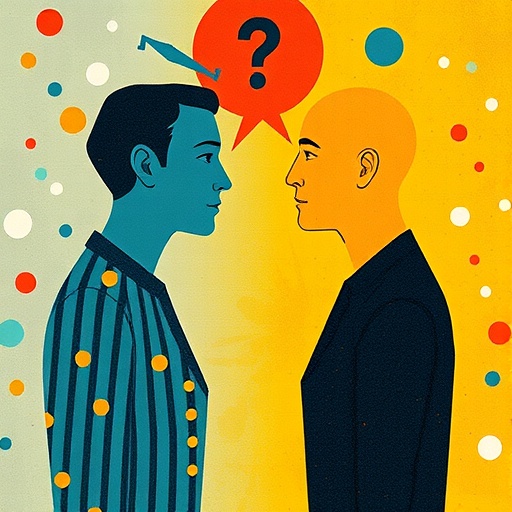
In the rapidly evolving field of psycholinguistics, traditional approaches have predominantly treated language production and comprehension as isolated processes. This division, while methodologically convenient, overlooks the dynamic, interwoven nature of these processes in actual social contexts. Recent empirical evidence emphasizes that language use in face-to-face conversation is far more complex, involving simultaneous production and comprehension that are inseparable from the social environments they occur within. In their recent comprehensive review, Holler and Kuhlen (2026) argue for a paradigmatic shift, urging psycholinguistic research to better capture the interactive and embodied realities of everyday communication.
One of the core insights from this review centers on the conceptualization of language as a situated joint action. Unlike monologues or disembodied forms of linguistic exchange, face-to-face conversation demands that interlocutors continuously coordinate their communicative efforts in real-time. This coordination encompasses aligning intentions, updating common ground, and negotiating meaning collaboratively, rather than merely encoding and decoding messages in isolation. Viewing language through this lens opens new avenues for experimental paradigms that better reflect how actual conversations unfold.
At the heart of this joint action model lies the recognition that conversation is multimodal. Verbal content is only one piece of the communicative puzzle, intricately integrated with nonverbal signals such as gestures, facial expressions, and body posture. These visual bodily signals do not merely accompany speech; they contribute fundamentally to the generation and interpretation of meaning. For example, a gesture can disambiguate an ambiguous utterance or emphasize a narrative point, while eye gaze can regulate turn-taking and indicate attentional focus. Understanding conversation fully, therefore, requires psycholinguistic models that incorporate these multimodal cues rather than treating language as purely linguistic.
Further complicating matters is the role of addressee feedback in conversations. When speakers communicate, they constantly monitor their partners for signals indicating comprehension or signaling difficulty. This feedback can take numerous forms—from subtle nods and brief verbal affirmations like “uh-huh” to explicit requests for clarification. The cognitive demands imposed by this monitoring process are significant. Speakers must allocate attention not only to their linguistic formulation and the delivery of their message but also to the real-time interpretation of their interlocutor’s responses. Thus, successful communication hinges on a continuous feedback loop that dynamically shapes the course of interaction.
The involvement of cognitive resources in managing these feedback signals has profound implications for psycholinguistic theory. It suggests that language processing cannot be fully understood without considering how social cues modulate cognitive load. For example, a speaker may slow down or simplify their speech when perceiving signs of listener confusion. Conversely, fluent feedback can enable speakers to maintain a rapid, uninterrupted flow. Experimental designs that ignore these interactive subtleties risk missing the nuanced ways cognition is engaged during natural conversation.
Moreover, the complexity increases exponentially in multi-party conversations, where participants must navigate the contributions and understanding of several interlocutors simultaneously. In such settings, speakers not only track their own comprehension and production but also monitor others’ feedback, shared knowledge, and turn allocations. Managing this interpersonal complexity requires advanced cognitive flexibility and situational awareness, pushing the limits of traditional psycholinguistic paradigms. It calls for research methodologies that embrace these dynamic, multi-agent interactions to unravel the cognitive architecture underpinning group communication.
Holler and Kuhlen’s review underscores the urgency for novel experimental approaches capable of capturing these defining features of face-to-face communication. Historically, psycholinguistics has relied heavily on controlled, laboratory-based tasks using simplified language stimuli presented in isolation. While these methods afford rigorous control, they often strip away the social and embodied contexts that shape meaning-making in real life. The future of the field demands richer paradigms that balance ecological validity with experimental rigor, leveraging technological advances such as motion tracking, eye-tracking, and neural imaging in interactive settings.
Integrating multimodal data streams into psycholinguistic research poses its own technical challenges. Precise synchronization of speech, gesture, gaze, and other bodily signals is essential to disentangle their intertwined contributions to meaning. Additionally, capturing naturalistic feedback calls for sophisticated annotation schemes and computational modeling that can represent the fluid temporal structure of conversation. Yet, overcoming these hurdles promises transformative insights into how language functions not as a solitary cognitive process but as embedded in social action.
Another promising avenue highlighted in the review is the exploration of the neural mechanisms supporting this integrated language use. Previous neuropsychological studies often examined language reception or production separately, but emerging research employs hyperscanning methodologies to monitor the brain activity of multiple interacting individuals simultaneously. These studies reveal patterns of neural synchrony that correspond with mutual understanding and successful turn-taking, hinting at a deeply embodied, networked substrate for conversation that extends beyond isolated brains.
From a practical perspective, acknowledging the multimodal, feedback-driven, and group-based nature of conversation can also inform applications in artificial intelligence and human-computer interaction. Developing conversational agents that recognize and produce nonverbal cues, respond adaptively to user feedback, and manage multiparty interactions could revolutionize digital communication tools. Thus, the psycholinguistic insights summarized by Holler and Kuhlen have significant interdisciplinary relevance, impacting everything from language teaching to clinical intervention and technology design.
Despite these advances, the review also highlights critical gaps in our understanding of conversational dynamics. For instance, how exactly do interlocutors integrate conflicting feedback signals, or how do social and cultural factors shape the interpretation of bodily cues? What are the limits of cognitive resources during complex conversational tasks, and how do individual differences modulate these processes? Addressing these questions requires not only innovative theoretical frameworks but also diverse and inclusive research samples that can capture the full spectrum of human communicative behavior.
In sum, the work by Holler and Kuhlen compellingly advocates for a richer, more nuanced psycholinguistic science—one that respects the embeddedness of language in social interaction. Far from being a mere exchange of encoded symbols, face-to-face conversation emerges as a complex joint action orchestrated through multimodal signals, continuous feedback, and multiplex interpersonal monitoring. Embracing this complexity promises a deeper understanding of human communication’s cognitive and social foundations.
The implications extend beyond academic curiosity, touching upon fundamental aspects of everyday life where language shapes relationships, transmits culture, and enables collaboration. As psycholinguistics moves to meet these challenges, it will likely usher in a new generation of research that blends rigorous control with ecological realism, fostering discoveries that resonate not only within laboratories but also across the diverse contexts where language breathes and lives.
Holler and Kuhlen’s review thus marks a pivotal moment in the evolution of the field. It invites scientists to rethink old assumptions and develop paradigms that reflect language’s true complexity in naturalistic, socially embedded settings. By doing so, psycholinguistics stands poised to contribute profound insights into the nature of human interaction, cognition, and the very fabric of meaning-making.
Cite Scienmag News
Glenn Wilkins. (February 17, 2026). Psycholinguistics Unveiled: Inside Face-to-Face Talk. Scienmag. https://scienmag.com/psycholinguistics-unveiled-inside-face-to-face-talk/
Glenn Wilkins. "Psycholinguistics Unveiled: Inside Face-to-Face Talk." Scienmag, 17 February 2026, https://scienmag.com/psycholinguistics-unveiled-inside-face-to-face-talk/. Accessed 4 September 2026.
Glenn Wilkins. "Psycholinguistics Unveiled: Inside Face-to-Face Talk." Scienmag. February 17, 2026. https://scienmag.com/psycholinguistics-unveiled-inside-face-to-face-talk/


