


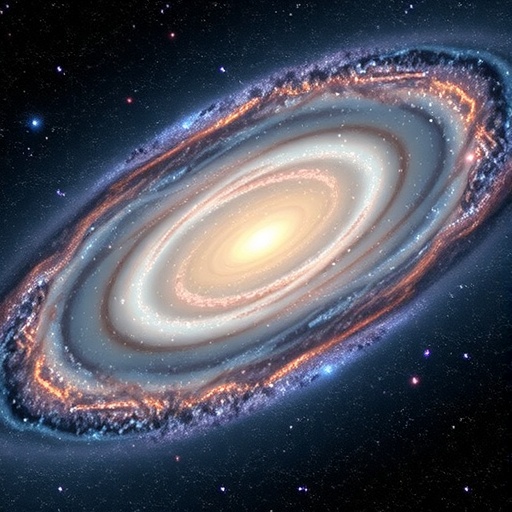
In a groundbreaking astronomical revelation, a team of 48 researchers from 14 different countries, spearheaded by the University of Massachusetts Amherst, has uncovered a population of elusive dusty, star-forming galaxies at the fringes of the observable cosmos. These galaxies, which emerged roughly one billion years subsequent to the Big Bang—a cataclysmic event estimated to have occurred about 13.7 billion years ago—offer a remarkable window into the formative stages of the universe, pushing the boundaries of our cosmic timelines and challenging the entrenched paradigms of galaxy formation.
These newly identified galaxies are not merely ancient; they embody a distinctive class marked by copious amounts of interstellar dust that cloak nascent stellar activity. Traditionally, such dust has obscured light in the ultraviolet (UV) and visible spectra, thereby evading detection by conventional optical telescopes reliant on these wavelengths. This cosmic veil has rendered the study of these galaxies profoundly difficult, leaving a sizeable gap in our understanding of star formation during the universe’s early epochs. The significance of the discovery lies not only in the age of these galaxies, which formed nearly 13 billion years ago, but also in their dusty nature, which patterns a crucial phase in galactic evolution previously hidden from astronomers.
The breakthrough owes much to technological advances in observational astronomy, particularly the deployment of submillimeter wavelength telescopes. Unlike their visible-light counterparts, these instruments can detect longer wavelengths, effectively piercing through the dust that absorbs higher-energy photons. Such telescopes measure the heat re-radiated by dust in the infrared spectrum, thereby unveiling regions of active star formation cloaked in obscurity. The Atacama Large Millimeter/submillimeter Array (ALMA), situated in the high-altitude deserts of Chile, has been instrumental in this endeavor due to its unprecedented sensitivity and resolution at these wavelengths.
Utilizing the capabilities of ALMA, the international team initially cataloged a population exceeding 400 bright, dusty galaxies. Subsequently, the team harnessed the power of NASA’s James Webb Space Telescope (JWST), which observes in the near-infrared regime, to precisely identify approximately 70 candidates for faint dusty galaxies residing near the cosmic horizon. Many of these faint galaxies had never before been documented. The researchers employed a stacking technique—combining multiple observational datasets to enhance signal detection—on archival ALMA measurements to verify the dusty nature and great age of these galaxies, confirming their formation epochs at nearly 13 billion years ago.
The implications of this discovery reverberate profoundly through theoretical cosmology and astrophysics. Dusty galaxies bear the hallmark of heavy elements and cosmic dust, byproducts of multiple cycles of star formation and stellar evolution. Their presence at such an early cosmic age suggests that star formation commenced earlier than current models predict, necessitating a reevaluation of the timeline for metal enrichment and dust production in the young universe.
Moreover, the galaxies identified by Zavala and colleagues appear to bridge a critical gap in the lifecycle of massive galaxies. They form a continuum connecting ultrabright, star-forming galaxies discovered by JWST, which are exceptionally young and luminous, and ancient, massive quiescent galaxies—systems that ceased star formation roughly two billion years after the Big Bang and remain dormant. This triptych suggests a galactic evolutionary sequence akin to human development: the ultrabright galaxies represent infancy, the freshly discovered dusty galaxies embody young adulthood, and the quiescent galaxies symbolize senescence.
This conceptual framework provides astronomers with a more structured and dynamic narrative of galaxy evolution. It underscores the necessity for models that accommodate rapid and efficient star formation, dust synthesis, and the subsequent quenching of such activity at early cosmological times. The challenges posed by these findings beckon a substantial reconfiguration of galaxy formation theories, potentially influencing our understanding of feedback mechanisms, the roles of supermassive black holes, and the impact of cosmic environment on galaxy growth.
The research exemplifies the synergy achievable through international collaborations and multi-instrument observations. Funding support from agencies such as the U.S. National Science Foundation illustrates the critical role of sustained investment in scientific infrastructure. The combination of ALMA’s capacity to detect cold dust emission and JWST’s ability to resolve faint near-infrared light has set a new standard for cosmic archeology, enabling astronomers to peer deeper and with greater clarity into the universe’s formative epochs.
Assistant Professor Jorge Zavala of UMass Amherst emphasizes that this is just the beginning. While the current dataset vividly illustrates the existence and preliminary characteristics of these dusty, early galaxies, extensive follow-up observations are imperative to unravel their physical properties, star formation rates, and their precise roles within the cosmic narrative. Such efforts will refine simulations and inform the astrophysical models that shape our comprehension of the universe’s evolution.
This research, published in The Astrophysical Journal Letters, opens a fertile avenue for exploring the genesis and maturation of galaxies under extreme conditions. It challenges preexisting notions that the early universe was a simple, relatively uniform milieu and highlights the complexity underpinning cosmic dawn. The advances suggest that dust and heavy elements played pivotal roles much earlier than previously recognized, prompting a reexamination of early star formation efficiency and the timeline of galaxy maturation.
The dusty galaxies’ detection at such a cosmologically significant redshift—indicated by the parameter z ∼ 8, reflecting their enormous distance and ancient light travel time—demonstrates the remarkable sensitivity of modern astronomical instrumentation. This sensitivity is critical not only for expanding the observable cosmic frontier but also for comprehensively cataloging the diverse galaxy populations that populate our universe. Each new discovery recalibrates our understanding of cosmic history and testifies to humanity’s relentless quest to decipher the origins of the cosmos.
In sum, the identification of these faint, dusty star-forming galaxies fundamentally revises our cosmic timeline, highlighting that galaxy formation and dust production were underway far earlier than theorized. It posits that the early universe’s complexity rivals that of later epochs, with diverse and dynamic galactic populations coexisting and evolving within a blast furnace of star formation and energetic processes. This transformative insight underscores the profound symbiosis between technological innovation and human curiosity in unearthing humanity’s place among the stars.
Web References:
– The Astrophysical Journal Letters: https://iopscience.iop.org/article/10.3847/2041-8213/ae382a
– Atacama Large Millimeter/submillimeter Array (ALMA): https://www.almaobservatory.org/en/home/
– James Webb Space Telescope (JWST): https://science.nasa.gov/mission/webb/
Keywords
Dusty star-forming galaxies, early universe, galaxy formation, cosmic dust, submillimeter astronomy, ALMA, James Webb Space Telescope, cosmic dawn, star formation, galactic lifecycle, ultrabright galaxies, quiescent galaxies, cosmic evolution
Cite Scienmag News
Grant Pearson. (February 17, 2026). International Astronomers Led by UMass Amherst Uncover Potential Missing Link in Galaxy Evolution. Scienmag. https://scienmag.com/international-astronomers-led-by-umass-amherst-uncover-potential-missing-link-in-galaxy-evolution/
Grant Pearson. "International Astronomers Led by UMass Amherst Uncover Potential Missing Link in Galaxy Evolution." Scienmag, 17 February 2026, https://scienmag.com/international-astronomers-led-by-umass-amherst-uncover-potential-missing-link-in-galaxy-evolution/. Accessed 3 September 2026.
Grant Pearson. "International Astronomers Led by UMass Amherst Uncover Potential Missing Link in Galaxy Evolution." Scienmag. February 17, 2026. https://scienmag.com/international-astronomers-led-by-umass-amherst-uncover-potential-missing-link-in-galaxy-evolution/


