


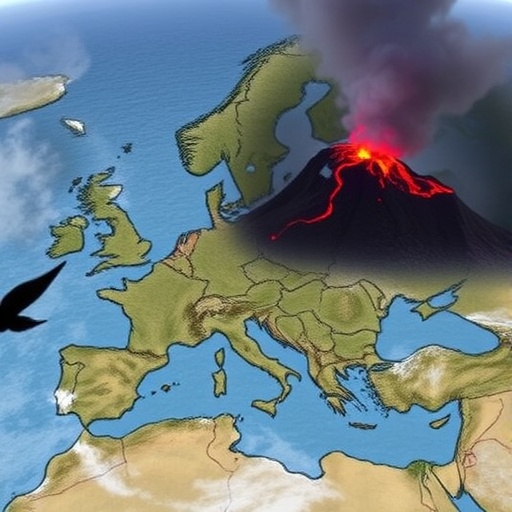
The Atlantic Meridional Overturning Circulation (AMOC) plays a pivotal role in maintaining climate stability across Northern Europe, particularly in Denmark, where it acts like a giant planetary heater. This vast oceanic conveyor belt transports warm waters from the tropics toward the North Atlantic, effectively tempering temperatures in the region and ensuring winters are relatively mild compared to other areas at similar latitudes. However, recent research has illuminated alarming vulnerabilities in the system that could induce sudden and dramatic climate shifts not only in Denmark but across the entire Northern Hemisphere.
Global warming has already imposed significant stress on this circulation by accelerating ice melt in the Arctic, fundamentally altering the salinity balance and temperature gradients that drive AMOC’s piston-like operation. Freshwater coming from the melting ice sheets dilutes the saltier ocean water, disrupting the density-driven currents that perpetuate the northward flow of thermally charged water masses. Scientists have long debated the timeline and extent to which this could lead to a partial or complete collapse of the system, with estimates ranging widely due to the complexity of ocean-atmosphere interactions and their feedback mechanisms.
In a groundbreaking study led by an international team from the Niels Bohr Institute at the University of Copenhagen, the focus has shifted to an additional, often overlooked factor influencing AMOC’s stability: volcanic eruptions. This research, published in the journal Science, proposes that the injection of volcanic aerosols into the atmosphere can initiate a cascade of physical changes that disrupt the oceanic circulation on both short and long timescales, particularly under glacial or near-glacial conditions.
Volcanic eruptions release massive quantities of sulfur dioxide and particulate matter high into the stratosphere, creating reflective aerosols that significantly reduce solar radiation reaching Earth’s surface. This phenomenon triggers global surface cooling and leads to a series of climatic feedbacks, including an increase in sea ice extent and alterations to salinity gradients within the Atlantic Ocean. The resultant changes deprive the AMOC of the energy needed to maintain its propulsion, thereby increasing the likelihood of a collapse or dramatic weakening that could persist for centuries.
One of the critical insights from this work is the realization that AMOC’s sensitivity to volcanic forcing could explain many of the sudden climate fluctuations observed during the last glacial period. For instance, the Dansgaard-Oeschger events—rapid transitions between warm and cold states occurring roughly every few thousand years—have long puzzled climatologists. The new models suggest that these abrupt climate changes may have been catalyzed by large equatorial volcanic eruptions acting as tipping points, capable of pushing the already precarious ocean circulation system into a different climatic regime.
To assess this, the researchers combined paleoclimate data derived from ice cores with hundreds of state-of-the-art climate simulations. This integrated approach allowed them to reconstruct the possible system responses not only to natural volcanic events but also to forecast how current anthropogenic warming might predispose AMOC to similar disruptions. Their findings indicate that in a warming climate approaching critical thresholds, even relatively moderate volcanic eruptions could have outsized effects on global climate.
Importantly, the disruption of AMOC would not simply be a regional problem. The configuration and strength of this oceanic conveyor have implications for global weather patterns, monsoon systems, and sea level changes, particularly along the eastern seaboard of North America and across Western Europe. A collapse could usher in prolonged cold spells, disrupt agricultural cycles, and intensify extreme weather events, compounding the already immense challenges posed by ongoing climate change.
Professor Markus Jochum, senior author of the study, highlighted the precarious balance in which the AMOC currently exists. “It’s like a balance board,” he explains; “the system today is close to a tipping point, so all it takes is a small nudge — such as a volcanic eruption — to likely push it over the edge.” This metaphor underscores the nonlinear nature of climate systems where thresholds matter more than gradual changes, meaning that sudden shifts can occur unexpectedly and with severe consequences.
Volcanic influences on climate are not a new concept, but their quantifiable impact on ocean circulation represents a breakthrough. While transient volcanic aerosols typically cool the climate for a few years, the amplified feedback through oceanic processes identified here suggests that the consequences can be much longer-lasting, particularly under the fragile conditions of past glacial periods or our current warming trajectory.
Looking forward, these findings emphasize the need for incorporating volcanic activity and its complex interactions with ocean dynamics into climate models used for future risk assessments. Improved predictions of AMOC stability would help governments and scientists better prepare for potential abrupt climate changes and design adaptive strategies to mitigate the associated impacts.
Ultimately, this study sheds new light on the intricate interplay between Earth’s geological processes and its climate systems. It reveals a heretofore underappreciated factor that could exacerbate or even trigger wholesale climatic swings unprecedented in human history. As our planet warms, understanding these tipping points becomes ever more crucial in navigating the path toward resilient and sustainable futures.
The research thus calls for heightened vigilance and interdisciplinary efforts combining volcanology, oceanography, and climatology to fully grasp the mosaic of forces shaping our environment. With potential ramifications spanning centuries and across continents, the stability of the Atlantic Meridional Overturning Circulation emerges as an essential focus for the scientific community and policymakers alike.
News Publication Date: 4-Feb-2026
Web References: https://www.science.org/doi/10.1126/sciadv.adx2124
References: Science journal article – DOI: 10.1126/sciadv.adx2124
Cite Scienmag News
Violet Maxwell. (February 17, 2026). Ancient Volcanic Eruptions May Have Triggered Collapse of Northern Europe’s Ocean Currents. Scienmag. https://scienmag.com/ancient-volcanic-eruptions-may-have-triggered-collapse-of-northern-europes-ocean-currents/
Violet Maxwell. "Ancient Volcanic Eruptions May Have Triggered Collapse of Northern Europe’s Ocean Currents." Scienmag, 17 February 2026, https://scienmag.com/ancient-volcanic-eruptions-may-have-triggered-collapse-of-northern-europes-ocean-currents/. Accessed 3 September 2026.
Violet Maxwell. "Ancient Volcanic Eruptions May Have Triggered Collapse of Northern Europe’s Ocean Currents." Scienmag. February 17, 2026. https://scienmag.com/ancient-volcanic-eruptions-may-have-triggered-collapse-of-northern-europes-ocean-currents/


