


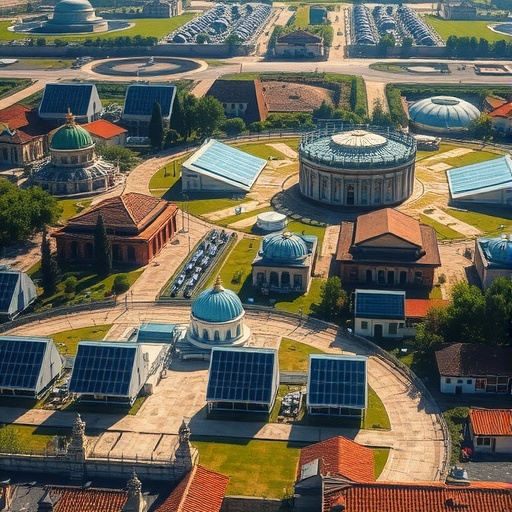
In an era where the preservation of built heritage is becoming increasingly critical, a team of researchers has unveiled a cutting-edge technique for evaluating solar radiation with unprecedented resolution and multidimensional insight. This breakthrough promises to revolutionize the scientific protection of heritage sites worldwide by delivering a comprehensive understanding of how solar energy interacts with these invaluable structures over time. The study, spearheaded by Ni, Zhang, Bi, and colleagues, has recently been published in Communications Engineering, marking a milestone in the marriage of advanced engineering and cultural conservation.
Solar radiation—arguably the most persistent natural force influencing the preservation and deterioration of architectural heritage—impacts materials in complex ways. From fading pigments to structural weakening through thermal expansion and contraction, the effects of sunlight are multifaceted and cumulative, often eluding simple measurement or prediction. Recognizing the limitations of prior assessment methods, which offered either limited spatial resolution or unidimensional data, the researchers developed a high-resolution, multidimensional solar radiation evaluation system that captures a full, dynamic profile of solar exposure on heritage surfaces.
At its core, this novel evaluation technique leverages an integrated network of sensors combined with advanced computational models to generate three-dimensional temporal maps of solar radiation exposure. Unlike traditional methods that rely solely on static readings or two-dimensional projections, this approach accounts for changes in atmospheric conditions, seasonal shifts, and even subtle architectural details such as niche shapes or ornamental protrusions. By assimilating vast datasets, the method produces granular insights into the intensity, angle, and duration of sunlight incident on each part of the structure.
What sets this study apart is its multidimensional analytical framework, which interprets raw solar radiation data through the lenses of physics, material science, and environmental engineering. The team employed spectral analysis to dissect the radiation into wavelength components, acknowledging that ultraviolet rays, visible light, and infrared radiation each exert distinct impacts on heritage materials. This spectral decomposition allows conservationists to tailor protective strategies based on which radiation types most threaten particular elements—be that organic pigments susceptible to UV degradation or stone materials sensitive to thermal cycling from infrared exposure.
Furthermore, the evaluation extends beyond the immediate radiation footprint to integrate surrounding topographical and meteorological variables. By incorporating factors such as local albedo, cloud cover, and wind patterns, the model predicts indirect and reflected solar radiation influences with exceptional precision. This holistic view is particularly critical in urban environments, where adjacent buildings and vegetation create complex shading and light scattering effects that can either exacerbate or mitigate solar damage.
The implications of deploying this evaluation method in real-world heritage preservation are vast and transformative. By identifying solar “hotspots” — areas receiving disproportionately high or harmful radiation doses — conservators can prioritize interventions, optimize the placement of shading devices, or adjust maintenance schedules. The dynamic nature of the model also supports long-term monitoring, allowing heritage managers to anticipate degradation trends tied to changing climate conditions and to adapt protection strategies proactively.
Technologically, the integration of sensors with machine learning algorithms underpins the system’s ability to manage and interpret the large volumes of data generated. The research team trained models to recognize patterns correlating specific environmental conditions with radiation profiles, enabling predictive analytics and the tailoring of interventions based on temporal patterns. This combination of empirical data and artificial intelligence marks a significant advancement over prior fixed, reactive approaches to solar damage mitigation.
Importantly, the system’s modular design ensures adaptability across diverse heritage contexts. Whether evaluating the sunlit façades of Renaissance cathedrals, the intricate mosaics of ancient temples, or the timeworn sculptures of archeological sites, the evaluation technique can be calibrated to site-specific factors. This versatility heralds a new era of precision conservation, where heritage protection is informed by scientifically rigorous, site-tailored solar insights rather than one-size-fits-all assumptions.
The study also addresses the pressing challenge of balancing heritage conservation with sustainable energy design. As many heritage sites seek to incorporate solar panels or other renewable technologies, understanding the nuanced patterns of natural solar radiation becomes critical. The evaluation framework aids in identifying optimal locations for solar installations that minimize visual and physical impacts on historic fabric while maximizing energy capture, thus harmonizing preservation and sustainability goals.
Beyond direct applications in conservation, the researchers foresee the methodology contributing to broader fields such as urban planning and material engineering. The detailed solar radiation maps can inform the design of new structures in heritage-rich environments, ensuring compatibility with existing solar exposure patterns and reducing risks to adjacent historic buildings. Material scientists can also use the spectral and temporal radiation data to develop next-generation protective coatings and building materials optimized for heritage preservation.
While the methodology represents a significant leap forward, the team is already exploring enhancements. Future efforts aim to incorporate real-time monitoring capabilities powered by IoT (Internet of Things) devices, facilitating continuous assessments and immediate alerts for potentially damaging solar events like heatwaves or unexpected direct sunlight during atypical periods. This evolution could enable dynamic, automated shading systems that respond instantaneously to solar conditions, further protecting vulnerable heritage surfaces.
Environmental factors linked to global climate change underscore the urgency of refining solar radiation evaluation tools. Increasingly unpredictable weather patterns, extended periods of intense sunlight, and rising average temperatures threaten heritage sites with accelerated degradation. The high-resolution, multidimensional approach equips conservationists with the foresight and quantitative backing necessary to design resilient, climate-adaptive protection strategies that preserve cultural assets for future generations.
In concluding remarks, the research underscores the transformative potential of combining advanced engineering, computational analytics, and cultural heritage science. By moving beyond simplistic, static assessments to embrace a nuanced, dynamic understanding of solar radiation’s impacts, this work paves the way for smarter, more effective conservation measures. It invites heritage professionals, engineers, and policymakers to rethink how sunlight—a fundamental natural element—can be managed scientifically to safeguard humanity’s architectural legacy.
As the conservation community increasingly integrates technological innovation, this solar radiation evaluation stands as a flagship example of interdisciplinary synergy, uniting data science with preservation ethics. With further validation and widespread adoption, the method could become an indispensable tool in the global effort to protect heritage sites from the subtle, persistent forces of nature. The study’s insights have already sparked interest in international heritage circles, signaling a bright future for science-informed conservation practices.
This advancement resonates far beyond academic domains; it holds profound implications for tourism, identity preservation, and cultural continuity. Heritage sites, often emblematic of communal history and artistic achievement, require careful stewardship that balances exposure and protection. Empowering conservation with detailed, multidimensional solar radiation data ensures that these treasures remain vibrant and intact, inspiring generations yet to come.
In sum, the innovative evaluation strategy crafted by Ni, Zhang, Bi, and their collaborators marks a watershed moment in built heritage science. By delivering high-resolution, multidimensional solar radiation assessments, it transforms how we perceive, measure, and ultimately shield our cultural landmarks from the sun’s relentless influence. As this technology matures and integrates into conservation praxis, it promises to redefine standards and elevate the art and science of heritage protection on a global scale.
Cite Scienmag News
Denise Maddox. (February 16, 2026). High-Res Solar Mapping Protects Built Heritage Sites. Scienmag. https://scienmag.com/high-res-solar-mapping-protects-built-heritage-sites/
Denise Maddox. "High-Res Solar Mapping Protects Built Heritage Sites." Scienmag, 16 February 2026, https://scienmag.com/high-res-solar-mapping-protects-built-heritage-sites/. Accessed 5 September 2026.
Denise Maddox. "High-Res Solar Mapping Protects Built Heritage Sites." Scienmag. February 16, 2026. https://scienmag.com/high-res-solar-mapping-protects-built-heritage-sites/


