


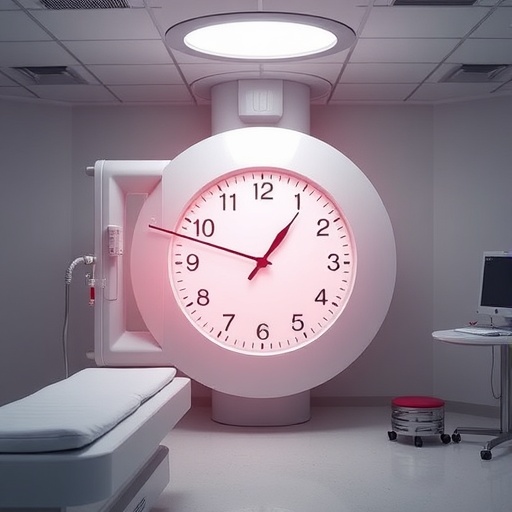
A groundbreaking study conducted by researchers at the Andalusian Centre for Molecular Biology and Regenerative Medicine (CABIMER) and the University of Seville, in collaboration with the Virgen Macarena University Hospital, has unveiled a vital molecular mechanism that synchronizes the 24-hour circadian rhythm with the cell’s ability to precisely repair DNA damage. This pioneering work examined the circadian clock protein Cryptochrome1 (CRY1) and revealed how its oscillating presence during the day influences the efficiency of DNA double-strand break repair, consequently impacting the therapeutic outcomes of radiotherapy in certain cancers.
Genomic stability is the cornerstone of cellular health, with DNA repair mechanisms playing an essential role in preventing mutations that could trigger malignant transformation. A critical insight of this research highlights that the homologous recombination pathway responsible for repairing DNA breaks is not static but exhibits robust circadian oscillations. The efficiency of DNA repair mechanisms fluctuates throughout the day, with peak activity occurring in the early morning hours and subsequently fading toward nighttime before rising again during the nocturnal phase of the cycle.
Central to this temporal regulation is CRY1, a core protein component of the molecular circadian clock. CRY1 functions as a modulator that suppresses DNA end resection, a key initial step in homologous recombination. The researchers discovered that when CRY1 levels diminish during the morning, DNA repair is at its most proficient, allowing cells to effectively rectify DNA double-strand breaks. In contrast, elevated CRY1 levels in the afternoon and evening hours act as a brake, dampening the repair machinery and increasing cellular vulnerability to DNA-damaging agents such as ionizing radiation.
This intimate link between circadian biology and DNA repair has profound implications for cancer progression and treatment. Tumors characterized by high CRY1 expression were shown to be more radiosensitive, which suggests that the timing of radiation delivery could be strategically optimized to exploit periods of reduced DNA repair capacity. By administering radiotherapy when CRY1 concentrations are elevated—typically later in the day—oncologists could enhance cancer cell killing while potentially sparing normal tissue with more efficient repair capacity.
Clinically, a retrospective analysis of patient data from the Virgen Macarena University Hospital substantiated these laboratory findings. Breast cancer patients receiving radiotherapy during afternoon and evening hours exhibited markedly improved overall survival compared to those treated earlier in the day. This temporal specificity in treatment outcomes was further observed in prostate cancer patients but did not extend to lung cancers or gliomas, underscoring the nuanced interplay between circadian regulation and cancer type.
The phenomenon known as chronoradiotherapy, which tailors radiation treatment to the body’s biological clock, emerges as a promising therapeutic avenue from this research. By aligning radiotherapy schedules with the rhythmic expression of CRY1 and other circadian factors, clinicians may be able to maximize DNA damage in tumor cells when their repair systems are least active, thereby improving the efficacy of treatment protocols and patient prognoses.
Mechanistically, the study provides a detailed molecular framework showing how CRY1 directly interferes with DNA end resection enzymes, hindering their ability to process DNA breaks efficiently. This disruption results in a controlled attenuation of homologous recombination, a high-fidelity repair pathway crucial for maintaining chromosomal integrity. The fine-tuning of this pathway by the circadian clock represents an elegant evolutionary adaptation that balances genome maintenance with cellular metabolic states that fluctuate throughout the day.
The implications of this discovery extend beyond cancer therapy. Understanding circadian influences on DNA repair pathways could illuminate broader aspects of human health and disease, including aging and neurodegeneration, where DNA damage accumulation plays a critical role. Such insights pave the way for exploring pharmacological modulation of clock proteins like CRY1 to enhance DNA repair capacity under conditions of stress or disease.
This research also underscores the importance of considering temporal biological factors in clinical protocols, advocating for a paradigm shift where the timing of drug administration, radiation exposure, or surgical interventions are optimized based on circadian biology. Integrating chronobiology into personalized medicine has the potential to transform treatment outcomes across a spectrum of disorders linked to genomic instability.
The findings prompt further investigation into the molecular crosstalk between circadian regulators and DNA damage response elements. Elucidating these pathways could yield novel biomarkers for cancer prognosis and new targets for therapeutic intervention. Additionally, the differential impact observed among distinct cancer types calls for more comprehensive studies examining how tumor-specific molecular landscapes interact with circadian dynamics.
In conclusion, this seminal study establishes a crucial link between the circadian protein CRY1 and the temporal regulation of homologous recombination-mediated DNA repair. By demonstrating how CRY1-mediated dampening of DNA break repair modulates cellular sensitivity to radiotherapy, the research opens exciting opportunities for chronotherapy approaches that exploit the natural rhythms of cellular repair. This advancement represents a significant leap toward precision cancer treatment informed by the intrinsic biological clocks governing human physiology.
News Publication Date: 1-Dec-2025
Web References: http://dx.doi.org/10.1038/s41467-025-65854-1
Cite Scienmag News
Nathaniel Bowman. (February 13, 2026). Timing Matters: Radiotherapy Works Best When Given at the Right Time of Day. Scienmag. https://scienmag.com/timing-matters-radiotherapy-works-best-when-given-at-the-right-time-of-day/
Nathaniel Bowman. "Timing Matters: Radiotherapy Works Best When Given at the Right Time of Day." Scienmag, 13 February 2026, https://scienmag.com/timing-matters-radiotherapy-works-best-when-given-at-the-right-time-of-day/. Accessed 5 September 2026.
Nathaniel Bowman. "Timing Matters: Radiotherapy Works Best When Given at the Right Time of Day." Scienmag. February 13, 2026. https://scienmag.com/timing-matters-radiotherapy-works-best-when-given-at-the-right-time-of-day/


