


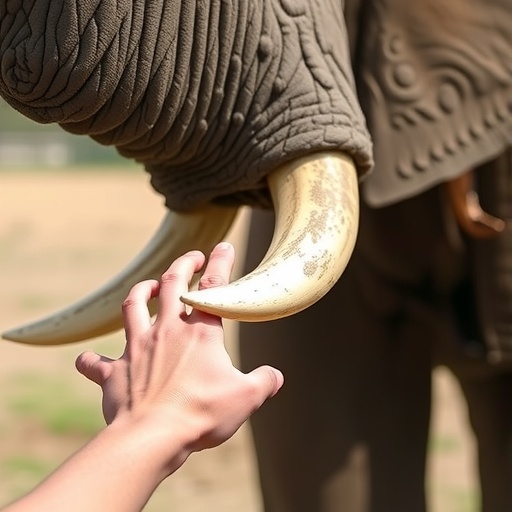
In the vast panorama of animal anatomy, the elephant’s trunk stands out as a marvel of both strength and sensory finesse. While its rugged exterior might suggest a tool built primarily for brute force, recent scientific investigations have unveiled a complex sensory system beneath its surface that rivals some of the most sophisticated touch organs in the animal kingdom. Central to this newfound understanding is the role of the elephant’s whiskers—structures previously overlooked but now recognized as essential conduits of tactile information. These whiskers possess a unique material architecture that shifts progressively from their base to their tip, enabling an extraordinary amplification of sensory signals that permit elephants to explore their environment with unmatched delicacy and precision.
Mammalian whiskers, or vibrissae, have long intrigued biologists due to their role in sensing and navigating the world through mechanical vibrations. Composed primarily of keratin—a fibrous protein also found in hair and nails—these elongated rods are encased in specialized follicles densely innervated by sensory neurons. When a whisker encounters an object, even the smallest mechanical deflection generates vibrations transmitted to these neurons, which then convert them into electrical signals interpretable by the brain. Traditional studies have largely emphasized whisker movement dynamics and shape, operating under the assumption that the mechanical properties along their length remain relatively homogenous. However, growing empirical evidence has begun to challenge this assumption, highlighting variations in stiffness, density, and porosity along whisker shafts that significantly impact sensory performance.
Against this backdrop, the research team led by Andrew Schulz delved into the tactile capabilities of elephants—a group of mammals whose whiskers differ markedly from those of commonly studied species like rodents or seals. Unlike their more mobile counterparts, elephants exhibit thousands of stationary whiskers integrated across the thick dermis of their trunks. These whiskers do not actively move or whisk but instead provide continuous sensory feedback as the trunk interacts with objects. The absence of active whisker control posed a compelling question: How do elephants achieve such refined tactile sensitivity without the advantage of whisker mobility?
Employing a combination of cutting-edge techniques—including micro-computed tomography (micro-CT) imaging, electron microscopy, and precision mechanical testing—Schulz and colleagues embarked on a comprehensive structural and functional characterization of these remarkable sensory appendages. They collected samples from both juvenile and adult Asian elephants to observe potential developmental differences in whisker properties. Micro-CT scans revealed intricate geometric variations, while electron microscopy illuminated ultrastructural features at nanometer scales, exposing gradations in porosity and fiber density that had never before been documented.
Mechanical testing further elucidated the functional significance of these structural gradients. The elephant whiskers were found to transition from a thick, porous, and remarkably stiff base to a slender, dense, and comparatively soft tip. This gradient in material properties produces a dynamic mechanical profile wherein the base provides stability and resilience against displacement, while the flexible tip can respond sensitively to minor tactile stimuli. Functional modeling demonstrated that such gradation enhances the transmission of mechanical vibrations to the follicle-bound sensory neurons, amplifying subtle surface contacts into potent neural signals. This property is especially critical given that the whiskers themselves lack motor control to reposition or scan objects actively.
One of the most striking aspects of the findings is the implication that these material gradients confer upon the elephant trunk a form of “physical intelligence.” Without neural input or active whisker movement, the trunk’s whiskers are inherently designed to optimize the clarity and localization of tactile information simply through their material composition. The stiff base to soft tip transition magnifies how changes in contact location affect vibration patterns, affording elephants the ability to discern not only the presence but the precise position of objects along each whisker. This capability likely contributes to their renowned dexterity and careful manipulation of food, tools, and their environment.
This elegant form of passive sensory optimization is unique among mammals and positions elephant whiskers as exemplary models for bioinspired sensor design. Current technologies in robotics and prosthetics strive to replicate the nuanced feedback systems found in nature, and the discovery of such a natural, material-driven sensory enhancement invites new avenues for engineering tactile sensors without reliance on complex electronics or active movement mechanisms. The biomimetic potential of this research is far-reaching, suggesting that gradients in material stiffness and density could be harnessed to produce highly sensitive yet robust artificial touch-sensitive appendages.
Moreover, the study sheds light on how elephants navigate their complex natural habitats and engage in social behaviors requiring precise tactile feedback. Previous research primarily attributed these capacities to the flexibility and muscular dexterity of the trunk, but these new insights emphasize the integral contribution of passive sensory structures. The thousands of nonmotile whiskers distributed along the trunk augment the elephant’s ability to detect subtle changes in texture, object shape, and surface irregularities, which are indispensable for survival, foraging, and communication.
Importantly, these findings challenge prevailing paradigms concerning sensory organ design, which often prioritize active sensing strategies and uniform mechanical characteristics. By demonstrating that passive material gradients alone can produce a sophisticated sensory output, Schulz and colleagues prompt a reevaluation of the principles that govern touch reception. Their work underscores the necessity of a multidisciplinary approach incorporating materials science, biomechanics, neurobiology, and computational modeling to decode the intricacies of tactile sensing.
In sum, the elephant’s whisker system exemplifies evolutionary ingenuity, evolving a finely tuned interface between environment and sensory processing without the metabolic costs associated with active movement. This research not only advances our understanding of elephant biology but also offers pivotal insights into the design of next-generation sensors capable of mimicking biological efficiency and sensitivity in artificial systems.
As research continues to unravel the complexities of tactile sensation in large mammals, the elephant’s trunk and its nonmotile whiskers stand as a testament to the power of material science and natural design. Their gradated structure provides a blueprint for how organisms can exploit physical properties to enhance sensory capabilities, opening new frontiers in neuroscience and biomimetic engineering. The subtleties encoded in the transition from stiff root to soft tip herald a new paradigm in how touch organs can be optimized—through their very composition—poised to redefine our understanding of sensation in the living world.
News Publication Date: 12-Feb-2026
Web References: 10.1126/science.adx8981
Cite Scienmag News
Drew Townsend. (February 12, 2026). Why Elephant Trunk Whiskers Excel at Touch Sensation. Scienmag. https://scienmag.com/why-elephant-trunk-whiskers-excel-at-touch-sensation/
Drew Townsend. "Why Elephant Trunk Whiskers Excel at Touch Sensation." Scienmag, 12 February 2026, https://scienmag.com/why-elephant-trunk-whiskers-excel-at-touch-sensation/. Accessed 4 September 2026.
Drew Townsend. "Why Elephant Trunk Whiskers Excel at Touch Sensation." Scienmag. February 12, 2026. https://scienmag.com/why-elephant-trunk-whiskers-excel-at-touch-sensation/


