


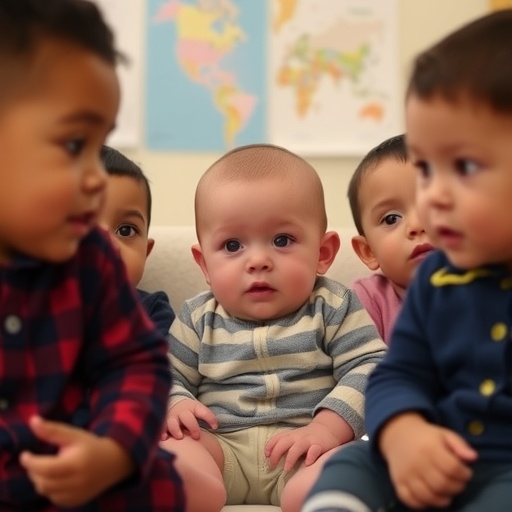
In a groundbreaking study poised to revolutionize our understanding of early cognitive development, researchers Zeng, Gill, and Sommerville reveal that infants as young as a few months old are capable of making sophisticated moral character inferences during multi-agent social interactions. This discovery challenges longstanding assumptions about the stages at which moral reasoning emerges, suggesting that the roots of ethical evaluation and social cognition are present far earlier than previously documented.
The heart of this research lies in dissecting the mechanisms through which infants observe and interpret complex social exchanges involving multiple individuals. Unlike prior studies that predominantly focused on dyadic interactions—where only two agents are involved—the current work illuminates how infants process and categorize behaviors in scenarios where several agents interact simultaneously. Such multi-agent contexts present higher cognitive demands, as infants must integrate more diverse cues to form impressions about others’ moral dispositions.
Technically, the researchers employed a series of carefully designed visual paradigms involving animated characters engaged in both prosocial and antisocial behaviors. These scenarios were presented to infants while their gaze patterns, looking times, and physiological responses were meticulously recorded through advanced eye-tracking technology combined with non-invasive biometrics. The resulting data allowed the team to infer not just passive attention but active evaluation, demonstrating that infants differentiate between helpful and harmful actions in contexts involving multiple agents.
One of the most fascinating technical elements of the study is the operationalization of moral character inference in infants. Rather than relying on verbal reports, which are obviously infeasible at this developmental stage, the team devised novel behavioral proxies that capture anticipatory looking and expectancy violation. For instance, infants were shown sequences where an agent’s behavior shifted dramatically, enabling the researchers to ascertain whether infants updated their moral impressions based on new information gleaned from complex social dynamics.
The implications of these findings extend beyond the developmental psychology community into broader fields such as philosophy, artificial intelligence, and ethical theory. If infants naturally engage in rudimentary moral reasoning, this could fundamentally recalibrate how moral competence is conceptualized—not as a product solely of socialization and formal education but as an innate cognitive architecture evolving from infancy. Such an understanding could influence early childhood education techniques, emphasizing the nurturing of nuanced social reasoning from the very beginning of life.
Neuroscientifically, this pioneering work paves the way for future investigations into the neural substrates that enable infants to parse multi-agent social interactions. While functional neuroimaging studies in infants remain challenging, the present behavioral evidence suggests early maturation of brain networks related to social cognition, including areas possibly homologous to the adult temporoparietal junction and medial prefrontal cortex. Future research combining behavioral paradigms with neurophysiological measurements could map the developmental trajectory of these networks more precisely.
The researchers also explore the role of context and ambiguity in infant moral judgments. Unlike simplistic binary categorizations, infants demonstrated sensitivity to subtleties such as intentions behind actions and the relationships between agents. For example, an agent’s harmful act was interpreted differently when contextualized as self-defense versus unprovoked aggression. This nuanced processing reflects a surprisingly sophisticated inferential capacity that goes beyond simple cause-and-effect learning.
Methodologically, the study exemplifies rigorous experimental design with longitudinal elements, tracking the same infants over time to assess developmental changes in moral inference capabilities. The consistency of findings across multiple test sessions strengthens the claim that even very young infants possess stable frameworks for social evaluation. Additionally, cross-cultural replication of these paradigms would be a valuable next step to examine the universality of these early moral inferences.
From an evolutionary perspective, the ability of infants to make moral inferences likely confers significant adaptive advantages. By rapidly determining the trustworthiness and cooperative potential of social partners, even at an early developmental stage, infants enhance their chances of survival and integration in complex social groups. This cognitive toolkit, deeply ingrained in human development, might be an evolutionary byproduct of living in intricate social environments where cooperation and moral judgment are crucial.
Beyond the laboratory, these findings may have practical applications in pediatric developmental assessment and early intervention. Recognizing deficits or atypical patterns in infants’ moral processing could serve as early markers for conditions such as autism spectrum disorder, where social cognition is often impaired. Tailored therapies might then focus on enhancing moral and social inference skills, potentially improving outcomes for affected children.
The paper also sparks important ethical discussions regarding the extent to which infants are moral agents versus passive observers. The demonstration that infants actively infer moral character challenges the notion of immorality or innocence as merely the absence of moral agency. Instead, infants may be seen as emerging moral evaluators who participate in shaping social norms through their early interpretations of others’ behavior, setting the stage for lifelong ethical development.
Furthermore, this research invites a reevaluation of theoretical models of moral development previously dominated by stage-based theories such as those by Piaget and Kohlberg. Instead of viewing morality as a linear progression reaching maturity in adolescence or adulthood, the findings propose a more dynamic, integrative model that acknowledges core cognitive and evaluative skills present from infancy, which are then scaffolded by socio-cultural experience.
In conclusion, the pioneering work of Zeng, Gill, and Sommerville fundamentally reshapes our understanding of infant cognition by revealing that moral character inferences occur at the dawn of human social experience. This study not only opens new avenues for interdisciplinary research at the intersection of psychology, neuroscience, and ethics but also invites society to appreciate the profound capacities of infants as social beings engaged in moral interpretation from the very start of life.
Cite Scienmag News
Glenn Wilkins. (February 12, 2026). Infants Judge Morality in Social Group Settings. Scienmag. https://scienmag.com/infants-judge-morality-in-social-group-settings/
Glenn Wilkins. "Infants Judge Morality in Social Group Settings." Scienmag, 12 February 2026, https://scienmag.com/infants-judge-morality-in-social-group-settings/. Accessed 4 September 2026.
Glenn Wilkins. "Infants Judge Morality in Social Group Settings." Scienmag. February 12, 2026. https://scienmag.com/infants-judge-morality-in-social-group-settings/


