


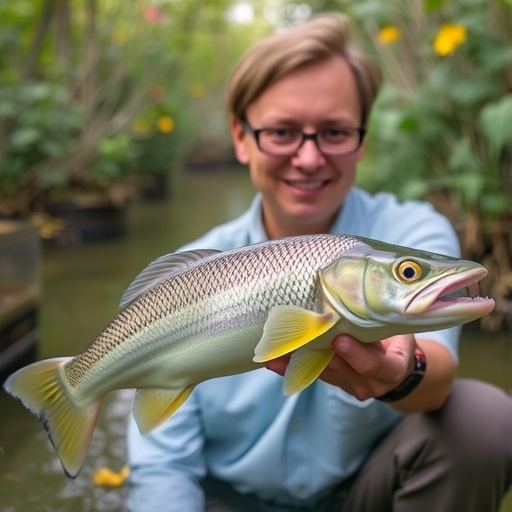
In a compelling new avenue of ecological research, Assistant Professor Matthew Troia at the University of Texas at San Antonio has received the prestigious National Science Foundation Faculty Early Career Development Program (CAREER) award. His innovative project focuses on unraveling the complex interplay between climate change, urbanization, and freshwater ecosystems, particularly investigating how these factors facilitate the northward expansion of exotic tropical fish species. This investigation is poised to deepen scientific understanding of ecosystem dynamics under escalating anthropogenic pressures—a subject of considerable urgency as global climate patterns continue to shift.
The significance of Troia’s research lies in its integration of multidisciplinary methodologies, combining rigorous laboratory experiments with extensive field monitoring and advanced computational modeling. By systematically capturing temperature variations of Central Texas rivers and springs, his team elucidates the physiological responses of tropical fish to thermal stressors. These studies are crucial because rising water temperatures and urban heat islands may be altering habitats to favor tropical species that were traditionally confined to warmer regions, thereby disrupting native biodiversity and ecosystem function.
Over a planned five-year period, Troia’s research will meticulously assess how climate-induced warming and urbanization synergistically affect freshwater biomes. This comprehensive approach encompasses behavioral assays, metabolic analyses, and cold tolerance metrics obtained through controlled lab conditions. Simultaneously, in situ monitoring across urban and comparatively pristine waterways near San Antonio will provide empirical data on how anthropogenic alterations shape thermal regimes and ecosystem vulnerability. Such data are indispensable for predictive modeling of species range shifts under various climate scenarios.
The project focuses on three tropical fish species prevalent in San Antonio’s freshwater systems but not yet established in North Texas: the suckermouth armored catfish (pleco), Rio Grande cichlid, and Mexican tetra. These species serve as biological sentinels for understanding potential dispersal mechanisms driven by urban heat island effects and global warming. By investigating their physiological thresholds and survival strategies in colder northern environments, Troia’s research aims to forecast future invasions and inform proactive management protocols to mitigate ecological disruptions.
Freshwater ecosystems, although covering less than 1% of Earth’s surface, support an extraordinary diversity of nearly 6% of known species, highlighting their disproportionate ecological value. Troia’s work underscores the imperative of preserving these habitats, especially in semi-arid regions like central Texas where freshwater availability is limited. Maintaining the functional integrity of streams and rivers is paramount not only for biodiversity conservation but also for sustaining human communities that depend on these water resources.
A particularly innovative facet of this project is its emphasis on translating scientific findings into actionable conservation strategies. The research will evaluate the efficacy of riparian restoration practices as a potential tool to mitigate thermal stress, investigating whether vegetative buffers and habitat enhancements can reduce stream temperatures and thereby impede the northern spread of tropical fish. Such restoration ecology elements are vital for developing scalable interventions that natural resource managers can deploy in increasingly urbanized landscapes.
Troia’s commitment to fostering scientific literacy and workforce development is evident through his integration of course-based undergraduate research experiences (CUREs) at UT San Antonio. In collaboration with Professor Mariah Hopkins, Troia embeds core research components into academic curricula, providing students with hands-on opportunities to conduct experiments, perform data analyses, and engage in modeling exercises. This pedagogical strategy equips aspiring scientists with practical skills while simultaneously advancing the objectives of the CAREER grant.
The project also demonstrates a strong commitment to knowledge dissemination by supporting student participation in scientific conferences, facilitating the presentation of research results, and building professional networks. This engagement will enhance the visibility and impact of the findings within the broader scientific community and among stakeholders involved in freshwater management and urban planning.
Looking toward the future, Troia envisions creating interactive, user-friendly online maps by 2030 that will enable municipal officials and environmental agencies, such as Texas Parks and Wildlife and the San Antonio River Authority, to make informed decisions regarding invasive species management and restoration efforts. These tools represent a critical nexus between cutting-edge science and practical resource governance, embodying the translational potential of modern ecological research.
In sum, Matthew Troia’s NSF CAREER award-funded project epitomizes an integrative approach to addressing some of the most pressing environmental challenges of our time. By combining high-resolution field data, controlled laboratory experimentation, and sophisticated predictive models, the research sheds light on how warming climates and urban heat islands jointly facilitate biogeographical shifts among aquatic species. This knowledge will prove indispensable for conserving biodiversity and safeguarding freshwater ecosystems amid rapid global change.
This research not only advances the frontiers of aquatic ecology but also exemplifies how early-career scientists can catalyze transformative impacts through innovative science and education. The convergence of ecological theory, empirical study, and applied conservation presents a powerful framework for understanding and mitigating human-induced environmental change, fostering resilience in both natural systems and the societies that rely on them.
News Publication Date: Not specified
Web References:
- National Science Foundation CAREER Program
- Project Details on NSF Website
- University of Texas at San Antonio
- San Antonio River Authority
- Course-based Undergraduate Research Experiences
Cite Scienmag News
Violet Maxwell. (February 12, 2026). UT San Antonio Researcher Monitors Climate Impacts on Texas Waterways as Tropical Fish Migrate North. Scienmag. https://scienmag.com/ut-san-antonio-researcher-monitors-climate-impacts-on-texas-waterways-as-tropical-fish-migrate-north/
Violet Maxwell. "UT San Antonio Researcher Monitors Climate Impacts on Texas Waterways as Tropical Fish Migrate North." Scienmag, 12 February 2026, https://scienmag.com/ut-san-antonio-researcher-monitors-climate-impacts-on-texas-waterways-as-tropical-fish-migrate-north/. Accessed 3 September 2026.
Violet Maxwell. "UT San Antonio Researcher Monitors Climate Impacts on Texas Waterways as Tropical Fish Migrate North." Scienmag. February 12, 2026. https://scienmag.com/ut-san-antonio-researcher-monitors-climate-impacts-on-texas-waterways-as-tropical-fish-migrate-north/


