


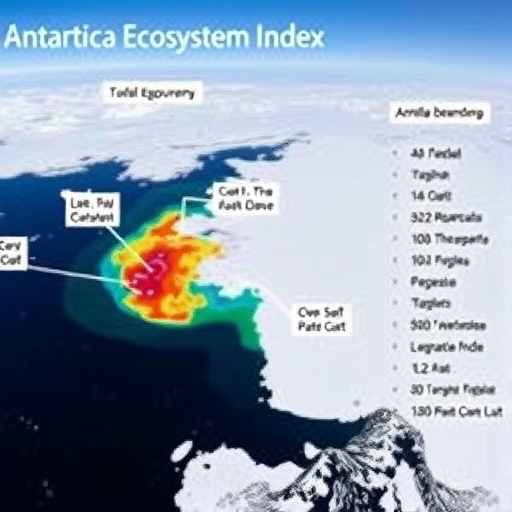
In the remote, icy expanse of Antarctica, where environmental changes ripple through delicate ecosystems with profound impacts, scientists have developed a groundbreaking new metric to quantify ecological value with unprecedented precision. This innovative metric, called the Antarctic Ecosystem Value Index (AEVI), promises to revolutionize the way researchers understand and monitor the ecological complexities of one of Earth’s most fragile biomes. By integrating data across multiple trophic levels and charting changes over time, AEVI offers a comprehensive, dynamic portrait of ecosystem health and function that holds implications far beyond the Antarctic region itself.
The development of AEVI addresses a longstanding challenge for ecologists: how to accurately assess the value of an ecosystem in a quantifiable manner that reflects the intricate interactions among species and their physical environment. Traditional methods often focus on isolated components—such as population sizes or species diversity—without capturing the cascading effects across food webs or long-term temporal shifts. AEVI breaks new ground by synthesizing information from various biological, chemical, and physical parameters into a singular, interpretable index. This allows for a more nuanced understanding of ecological resilience and vulnerability in the face of accelerating climatic disruptions.
At its core, AEVI harnesses extensive datasets derived from a diverse array of biological surveys and environmental monitoring tools strategically deployed across multiple Antarctic sites. These datasets encompass primary producers like phytoplankton, key in driving carbon fixation, through zooplankton and benthic invertebrates, all the way to apex predators such as seals and penguins. By aggregating trophic interactions and energy flows alongside key environmental variables—temperature fluctuations, sea-ice extent, and nutrient availability—the index captures a multifaceted picture of ecosystem dynamics over seasonal and interannual timescales.
A defining feature of AEVI is its temporal resolution, which allows researchers to track ecosystem changes year after year, capturing the subtle yet significant responses to ongoing climate change. For instance, shifts in sea ice duration and coverage, which are critical drivers of Antarctic food web structure, can now be correlated directly with changes in trophic level biomass and diversity through the index. This time-sensitive monitoring is vital for predicting future ecological shifts and for guiding conservation policies aimed at protecting species and habitats most vulnerable to environmental stressors.
The technical framework underpinning AEVI relies on sophisticated mathematical modeling and network analysis. The research team employed advanced statistical tools to distill complex ecological interactions into level-specific value scores that are then integrated into an overall ecosystem score. This methodology bridges the gap between raw empirical data and interpretable ecological indicators, enabling scientists and policymakers to assess the functional integrity and service provisioning of Antarctic ecosystems in a unified manner.
Importantly, AEVI also incorporates measures of ecosystem services—such as carbon sequestration by phytoplankton and the habitat support provided to iconic species—linking ecological function with broader environmental and economic significance. By quantifying ecosystem services, the index emphasizes the intrinsic and extrinsic value of biological processes that sustain biodiversity and human well-being. This dimension enriches the discourse on Antarctic stewardship and highlights the necessity of preserving these ecosystems amidst growing anthropogenic pressures.
This research, spearheaded by DuVivier, Krumhardt, Landrum, and colleagues, presents AEVI at a critical juncture in Antarctic science. With sea ice diminishing at record rates and global temperatures on an upward trajectory, there has been an urgent call for more rigorous ecosystem monitoring tools. AEVI’s capacity to integrate across multiple trophic levels and track temporal trends equips scientists and decision-makers with a foresight tool essential for adaptive management in this vulnerable region.
The index’s flexibility is another notable advantage. While the current focus is on the Antarctic, the underlying principles and modeling techniques are adaptable to other ecosystems facing similar pressures—be it Arctic marine environments, coral reefs, or terrestrial habitats experiencing fragmentation. This scalability makes AEVI a potentially transformative instrument in the global ecological monitoring toolkit.
Field validation of the AEVI involved deploying automated sampling stations and remote sensing technologies, which provided continuous, high-resolution data streams. This real-time data collection enabled calibration and refinement of the index models, ensuring robustness and sensitivity of the index to ecological fluctuations. The integration of satellite data, particularly regarding sea ice and primary productivity, augmented ground-based observations and enhanced spatial coverage.
The application of AEVI has already yielded compelling insights. For example, preliminary results indicate that specific trophic levels, such as krill populations—central to the Antarctic food web—have experienced disproportionate fluctuations correlated with changing oceanographic conditions. Tracking these variations through AEVI underscores the cascading impacts on predators dependent on krill, illuminating previously underappreciated vulnerabilities within the ecosystem.
Moreover, AEVI’s temporal lens revealed seasonal patterns of ecological value that correspond with biological cycles such as breeding, feeding, and migration periods. These patterns provide critical context for timing conservation interventions to maximize effectiveness. Understanding seasonal ecosystem value helps mitigate human impacts like fishing and tourism, which peak during certain windows each year.
Another groundbreaking aspect of AEVI is its ability to visualize and communicate complex ecosystem dynamics through innovative data visualization techniques. These graphical representations enable both scientific communities and the public to grasp intricate biotic interactions and environmental changes in an accessible, engaging manner—crucial for raising awareness and fostering global environmental stewardship.
This research underscores the urgency of integrating multidimensional ecological data into policy frameworks. Antarctic governance bodies, such as the Antarctic Treaty System, can leverage AEVI-derived insights to draft regulations that accurately reflect ecosystem health indicators rather than relying solely on narrow species counts or habitat area metrics. This holistic approach paves the way for more resilient, informed protection strategies.
In synthesis, AEVI marks a paradigmatic shift in ecosystem evaluation, coupling rigorous science with practical applications in conservation. It elevates ecological valuation beyond static snapshots, offering a dynamic, comprehensive framework capable of shaping the future of biodiversity preservation in Antarctica and beyond. As global environmental challenges mount, tools like AEVI will be indispensable in safeguarding planetary ecosystems.
The implications of AEVI extend even into climate science, as Antarctic ecosystems play a critical role in global carbon cycles and climate regulation. Understanding ecological value in this context helps clarify feedback mechanisms and predict the broader environmental consequences of Antarctic ecosystem disturbances.
Looking forward, the expansion and refinement of AEVI will likely incorporate more advanced biogeochemical parameters and genomic data, further enriching the index’s accuracy and ecological relevance. The research team envisions collaborations across disciplines to enhance the predictive power and applicability of this tool in an era of rapid ecological transformation.
Ultimately, AEVI epitomizes the fusion of cutting-edge ecological science and technology, embodying a proactive approach to environmental stewardship. Its contribution to Antarctic research promises to inspire parallel innovations worldwide, catalyzing a new era of ecosystem valuation that is as dynamic and interconnected as the natural world itself.
Cite Scienmag News
Gavin Prescott. (February 12, 2026). Antarctic Ecosystem Index Quantifies Ecological Value Over Time. Scienmag. https://scienmag.com/antarctic-ecosystem-index-quantifies-ecological-value-over-time/
Gavin Prescott. "Antarctic Ecosystem Index Quantifies Ecological Value Over Time." Scienmag, 12 February 2026, https://scienmag.com/antarctic-ecosystem-index-quantifies-ecological-value-over-time/. Accessed 3 September 2026.
Gavin Prescott. "Antarctic Ecosystem Index Quantifies Ecological Value Over Time." Scienmag. February 12, 2026. https://scienmag.com/antarctic-ecosystem-index-quantifies-ecological-value-over-time/


