


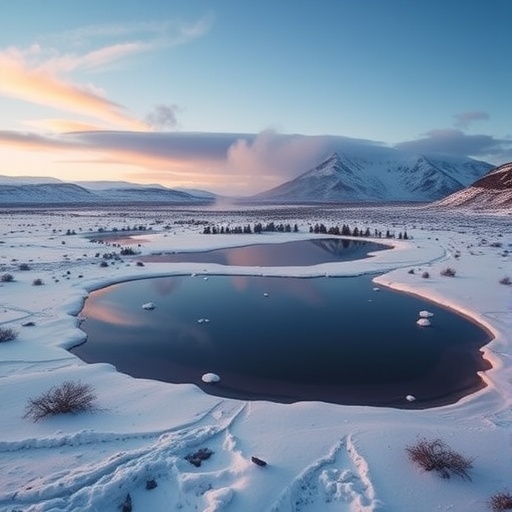
In a significant advancement for our understanding of climate change and its ecological implications, a groundbreaking study has emerged highlighting the annual carbon dioxide emissions from lakes situated in the drier regions of the Arctic. Conducted by a team led by renowned researchers Hazuková, Alriksson, and Gudasz, this research reveals a startling increase in CO2 emissions, coupled with a surprising variance triggered by distinct climatic conditions. The findings, soon to be published in Commun Earth Environ, have crucial implications for regional climate patterns and the global carbon cycle.
As the Arctic continues to experience transformative climatic shifts due to global warming, it becomes crucial to understand the mechanisms through which ecosystems adapt—or fail to adapt—to these changes. The study emphasizes that lakes in drier Arctic environments are experiencing not only higher annual emissions of CO2 but also a higher variability in these emissions compared to their wetter counterparts. This revelation is critical, as it indicates a new layer of complexity in how freshwater ecosystems respond to changing climate conditions.
The research involved an extensive examination of both field data and remote sensing technologies. By integrating direct measurements of CO2 emissions from various lakes with advanced satellite observations, the researchers were able to paint a detailed picture of how these emissions fluctuate annually. An array of environmental factors was evaluated, including temperature changes, precipitation patterns, and nutrient availability, all of which contribute to the lakes’ carbon dynamics.
One of the most striking outcomes of this study is the identification of the drier Arctic lakes as “hotspots” for carbon emissions. Researchers illustrate that these bodies of water are not merely passive recipients of carbon inputs but are actively contributing to atmospheric CO2 levels, thus catalyzing further climate changes. This is particularly alarming, as the increased emissions exacerbate the existing phenomenon of the Arctic’s role as a major carbon sink, a role that is predicted to diminish as the climate continues to warm.
Further complicating the matter, the variability in emissions suggests that these lakes may respond unpredictably to climatic fluctuations. For instance, during particularly warm years, the emissions may spike dramatically due to increased organic matter decomposition and reduced ice cover, while cooler, wetter years may see a dip in emissions. This unpredictability poses challenges for climate modeling and makes it difficult for policymakers to ascertain the future impacts of these ecosystems on global carbon budgets.
The implications of these findings extend far beyond the specific confines of the Arctic. The researchers urge scientists and policymakers alike to consider the ripple effects of carbon emissions from these lakes on global climate systems. The Arctic landscape serves as a significant barometer for climate changes, and understanding how it emits carbon is vital for predicting future scenarios.
In terms of ecological consequences, higher CO2 levels due to lake emissions could pertain to further warming and shifting of biomes, affecting both the flora and fauna that populate these areas. The researchers posit that as lakes release more carbon into the atmosphere, they could fundamentally alter the chemical composition of surrounding environments, which may have deleterious effects on biodiversity, fish stocks, and even indigenous communities reliant on these ecosystems for their livelihoods.
The interaction between terrestrial and aquatic systems is also emphasized. The nutrient cycles are intricately linked, and changes in one can lead to unforeseen changes in the other. For instance, a spike in emissions from lakes may correlate with nutrient runoffs from surrounding landscapes, which could lead to algal blooms that further complicate the ecological landscape.
In light of these findings, the authors of the study advocate for more research into not only Arctic lakes but also other freshwater systems globally. A comprehensive understanding of carbon emissions dynamics in varied climatic contexts is imperative for enhancing our prediction models regarding climate change impacts. Greater emphasis should be placed on long-term monitoring of carbon emissions across diverse ecosystems to ensure a robust understanding of their contributions to global carbon cycles.
In conclusion, the research conducted by Hazuková and her colleagues opens doors to critical questions surrounding climate change, emissions dynamics, and ecosystem resilience. With the urgency to address climate issues becoming ever more pronounced, findings like these underscore the need for immediate action, both in research funding and policy implementation. The Arctic’s vulnerability can serve as a vital lesson in global terms; changes in this remote region could very well be precursors to changes that other regions may soon face.
In a world already grappling with climate change, the discovery of higher and more variable CO2 emissions from drier Arctic lakes has immense implications. As we move forward, it is crucial that we heed these findings, rethink our strategies, and foster collaboration across scientific disciplines to better understand and combat these pressing environmental challenges.
Hazuková, V., Alriksson, F., Gudasz, C. et al. Higher, but more variable, annual CO2 emissions from lakes in drier Arctic landscapes.
Commun Earth Environ (2026). https://doi.org/10.1038/s43247-026-03275-8
Cite Scienmag News
Sloane Callahan. (February 12, 2026). Increased CO2 Emissions from Lakes in Dry Arctic. Scienmag. https://scienmag.com/increased-co2-emissions-from-lakes-in-dry-arctic/
Sloane Callahan. "Increased CO2 Emissions from Lakes in Dry Arctic." Scienmag, 12 February 2026, https://scienmag.com/increased-co2-emissions-from-lakes-in-dry-arctic/. Accessed 4 September 2026.
Sloane Callahan. "Increased CO2 Emissions from Lakes in Dry Arctic." Scienmag. February 12, 2026. https://scienmag.com/increased-co2-emissions-from-lakes-in-dry-arctic/


