


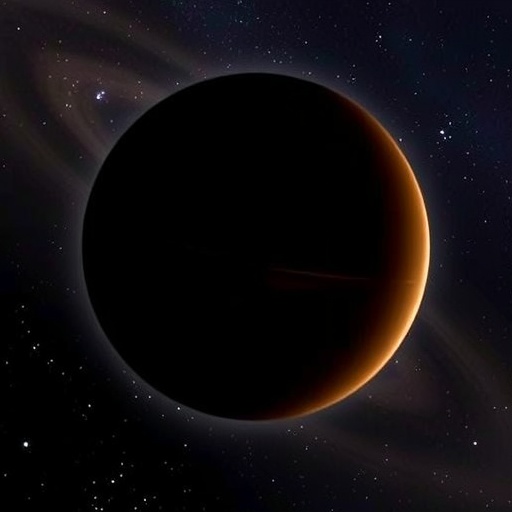
One of the most breathtaking phenomena in the cosmic realm is the dimming of stars. Such events offer astronomers critical insight into the dynamics of celestial bodies and their complex interactions. Recently, researchers shed light on an exceptionally long stellar dimming event attributed to an unseen companion object, possibly a brown dwarf or a super-Jupiter, encircled by an extensive ring system. This stellar twilight unfolded around ASASSN-24fw, a star positioned 3,200 light-years from Earth and nearly twice the size of our Sun. For years, ASASSN-24fw had been stable, exhibiting a consistent brightness. However, an unexpected fade at the end of 2024 startled astronomers and challenged existing theories about star behavior and planetary formations.
The mystery deepened as ASASSN-24fw sustained its dimming for over nine months, an unusually lengthy period that stirred curiosity and confusion among researchers. While dimming events are not entirely uncommon in astronomy, their protracted nature and significant intensity in this instance made the event remarkably rare. In the journal Monthly Notices of the Royal Astronomical Society, a dedicated team comprising international researchers proposed a solution to the enigma surrounding their celestial target. Their analysis inferred that the dramatic dimming was primarily instigated by a brown dwarf, an object too massive to classify as a planet yet too light to be regarded as a true star, characterized as having the size and attributes that bridge the two categories.
The essential finding of this investigation indicates that the brown dwarf is likely shrouded by a vast system of rings, typically akin to those found around Saturn. This ring system, as described by the study, extends approximately 0.17 astronomical units, a distance comparable to nearly half the interval separating our Sun from Mercury. The researchers, capturing the imagination of the scientific community, opened up discussions about the implications such a structure may have for understanding planetary ring systems in other star systems.
Brown dwarfs have often intrigued and puzzled astrophysicists because of their unique characteristics. They occupy a niche within stellar classification, as they hold a mass sufficient to undergo some hydrogen fusion but insufficient for sustained nuclear reactions like those powering stars. Their formation and the mechanisms through which they evolve remain speculative. This event, particularly centered on ASASSN-24fw, offers tremendous potential for enhancing our understanding of the processes contributing to their existence.
In their study, the scientists present a compelling case that the dimming occurred due to the intricate dynamics of the ringed object orbiting the host star at a significant distance. Notably, the dimming was not abrupt; rather, it progressed gradually, attributed to the outer regions of the rings being comparatively thin, allowing only the denser inner sections to obscure the star fully. This excellent alignment between the brown dwarf or super-Jupiter and ASASSN-24fw suggests an intricate choreography that allows us to glimpse planetary scale interactions beyond our solar system.
The findings also indicate evidence of a circumstellar environment surrounding ASASSN-24fw. This environment may contain remnants from past planetary collisions that result from the star’s advanced age, estimated at over 1 billion years. Observing such phenomena provides an intriguing perspective on the possible evolutionary trajectories of stars and their planetary systems. The researchers emphasized that these large, complex ring systems are typically challenging to observe directly, making this dimming event a unique opportunity to investigate the characteristics of such celestial bodies up close.
The study’s lead author, Dr. Sarang Shah, highlight emphasized the rarity and significance of such prolonged dimming events, which require precise alignments for observation. They have outlined plans for future investigations, including utilizing powerful observational instruments like the European Southern Observatory’s Very Large Telescope and the James Webb Space Telescope. These efforts aim to delve deeper into ASASSN-24fw’s characteristics and its evolving relationship with surrounding celestial bodies, offering a richer understanding of cosmic evolution.
Provocatively, the researchers anticipate that ASASSN-24fw may dim again in approximately 42 to 43 years. Should this occur, it would provide a golden opportunity to reevaluate and enhance our comprehension of stellar dimming phenomena while examining the associated ring dynamics. This exciting prospect invites further analysis of such fascinating interstellar interactions that challenge our perceptions of cosmic structures.
Reflecting on these incredible developments in astronomy, the study sets a precedent for future explorations into complex celestial environments. The intrigue surrounding ASASSN-24fw’s dimming not only enhances our knowledge of stars and their companions but also fuels interest in the broader implications for planetary formation theories. As these observations continue to unfold, we are reminded of the delicate and intricate interactions that govern the interactions amongst stars, planets, and their respective ring systems, emphasizing how much more there is to learn about our universe.
This remarkable event serves as a stepping stone toward unlocking the mysteries of not only our solar neighborhood but also those of distant systems, where the echoes of such interactions pave pathways to greater knowledge in astronomical research. The unfolding narrative around ASASSN-24fw stands as a testament to the ongoing quest for understanding the complexities of the cosmos, underscoring the importance of sustained observation and innovation in scientific inquiry.
Keywords
Stellar dimming, brown dwarf, super-Jupiter, planetary ring systems, ASASSN-24fw, astronomical phenomena, cosmic interactions.
Cite Scienmag News
Grant Pearson. (February 12, 2026). Uncharted Planet or Brown Dwarf Could Conceal Mysterious Fading Star. Scienmag. https://scienmag.com/uncharted-planet-or-brown-dwarf-could-conceal-mysterious-fading-star/
Grant Pearson. "Uncharted Planet or Brown Dwarf Could Conceal Mysterious Fading Star." Scienmag, 12 February 2026, https://scienmag.com/uncharted-planet-or-brown-dwarf-could-conceal-mysterious-fading-star/. Accessed 3 September 2026.
Grant Pearson. "Uncharted Planet or Brown Dwarf Could Conceal Mysterious Fading Star." Scienmag. February 12, 2026. https://scienmag.com/uncharted-planet-or-brown-dwarf-could-conceal-mysterious-fading-star/


