


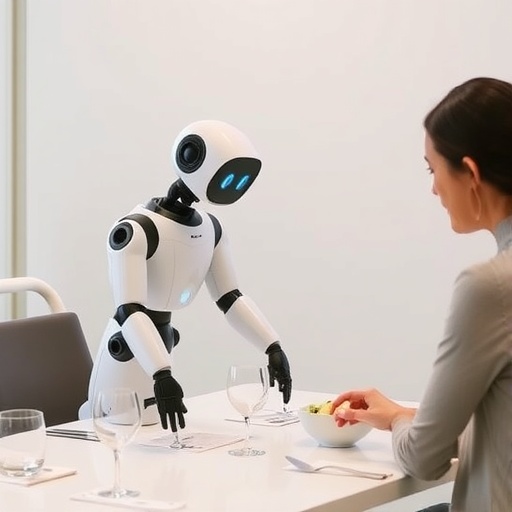
Researchers from the Universidad Carlos III de Madrid (UC3M) have revealed a groundbreaking advancement in robotic technology that could reshape the future of domestic assistance. Their innovative methodology, presented at the prestigious IROS 2025 robotics conference, involves teaching robots how to learn movements autonomously. This is achieved through a unique blend of observational learning and intercommunication between the robot’s limbs, paving the way for more natural and teachable service robots capable of assisting in everyday tasks. This milestone could significantly enhance the efficiency and effectiveness with which robots operate in household environments, including activities like setting and clearing the table, ironing, and tidying up.
The primary challenge that this research addresses is the complex coordination required for a robot to use both of its arms in unison. The research group utilizes their advanced prototype, ADAM (Autonomous Domestic Ambidextrous Manipulator), which is specifically designed to perform a variety of assistive tasks in domestic settings. Unlike traditional robots limited to single-arm movements or reliant on pre-programmed routines, ADAM can autonomously carry out tasks such as serving meals and tidying spaces. This proactive approach to domestic assistance aims to support elderly individuals and those requiring additional help, allowing for safer and more comfortable living conditions.
ADAM is equipped with sophisticated features that enable it to analyze and adapt within various home scenarios. Researcher Alicia Mora, from the Mobile Robots Group at UC3M, emphasizes the significance of this flexible, adaptive learning style. For example, the robot can autonomously serve a glass of water or retrieve necessary items for an individual – tasks that, while seemingly simple to humans, encompass a myriad of complex movements and interactions challenging for robotic systems. Through the advanced capabilities of ADAM, the team envisions a future where robots can provide essential aid in the lives of those who need it most.
The technology underlying this robotic advancement hinges on a novel technique that allows each arm of the robot to learn tasks independently via imitation learning. Researchers Adrián Prados and Gonzalo Espinoza propose innovative methods whereby each arm learns to perform tasks in isolation before enabling seamless communication between them, utilizing a mathematical framework known as Gaussian Belief Propagation. This innovative technique simulates a constant, real-time dialogue between the robot’s limbs, allowing them to synchronize and navigate around obstacles or avoid collisions without interruptions for recalibrations. As a result, the movements executed by ADAM are not only more fluid and efficient but align closely with human-like interaction styles.
The core of this robotic learning paradigm centers around the idea that mere imitation is not enough. Current robotics technology often demands extensive programming and detailed code for even basic movements, whereas the UC3M approach focuses on enabling robots to learn through observation. By watching humans perform tasks, ADAM captures the intricacies of motion, empowering it to adapt to situations where exact replication would result in failure. Instead of rigidly repeating movements, the robot utilizes adaptive learning methods, making it capable of modifying actions in real-time, such as adjusting the trajectory of its limbs to compensate for unforeseen changes in the environment.
This adaptive learning resembles the properties of a “rubber band,” allowing the robot to preserve the essence of an action even when the context shifts. For example, if it learns to pick up a bottle, it can adjust its wrist and arm positioning to ensure the bottle remains upright, preventing spills, regardless of the original placement of the bottle. This cognitive flexibility not only increases efficiency but also enhances safety by ensuring that robotic assistance does not pose risks to its surroundings or the people it serves.
The functionality of ADAM is structured into three critical phases: perception, reasoning, and action. Initially, the robot perceives its environment by gathering data through an array of sensors. Advanced 2D and 3D laser sensors are utilized to measure distances, identify obstacles, and locate relevant objects within the space. Following perception, the reasoning phase involves processing the collected data to derive important insights and relevant information essential for decision-making. Finally, the action phase is where ADAM computes its movements, determining how best to execute tasks and coordinate its dual arms effectively.
One of the most challenging aspects of robotic implementation is transitioning from a mere visual analysis of objects to a deeper understanding of their usage and context. Conventional robotic systems relied on pre-programmed ‘common sense’ databases. However, UC3M researchers are now embedding generative models along with artificial intelligence into their system, enhancing ADAM’s capability to adapt to the specific requirements of real-world scenarios and the dynamic nature of human behavior.
While ADAM currently exists as an experimental platform with a development cost in the range of 80,000 to 100,000 euros, the technology demonstrates the potential for future widespread deployment in domestic environments, projected to become more economically accessible within the next 10 to 15 years as advancements continue. The implications of this research stretch beyond technical achievements and highlight the burgeoning role of robotics in addressing societal challenges, such as an aging population increasingly needing assistance in daily activities.
As global demographics shift, with an ever-growing number of elderly individuals and a declining pool of caretakers, solutions such as ADAM will play an integral part in addressing these societal needs. The vision shared by Ramón Barber, the director of the Mobile Robots Group at UC3M, is that robotic assistance will evolve into a critical resource for enhancing the quality of life and independence for vulnerable populations, thereby allowing individuals to maintain autonomy within their daily lives.
Thus, robotics is not simply about developing machines that can perform tasks—it represents a significant step toward enabling a future where technology complements human capabilities, enhancing overall well-being and quality of life. These innovative technologies, as highlighted by the research team’s dedication and methodology, signify a promising advancement toward a nuanced synergy between humans and machines that can transform societal living conditions and address essential needs.
As the field of robotic learning continues to advance, the ongoing research will undoubtedly inspire further innovation, opening doors for future collaboration between humans and intelligent systems. With every milestone achieved, we move closer to realizing the dream of seamlessly integrated robotic helpers that can intelligently and adaptively navigate the complexities of human environments.
In conclusion, the work being done at UC3M marks a revolution in the application of robotics for domestic assistance. This ambitious and thoughtful approach aligns with the evolving landscape of societal needs, showcasing how technological advancements can be harnessed to support a more independent and dignified life for individuals requiring assistance. The promising results of the ADAM project underline a future where robots are not merely machines but companions, co-workers, and invaluable contributors to enhancing daily life.
Cite Scienmag News
Denise Maddox. (February 11, 2026). UC3M Develops Assistive Robot Capable of Learning Table Setting and Clearing by Observing Human Actions. Scienmag. https://scienmag.com/uc3m-develops-assistive-robot-capable-of-learning-table-setting-and-clearing-by-observing-human-actions/
Denise Maddox. "UC3M Develops Assistive Robot Capable of Learning Table Setting and Clearing by Observing Human Actions." Scienmag, 11 February 2026, https://scienmag.com/uc3m-develops-assistive-robot-capable-of-learning-table-setting-and-clearing-by-observing-human-actions/. Accessed 4 September 2026.
Denise Maddox. "UC3M Develops Assistive Robot Capable of Learning Table Setting and Clearing by Observing Human Actions." Scienmag. February 11, 2026. https://scienmag.com/uc3m-develops-assistive-robot-capable-of-learning-table-setting-and-clearing-by-observing-human-actions/


