


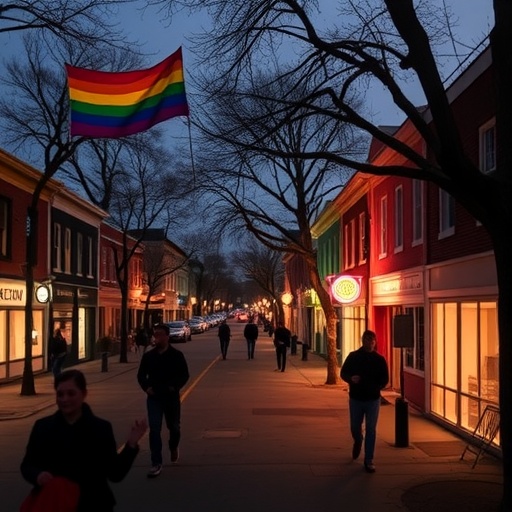
New research published in the Journal of Politics has revealed a striking link between spatial concentration of lesbian, gay, and bisexual (LGB) individuals and their likelihood to vote. The study, conducted in Sweden, demonstrates that when the proportion of LGB residents in a neighborhood rises by just one percentage point, those LGB residents become approximately 1.56 percentage points more likely to participate in elections compared to their heterosexual counterparts. This discovery sheds new light on the underlying social dynamics that drive minority voter mobilization.
Sweden provides a uniquely advantageous context for this research due to its exceptionally high voter turnout, which consistently exceeds 84 percent in parliamentary elections. Despite such robust participation, slight upticks in turnout, particularly among marginalized groups, can have outsized political consequences. Therefore, detecting and understanding the mechanisms behind these modest increases among LGB voters is essential to grasp broader democratic engagement patterns.
The investigation was spearheaded by interdisciplinary scholars affiliated with the University of Southampton in the United Kingdom and Uppsala University in Sweden. They meticulously analyzed voting records of over 20,000 LGB individuals alongside nearly eight million heterosexual residents across four election cycles between 1994 and 2022. This approach resulted in a dataset comprising more than 17.6 million person-election observations, affording tremendous statistical power and precision in estimating behavioral trends over nearly three decades.
Unlike prior research reliant on self-reported surveys, this work leverages Sweden’s comprehensive population registers, which capture official data on same-sex partnerships and parenthood, allowing accurate identification of LGB individuals. Furthermore, combining these records with precise geocoded data facilitated the measurement of the local density of LGB residents surrounding each voter, specifically the nearest one thousand neighbors. This granularity facilitated novel insights into how micro-geographic social contexts influence political participation.
The researchers applied advanced statistical models to isolate the causal effect of living near others who share one’s minority sexual orientation, ruling out confounding variables such as neighborhood affluence or other socioeconomic factors. This methodological rigor ensures the observed mobilization effect is genuinely attributable to minority spatial concentration rather than extraneous factors associated with neighborhood desirability or voter demographics.
One of the study’s groundbreaking insights is the reconceptualization of “gayborhoods” or similarly concentrated communities not merely as cultural or social enclaves but as potent catalysts for democratic engagement. The findings suggest that the mere proximity to others who share a minority identity fosters supportive social networks and heightened political efficacy, thereby encouraging higher voter turnout. This phenomenon underscores geography’s persistent relevance in an increasingly digital world, demonstrating that physical spatial clusters continue to exert profound influence on political behavior.
Experts involved in the research emphasize that the increased participation rates linked to minority spatial concentration could have strategic implications for political candidates, particularly ahead of local elections in metropolitan areas with substantial LGBTQ+ populations, such as Brighton, Manchester, and London. Understanding how neighborhood composition shapes voter mobilization can inform targeted campaign strategies aiming to engage historically underrepresented groups.
The team’s longitudinal design allowed for a dynamic examination of how changes in neighborhood LGB composition—due to residential moves or demographic shifts—correlate with corresponding shifts in voting behavior. This temporal perspective provides robust evidence that the mobilization effect is not merely static but responsive to evolving local social environments, highlighting the critical role of community structures in sustaining political engagement over time.
Researchers also point out that these findings extend knowledge about minority political behavior beyond what was previously inferred from individual-level studies, offering compelling evidence that collective identity and shared spatial environments boost minority voters’ participation. This has broad implications for understanding democratic inclusion, representation, and the societal conditions that facilitate or hinder political engagement of marginalized groups.
Dr. Stuart Turnbull-Dugarte, Associate Professor at the University of Southampton and a lead author, remarks that these insights challenge prevailing assumptions about digital communication superseding traditional community bonds by illustrating that “where you live, and who you live near, shapes whether you show up at the ballot box.” The study bridges political science and human geography by elucidating how place-based social networks serve as engines of democratic vitality.
Moreover, Dr. Michal Grahn of Uppsala University highlights the methodological accomplishment achieved by leveraging Sweden’s unparalleled population registers. This allowed for the generation of a uniquely large and precise dataset far exceeding sample sizes typical in social science research on sexual minorities. The innovative use of administrative data serves as a model for other researchers seeking to understand minority political behavior in contexts with similarly rich data infrastructure.
As broader societal debates surrounding minority rights and political representation continue to evolve globally, this research provides empirical grounding for the critical importance of “gaybourhoods” and minority spatial concentration as more than cultural landmarks—they are vital arenas cultivating political voice and empowerment. The study’s implications extend beyond the LGBTQ+ community to other marginalized populations for whom neighborhood social contexts might similarly shape patterns of civic engagement.
In closing, this comprehensive investigation elucidates the interplay between minority identity, residential geography, and voter turnout with unprecedented scale and precision. By unpacking how community proximity mobilizes LGB voters in Sweden’s high-turnout environment, the research offers vital new perspectives on democratic participation, social cohesion, and the power of place in an era often dominated by virtual interactions.
Cite Scienmag News
Courtney Benton. (February 11, 2026). How ‘Gaybourhoods’ Amplify LGB Voter Turnout. Scienmag. https://scienmag.com/how-gaybourhoods-amplify-lgb-voter-turnout/
Courtney Benton. "How ‘Gaybourhoods’ Amplify LGB Voter Turnout." Scienmag, 11 February 2026, https://scienmag.com/how-gaybourhoods-amplify-lgb-voter-turnout/. Accessed 7 September 2026.
Courtney Benton. "How ‘Gaybourhoods’ Amplify LGB Voter Turnout." Scienmag. February 11, 2026. https://scienmag.com/how-gaybourhoods-amplify-lgb-voter-turnout/


