


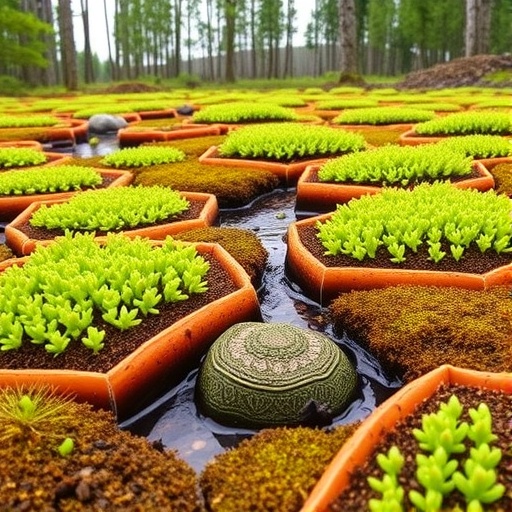
In the sprawling and cryptic landscapes of the boreal biome, a groundbreaking revelation is reshaping our understanding of the soil carbon cycle in one of Earth’s most vital ecosystems. Recent research has illuminated an unexpected climate feedback mechanism in boreal Sphagnum-dominated peatlands—ecosystems that had long been overshadowed by studies focusing on boreal forests and tundra. Contrary to the prevailing paradigm that warming accelerates soil carbon loss through enhanced microbial decomposition in cold ecosystems, these peatlands exhibit a unique and counterintuitive response to rising temperatures.
Led by Professor Feng Xiaojuan from the Institute of Botany at the Chinese Academy of Sciences, in partnership with the University of Helsinki and the Finnish Meteorological Institute, this comprehensive study synthesizes data from 735 paired observations across diverse boreal environments. These datasets stem from 93 individual field warming experiments, spanning various boreal terrestrial systems, and distinguish between Sphagnum peatlands, vascular plant wetlands, boreal forests, and tundra. Their findings have been recently published in the prestigious journal Nature Ecology & Evolution, marking a significant advancement in our comprehension of boreal carbon dynamics under anthropogenic climate change.
Boreal ecosystems, often termed the planet’s cold forests and wetlands, are carbon superstores, holding twice the amount of carbon present in the entire atmosphere. Historically, scientific consensus has held that warming trends accelerate heterotrophic respiration—the microbial breakdown of organic matter—thus releasing stored carbon as carbon dioxide and exacerbating global warming. This lens, however, has been primarily shaped by observations in boreal forests and tundra landscapes. The boreal Sphagnum peatlands, which constitute about 20% of the boreal biome and harbor roughly 40% of its soil carbon, have not been equally scrutinized, leaving a critical knowledge gap.
What distinguishes these peatlands is their hydrologic and biogeochemical environment. Sphagnum mosses cultivate acidic, water-saturated, and antimicrobial conditions that profoundly limit microbial communities responsible for decomposition. This unique niche shapes the interactions between plant productivity, microbial activity, and soil mineralogy, particularly the role of iron oxides as protective agents for organic carbon.
The study delves into a nexus of biotic and abiotic mechanisms driving the observed net soil carbon accumulation under warming conditions in these moss-dominated peatlands. First, experimental warming robustly enhances the growth and productivity of Sphagnum species. The increased photosynthetic capacity of Sphagnum not only amplifies carbon input through biomass accumulation but also strengthens the overall carbon fixation at the ecosystem scale. This is particularly pronounced where sufficient moisture maintains peatland hydrology, avoiding dryness that could otherwise promote decomposition.
Secondly, warming induces a metabolic shift in Sphagnum mosses, stimulating the biosynthesis of secondary metabolites with potent antimicrobial properties. These compounds, which include phenolics and other biochemicals, suppress microbial enzyme activity necessary for oxidizing soil organic matter. The ecological consequence is a retardation of microbial decomposition pathways, thereby extending the residence time of carbon within the peat soil matrix.
Thirdly, the dynamics of soil mineral protection are critical. Sphagnum not only influences organic carbon directly but also actively promotes the accumulation of reactive iron (hydr) oxides—minerals known for their high capacity to stabilize organic carbon through sorption and co-precipitation processes. The interplay between enhanced Sphagnum growth and iron mobilization, often characterized as the “rust engineer” effect, increases the sequestration potential for soil carbon by physically shielding it from microbial degradation.
These synergistic mechanisms collectively foster an environment in which warming paradoxically increases soil carbon stocks rather than diminishing them, a stark contrast to expectations derived from other boreal systems. In fact, modeling projections based on these findings suggest that Sphagnum peatlands could offset nearly half of the anticipated carbon losses from boreal forest sinks or increased microbial respiration in Arctic tundra under similar warming scenarios.
The implications of this discovery are multifaceted and profound. First, it challenges the existing paradigms in global carbon cycle models, which predominantly emphasize carbon release feedbacks in boreal regions. Incorporating the role of Sphagnum peatlands into Earth system models will be critical for refining predictions of future carbon-climate interactions and ensuring climate policy and mitigation strategies are grounded in comprehensive ecosystem-specific feedbacks.
Moreover, it underscores the essential need to preserve and study these unique ecosystems. As climate change accelerates, the resilience and adaptive capacities of Sphagnum peatlands may become pivotal in buffering the boreal biome’s overall carbon balance. This insight also emphasizes the intricate biochemical and geochemical interdependencies that govern ecosystem-level responses to environmental change, pointing to the importance of integrating microbial ecology and soil mineralogy into climate modeling frameworks.
Professor Feng emphasizes the novelty and importance of these findings, noting, “Sphagnum peatlands have been vastly underrepresented in our understanding of boreal carbon dynamics. Our work not only redefines their role in the climate system but also highlights critical biochemical pathways that could guide ecosystem management and conservation.”
In conclusion, this study invites a paradigm shift in how scientists and policymakers view boreal landscapes. The complex interactions between climate warming, Sphagnum productivity, microbial activity suppression, and mineral-mediated protection reveal an overlooked mechanism of carbon sequestration that could have global implications. As the planet continues to grapple with escalating greenhouse gas concentrations, such nuanced ecological insights are invaluable for crafting effective and informed climate response strategies.
News Publication Date: 9-Feb-2026
Web References:
https://doi.org/10.1038/s41559-026-02982-x
Cite Scienmag News
Gavin Prescott. (February 11, 2026). Scientists Find Boost in Soil Carbon Storage in Boreal Sphagnum Peatlands Amidst Warming. Scienmag. https://scienmag.com/scientists-find-boost-in-soil-carbon-storage-in-boreal-sphagnum-peatlands-amidst-warming/
Gavin Prescott. "Scientists Find Boost in Soil Carbon Storage in Boreal Sphagnum Peatlands Amidst Warming." Scienmag, 11 February 2026, https://scienmag.com/scientists-find-boost-in-soil-carbon-storage-in-boreal-sphagnum-peatlands-amidst-warming/. Accessed 3 September 2026.
Gavin Prescott. "Scientists Find Boost in Soil Carbon Storage in Boreal Sphagnum Peatlands Amidst Warming." Scienmag. February 11, 2026. https://scienmag.com/scientists-find-boost-in-soil-carbon-storage-in-boreal-sphagnum-peatlands-amidst-warming/


