


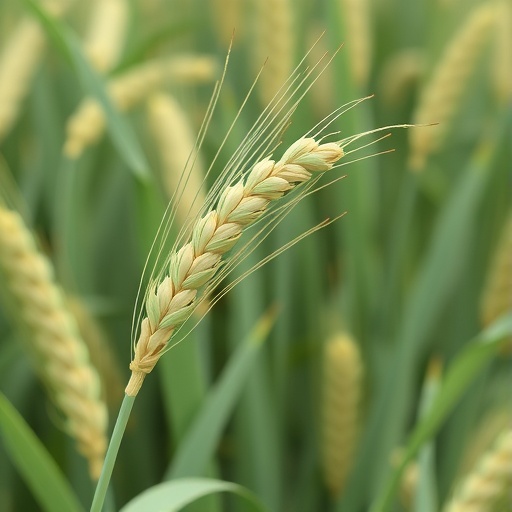
In the context of escalating global population pressures and the urgent need for sustainable food production, wheat remains one of the world’s most vital staple crops, supplying calories to nearly 40% of the human population. While traditional breeding efforts have predominantly focused on increasing yield through improved agronomic practices and genetic height reduction, recent groundbreaking research pushes the boundaries of our understanding by dissecting the complex interplay between genetic factors and wheat plant architecture. Among the genetic tools at the forefront stands the Green Revolution semi-dwarfing gene Rht-D1b, historically celebrated for its height-reducing effects that confer lodging resistance. However, new research unveils a richer, pleiotropic role for Rht-D1b that extends well beyond dwarfism, fundamentally reshaping how scientists and breeders conceive wheat canopy and yield optimization.
Conducted by Dr. Han Zhang and his team at Shandong Agricultural University in China, this pioneering study probes the multifaceted influence of the Rht-D1b allele on wheat’s morphological traits, focusing intently on tiller angle and canopy architecture. These traits directly impact light interception efficiency, spatial plant competition, and ultimately grain yield—factors critical to maximizing productivity under high-density planting conditions. Unlike the conventional appreciation of Rht-D1b as a mere height reducer, the researchers reveal that it is also a central regulator orchestrating tiller number and tiller angle, pivotal determinants in the structuring of plant canopies.
The experimental approach employed a series of detailed physiological and molecular assays, complemented by gene expression profiling and plant phenotyping under controlled and field conditions. Through these analyses, the researchers discovered that Rht-D1b modulates shoot gravitropism by altering lateral auxin transport pathways—a key hormone-mediated signal directing plant growth orientation. Alterations in the expression levels of auxin signaling and transport genes were observed, highlighting a sophisticated genetic network by which Rht-D1b influences both plant stature and lateral branching angles.
An intriguing aspect of their findings is the dosage-dependency of Rht-D1b’s effects: moderate expression levels conferred the optimal balance between reduced height and an ideal tiller angle, enhancing photosynthetic light capture and ultimately translating into increased grain yield per plant. Conversely, both null mutations and excessive overexpression had deleterious consequences, underscoring the necessity of a finely tuned gene expression balance to harness the full agronomic potential of Rht-D1b.
This nuanced understanding challenges long-standing breeding paradigms that have primarily leveraged Rht genes for their dwarfing property alone. The revelation that Rht-D1b acts as a master genetic ‘architect’ of canopy structure opens a new horizon for wheat improvement, where breeders can manipulate gene alleles for desired tiller angles and densities to maximize sunlight interception and resource use efficiency. The combinatorial selection of specific Rht alleles now emerges as a strategic approach to optimize not only lodging resistance but also enhance yield potential and environmental adaptability.
The implications of this study are profound for the future of wheat cultivation and global food security. By engineering wheat varieties with optimized canopy architecture through precise manipulation of Rht-D1b, agricultural systems can achieve higher productivity on the same land area, mitigating the need for expanded cultivation and reducing ecological footprints. Moreover, these genetic innovations promise enhanced resilience to environmental stresses, contributing to more stable yields in the face of climate variability.
Mechanistically, the team’s elucidation of Rht-D1b’s role in auxin transport modulation links classical Green Revolution genetics with contemporary plant hormone biology and developmental genetics. This intersection offers exciting avenues for the development of molecular markers and biotechnological tools to accelerate breeding cycles. Targeting expression regulators upstream or downstream of Rht-D1b could allow breeders an unprecedented level of control over complex traits such as canopy structure and resource allocation efficiency.
Furthermore, the researchers emphasize that their findings extend beyond fundamental plant science, offering a tangible framework for translational research and practical breeding programs. The integration of Rht-D1b dosage strategies into molecular breeding pipelines equips crop developers with the means to tailor wheat phenotypes precisely to agroecological zones and farming practices, optimizing yield and sustainability simultaneously.
By reconceptualizing the role of Green Revolution alleles through the lens of pleiotropy, this study also sparks broader considerations about the multifaceted genetic controls underpinning crop adaptation and performance. Rather than viewing key genes solely through the narrow lens of a single trait effect, the pleiotropic influences uncovered here compel breeders and scientists to adopt holistic, systems biology perspectives when evaluating breeding targets.
In conclusion, the work spearheaded by Dr. Han Zhang and colleagues represents a landmark advancement in wheat genetics, reframing Rht-D1b from a simple dwarfing allele to a complex genetic orchestrator of plant architecture. This breakthrough integrates molecular insights with agronomic relevance, setting the stage for next-generation wheat cultivars optimized for maximal grain yield, canopy efficiency, and sustainability. As the global demand for staple crops continues to rise, innovations such as these will be essential pillars in ensuring resilient global food systems for the future.
News Publication Date: December 09, 2025
Web References: https://www.sciencedirect.com/science/article/pii/S2214514125002892?via%3Dihub
References: 10.1016/j.cj.2025.11.010
Cite Scienmag News
Juliet Wilcox. (February 11, 2026). Shandong Agricultural University Scientists Redefine Green Revolution Genes to Enhance Wheat Yield Potential. Scienmag. https://scienmag.com/shandong-agricultural-university-scientists-redefine-green-revolution-genes-to-enhance-wheat-yield-potential/
Juliet Wilcox. "Shandong Agricultural University Scientists Redefine Green Revolution Genes to Enhance Wheat Yield Potential." Scienmag, 11 February 2026, https://scienmag.com/shandong-agricultural-university-scientists-redefine-green-revolution-genes-to-enhance-wheat-yield-potential/. Accessed 3 September 2026.
Juliet Wilcox. "Shandong Agricultural University Scientists Redefine Green Revolution Genes to Enhance Wheat Yield Potential." Scienmag. February 11, 2026. https://scienmag.com/shandong-agricultural-university-scientists-redefine-green-revolution-genes-to-enhance-wheat-yield-potential/


