


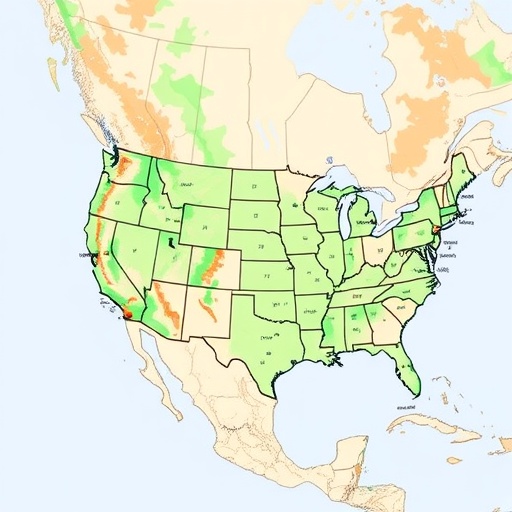
In a groundbreaking study set to redefine our understanding of avian influenza spread, researchers have launched an unprecedented investigation into the transmission risks of the highly pathogenic avian influenza H5 (HPAI-H5) across wild bird migratory flyways in the United States. As migratory birds traverse continents, these flyways serve as vital ecological highways, but also as potential conduits for viral dissemination with profound implications for both wildlife conservation and public health. The insights revealed by this research are poised to inform strategies that could mitigate future outbreaks and bolster biosecurity measures nationwide.
The study delves into the intricate dynamics underlying HPAI-H5 virus transmission, a strain notorious for its devastating impacts on poultry industries and wild bird populations alike. By employing sophisticated epidemiological models coupled with comprehensive migratory tracking data, the researchers have mapped not only the geographical routes of migration but also the temporal patterns of virus exposure and movement. This fusion of ecological and virological data offers a nuanced perspective into how migratory behavior influences viral spread over vast distances and diverse ecosystems.
Central to the investigation is the concept of migratory flyways: the well-established corridors used annually by millions of birds for seasonal movements. In the United States, four principal flyways—the Atlantic, Mississippi, Central, and Pacific—form the backbone of avian migration. These pathways intersect numerous habitats, providing a complex network through which the HPAI-H5 virus can potentially propagate. The study critically assesses how the interaction of bird populations along these flyways modulates the risk of virus transmission both locally and across regions separated by thousands of kilometers.
The research team utilized an integrative approach, harnessing satellite telemetry and banding data to trace the migratory trajectories of key wild bird species most susceptible to carrying HPAI-H5. This empirical data was then fed into spatially explicit transmission models, which incorporate variables such as bird density, interspecies contact rates, and environmental factors influencing virus survival. Such detailed modeling revealed hotspots of heightened transmission risk, often coinciding with critical stopover sites where large aggregations of birds gather to rest and refuel.
Moreover, the study highlights the importance of seasonality in shaping transmission dynamics. Peak migration periods corresponded with spikes in virus detection rates, underscoring the temporal windows during which surveillance and intervention efforts could be most effective. The authors emphasize that understanding the timing of migration events is paramount for anticipating and preventing outbreaks, which often occur when infected birds introduce the virus to naïve populations in new locations.
Crucially, the investigation addresses the role of intercontinental migratory exchanges in the global spread of HPAI-H5. Many of the species examined undertake lengthy transoceanic journeys, potentially bridging viral populations across continents. This aspect underscores the necessity for coordinated international surveillance and data sharing to track emergent strains and preempt pandemic risks. The findings advocate for enhanced cross-border collaboration to monitor and mitigate the threats posed by migratory birds at an ecological scale.
Beyond the ecological and epidemiological insights, the study also explores the implications for agricultural biosecurity. The proximity of migratory flyways to poultry operations presents a persistent risk of spillover events, where wild birds transmit HPAI-H5 to domestic flocks. The models developed in this research allow for risk stratification at regional levels, guiding targeted biosecurity enhancements and rapid response strategies to prevent economic losses. This approach exemplifies the intersection of wildlife ecology and public health policy.
The researchers further interrogated environmental drivers influencing viral persistence and transmission efficiency along flyways. Factors such as temperature, humidity, and habitat type emerged as critical determinants of how long the virus remains viable in the environment, thus affecting the probability of contagion. Such granular environmental data integration marks a significant advance in predictive modeling of avian influenza risk, potentially transforming preventative measures from reactive to proactive.
In addition to revealing transmission patterns, the study presents a comprehensive risk assessment framework adaptable to other zoonotic diseases associated with migratory species. This methodological innovation broadens the utility of the research, offering a template for monitoring future emerging infectious diseases that rely on animal vectors. The fusion of ecological tracking with pathogen genomics and environmental analytics positions this study at the forefront of One Health research paradigms.
One of the most striking revelations concerns the role of specific species that act as super-spreaders within these migratory networks. By identifying these key taxa, the study prioritizes surveillance efforts towards species whose migratory habits and population connectivity amplify viral dissemination risks. This targeted focus could improve the efficiency of limited resources available for ongoing field monitoring and viral sampling programs.
The collaborative nature of this research, integrating virologists, ecologists, data scientists, and epidemiologists from multiple institutions, reflects the multidisciplinary approach required to tackle complex disease ecology challenges. Open access publication in a high-impact journal ensures that these critical findings are widely disseminated among scientific, governmental, and conservation communities, maximizing their impact on public health strategies.
Overall, this seminal study not only advances our understanding of HPAI-H5 transmission dynamics along U.S. migratory flyways but also sets a new standard for combining cutting-edge tracking technologies with sophisticated epidemiological modeling. As migratory birds continue to navigate vast distances, their role in spreading infectious diseases demands ongoing vigilance, informed by rigorous science such as presented here.
With the threat of emerging avian influenza strains ever-present, this research underpins the urgency for integrating wildlife disease surveillance into broader biosurveillance frameworks. It highlights the critical role of migratory birds in the eco-epidemiology of HPAI-H5 and points towards adaptive management strategies that could mitigate risks at the nexus of wildlife, agriculture, and human health. Ultimately, this work contributes to a more resilient system capable of anticipating and curbing outbreaks before they escalate into crises.
By elucidating the routes and mechanisms of HPAI-H5 spread, the study also lays the groundwork for future vaccine development and deployment strategies, potentially aimed at wildlife reservoirs. Understanding transmission corridors enables targeted intervention points that could disrupt the viral lifecycle and reduce infection pressure within both wild and domestic populations, a revolutionary step in controlling a historically challenging virus.
This research demonstrates the power of synthetic data analysis and the integration of technological advances such as AI-driven migration prediction models, offering a blueprint for next-generation epidemiological forecasting. As global environmental changes alter migratory patterns, continuous refinement of these models will be essential to maintain their predictive accuracy and ensure timely responses to evolving disease threats.
In conclusion, as the world grapples with the interconnectedness of ecosystems and health, studies like this underscore the complexity and critical importance of monitoring wildlife diseases along migratory pathways. The comprehensive assessment of HPAI-H5 transmission risk across U.S. migratory flyways represents a major scientific achievement, heralding a future in which improved surveillance and informed interventions can safeguard both biodiversity and human interests from the devastation of avian influenza.
Cite Scienmag News
Kristina Jarvis. (February 10, 2026). Evaluating HPAI-H5 Spread Along US Bird Flyways. Scienmag. https://scienmag.com/evaluating-hpai-h5-spread-along-us-bird-flyways/
Kristina Jarvis. "Evaluating HPAI-H5 Spread Along US Bird Flyways." Scienmag, 10 February 2026, https://scienmag.com/evaluating-hpai-h5-spread-along-us-bird-flyways/. Accessed 5 September 2026.
Kristina Jarvis. "Evaluating HPAI-H5 Spread Along US Bird Flyways." Scienmag. February 10, 2026. https://scienmag.com/evaluating-hpai-h5-spread-along-us-bird-flyways/


