


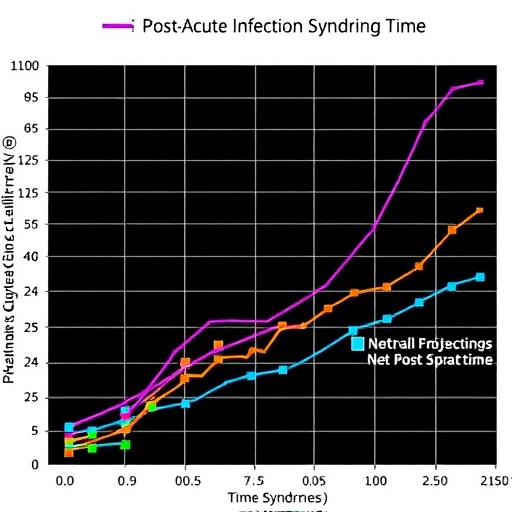
In a groundbreaking advancement poised to reshape how scientists understand post-acute infection syndromes (PAIS), researchers Gusinow, Górska, Canziani, and colleagues have introduced a sophisticated statistical approach known as latent transition analysis (LTA) to dissect the longitudinal patterns inherent in these complex conditions. Published in Nature Communications in 2026, this study harnesses the power of LTA to untangle the intricate temporal dynamics of patients suffering from lingering symptoms after acute infections, offering a transformative lens to both clinicians and epidemiologists confronting these enigmatic syndromes.
Post-acute infection syndromes, encompassing a wide array of debilitating symptoms that persist or emerge following the resolution of an initial infection, represent one of the most pressing medical challenges of the 21st century. Despite increasing recognition, understanding the heterogeneous trajectories patients experience over time has remained elusive, largely due to the limitations of traditional analytical frameworks which often fail to capture the fluidity and variability inherent in symptom progression. This novel application of LTA offers a paradigm shift by enabling researchers to characterize latent subgroups within the patient population and map transitions between disease states across multiple time points.
At its core, latent transition analysis is a longitudinal extension of latent class analysis, allowing for the identification of distinct unobservable (latent) subpopulations based on observed symptom patterns. Unlike conventional methods that consider symptom measurements at isolated time points, LTA dynamically models how individuals move between these latent classes over the course of disease progression. This approach facilitates the investigation of temporal stability or variability within symptom clusters, elucidating whether certain patient profiles are transient or enduring and shedding light on prognostic factors influencing these trajectories.
The research team applied LTA to longitudinal datasets derived from cohorts of individuals afflicted by various post-acute infection syndromes, including those following viral, bacterial, and other infectious etiologies. By integrating symptom severity scores, clinical biomarkers, and patient-reported outcomes collected at multiple post-acute phases, they were able to detect latent states representing distinct clinical phenotypes. Crucially, the analysis enabled quantification of transition probabilities, offering unprecedented insights into the likelihood of patients improving, deteriorating, or stabilizing within defined symptom clusters over time.
One of the key revelations from this work is the demonstration of heterogeneity not only in symptom expression but also in disease evolution. While some patients exhibited persistent symptoms clustered in fatigue and cognitive impairment domains, others transitioned towards phenotypes typified by cardiopulmonary complaints or musculoskeletal pain. This heterogeneity challenges one-size-fits-all treatment paradigms and underscores the necessity for personalized therapeutic interventions guided by dynamic phenotyping rather than static diagnostic categories.
From a methodological perspective, the study rigorously validates the application of LTA in biomedical contexts, addressing critical considerations such as model selection criteria, handling of missing data, and incorporation of covariates that may influence latent class membership or transition dynamics. The authors employed maximum likelihood estimation techniques optimized for longitudinal latent variable modeling, ensuring robustness and statistical power despite variable follow-up intervals and measurement noise. This methodological rigor affords confidence in the reproducibility and generalizability of the findings across diverse patient populations.
Moreover, the integration of biomarkers alongside symptomatology within the LTA framework marks a significant stride toward mechanistic understanding. By correlating transitions between latent classes with changes in immunological markers and inflammatory profiles, the analysis presents compelling evidence linking symptom clusters to underlying biological processes. For instance, shifts toward symptom states dominated by fatigue and malaise were associated with persistent immune activation signatures, suggesting that immune dysregulation plays a pivotal role in the perpetuation of certain PAIS phenotypes.
The temporal resolution afforded by LTA also offers potential utility in clinical trial design and outcome evaluation. Traditional endpoints, often assessed at isolated time points, may fail to capture the nuanced trajectory of symptom changes. In contrast, modeling transitions between latent states allows for the identification of critical windows wherein interventions may be most efficacious and for the development of dynamic risk stratification tools personalized to patient trajectories. Such data-driven insights could revolutionize therapeutic strategies and enhance the precision of clinical decision-making.
Furthermore, this analytical approach lends itself well to integration with emerging technologies such as digital health monitoring and remote symptom tracking. Continuous or frequent data streams could be leveraged to update latent state membership in near real-time, enabling timely interventions and adaptive treatment modifications. The seamless fusion of wearable-generated data with sophisticated statistical modeling stands to redefine disease monitoring paradigms and optimize patient outcomes in PAIS and beyond.
The impact of this study extends beyond its immediate clinical implications. By laying down a robust analytical framework, Gusinow and colleagues have opened avenues for applying latent transition analysis to other complex longitudinal phenomena in medicine, such as neurodegenerative diseases, psychiatric conditions, and chronic inflammatory disorders. The versatility of the approach invites interdisciplinary collaborations between statisticians, clinicians, and data scientists aimed at unraveling the temporal complexities of myriad chronic conditions.
This work also highlights the vital role of interdisciplinary methodologies in tackling modern biomedical challenges. The synergy between advanced statistical techniques and clinical epidemiology demonstrated here exemplifies how data science innovations can catalyze breakthroughs in our understanding of disease trajectories and heterogeneity. As biomedical datasets grow in size and complexity, such integrative approaches will be indispensable in translating data into actionable knowledge.
In summation, the application of latent transition analysis to the longitudinal study of post-acute infection syndromes stands as a landmark achievement, offering a granular and dynamic characterization of symptom trajectories that defy simplistic classification. By unveiling the probabilistic pathways through which patients transition among diverse symptom states, this research provides a foundation for precision medicine approaches tailored to the unfolding course of disease rather than static snapshots. It heralds a new era in the study and management of post-acute infections, with implications reverberating throughout clinical research and patient care landscapes.
As the medical community continues to grapple with the burgeoning burden of long-term post-infectious sequelae—exacerbated by pandemics and emerging pathogens—the tools and insights pioneered by Gusinow et al. are timely and invaluable. Their work empowers clinicians and researchers to anticipate disease evolution, identify high-risk individuals, and optimize interventions in a scientifically rigorous and nuanced manner. The ripple effects of this study will likely influence future guidelines, therapeutic development, and patient monitoring protocols, rendering latent transition analysis an indispensable instrument in the epidemiological toolkit.
Looking forward, further research expanding upon this foundation could integrate genetic, environmental, and psychosocial variables within the latent transition models, enriching the multidimensional portrait of post-acute infection syndromes. Coupling LTA with machine learning techniques may uncover yet more complex latent structures and predictive patterns, advancing a more holistic and mechanistic understanding of these multifaceted conditions.
In essence, this research presents latent transition analysis not merely as a statistical novelty but as a transformative analytic paradigm enabling the decoding of the evolving landscapes of chronic post-infectious illnesses. Its potential to refine classification systems, personalize care, and fuel mechanistic hypotheses positions it at the forefront of contemporary biomedical research innovation.
Cite Scienmag News
Kristina Jarvis. (February 10, 2026). Tracking Post-Acute Infection Syndromes Over Time. Scienmag. https://scienmag.com/tracking-post-acute-infection-syndromes-over-time/
Kristina Jarvis. "Tracking Post-Acute Infection Syndromes Over Time." Scienmag, 10 February 2026, https://scienmag.com/tracking-post-acute-infection-syndromes-over-time/. Accessed 4 September 2026.
Kristina Jarvis. "Tracking Post-Acute Infection Syndromes Over Time." Scienmag. February 10, 2026. https://scienmag.com/tracking-post-acute-infection-syndromes-over-time/


