


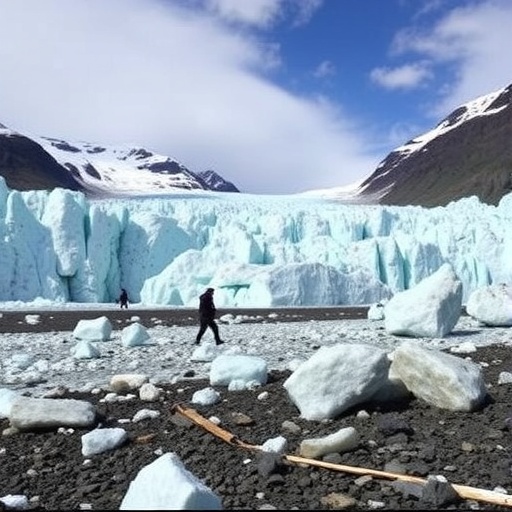
As glaciers worldwide continue to recede at alarming rates, propelled by the accelerating impacts of climate change, a paradox arises within the realm of tourism: the very draw of these majestic ice formations simultaneously fosters economic vitality and ecological vulnerability. A recently published article in Nature Climate Change by Emmanuel Salim and colleagues from the University of Lausanne tackles this complex and urgent dilemma, articulating the multidimensional repercussions of glacier tourism and advocating for integrative strategies that harmonize conservation, cultural resonance, and social equity.
Glaciers have captivated human imagination since the 18th century, enthralling naturalists, mountaineers, and travelers alike with their sublime grandeur and the crucial environmental insights they harbor. The present era, however, witnesses unprecedented rates of glacial melting, a phenomenon extensively publicized in global media, which has paradoxically galvanized a surge in tourism. Annually, over fourteen million visitors are drawn to iconic glacial sites — propelled by fascination, scientific inquiry, and a profound sense of ecological mourning. This influx generates substantial economic opportunities but imposes intensified strain on fragile mountain ecosystems, which are already reeling from climatic disruptions.
In their article, the research team led by Emmanuel Salim, an associate researcher at UNIL’s Institute of Geography and Sustainability, scrutinizes the cultural and commercial dynamics shaping glacier tourism. A central concern outlined is the proliferation of maladaptation strategies—tourism or policy responses that inadvertently exacerbate the vulnerabilities they intend to mitigate. These strategies, although often well-meaning, fail to engage with the ecological narratives or the socio-political realities of affected communities, resulting in detrimental outcomes for biodiversity, water resources, and local livelihoods.
One of the pivotal phenomena discussed is “last-chance” tourism, a frenetic rush to experience glaciers before their disappearance. This phenomenon instigates infrastructural developments such as new walkways and artificial coverings designed to preserve ice surfaces, alongside novel tourist offerings like helicopter overflights. While economically motivated, these interventions neglect their ecological footprints and often disregard critical issues such as local water security and community safety. Salim emphasizes that regions including Alaska, Greenland, and Antarctica exemplify these maladaptive practices, where economic incentives overshadow long-term conservation goals and educational imperatives.
Alongside economic drivers, glacier tourism also assumes a cultural and political dimension. The emergence of “dark tourism” reflects a growing recognition of glaciers as symbols of environmental crisis and catalysts for ecological mourning. Across several countries—Switzerland, France, Nepal, Iceland—citizen-led commemorative events, ranging from funeral ceremonies to sporting events like the Glorious Glacier Ride, manifest collective grief and awareness. Such cultural practices not only commemorate what is being lost but also mobilize public sentiment towards climate justice. For example, Switzerland’s Glacier Initiative embedded within its legal framework the objectives of the Paris Agreement, underscoring how glaciers serve as political icons with tangible policy ramifications.
Scientifically, the article advocates for a nuanced evaluation of tourism and cultural adaptation strategies concerning their impacts on ecosystem integrity and social dynamics. It underscores the necessity of interdisciplinary research frameworks that integrate principles of social justice, environmental stewardship, and governance. Understanding public motivations behind glacial visits and rituals is crucial for crafting responsible, sustainable tourism models that advance environmental literacy and encourage proactive behavioral change. This includes assessing how revenue from glacier tourism is distributed and ensuring local communities have equitable access to freshwater resources and economic benefits.
The study highlights the imperative to anticipate and manage newly exposed deglaciated terrains, which will multiply as ice volumes potentially diminish by 60% by the end of the century. Glaciers, as dynamic natural archives, profoundly influence hydrological regimes and biodiversity; their retreat opens novel landscapes vulnerable to erosion, invasive species, and human encroachment. Establishing protective protocols for these nascent ecosystems is vital, demanding collaborative governance between scientists, policymakers, and local stakeholders.
Emmanuel Salim and his team pose a critical question: Can the disappearance of glaciers transcend symbolic mourning and spur a systemic transformation towards collective environmental responsibility? They explore the psychological dimensions of glacier loss—how sadness, anxiety, and curiosity can be channeled into political will and societal mobilization. This underscores a need for fostering meaningful engagement that moves beyond aesthetic appreciation to embrace stewardship and activism.
Furthermore, the article accentuates the risks inherent in overlooking the socio-economic heterogeneity of glacier-affected communities. Disparities in economic dependence on tourism, vulnerability to water scarcity, and political agency mean that uniform policy prescriptions are inadequate. Adaptive governance models must be context-specific, informed by local knowledge systems, and guided by principles of equity and participation.
The interface of glacier tourism and climate change also raises profound ethical dilemmas. Encouraging visitation to fragile environments threatened by human-induced warming risks turning genuine engagement into voyeuristic consumption. To counter this, efforts must prioritize interpretative frameworks that communicate the urgency of climate crises while empowering visitors to contribute positively, for example, by supporting conservation initiatives or reducing their environmental footprints during travel.
In conclusion, the research foregrounds glaciers as multifaceted symbols embedded within ecological, cultural, and economic matrices. Addressing the paradoxical surge of glacier tourism demands cross-disciplinary approaches that reconcile economic development with urgent environmental conservation and social justice imperatives. As glacier landscapes evolve rapidly under climatic pressures, their fate constitutes a poignant barometer of humanity’s capacity to adapt ethically and sustainably in the face of planetary change.
News Publication Date: 2026
Web References: Not provided
References:
E. Salim, A. Varnajot, M. Carey, K. Gagné, G. Hoogendoorn, C. Howe, M. Huss, C. J. Lemieux, E. J. Stewart, Melting glaciers as symbols of tourism paradoxes, Nature Climate Change, 2026
Cite Scienmag News
Courtney Benton. (February 9, 2026). Melting Glaciers Reveal the Paradoxes of Tourism: A Scientific Exploration. Scienmag. https://scienmag.com/melting-glaciers-reveal-the-paradoxes-of-tourism-a-scientific-exploration/
Courtney Benton. "Melting Glaciers Reveal the Paradoxes of Tourism: A Scientific Exploration." Scienmag, 9 February 2026, https://scienmag.com/melting-glaciers-reveal-the-paradoxes-of-tourism-a-scientific-exploration/. Accessed 3 September 2026.
Courtney Benton. "Melting Glaciers Reveal the Paradoxes of Tourism: A Scientific Exploration." Scienmag. February 9, 2026. https://scienmag.com/melting-glaciers-reveal-the-paradoxes-of-tourism-a-scientific-exploration/


