

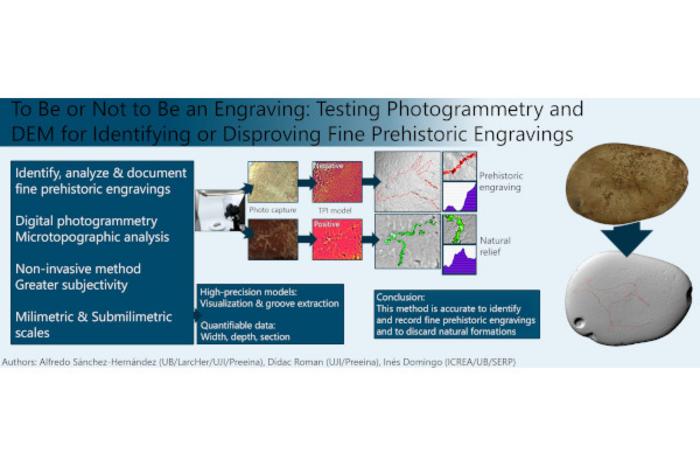
A pioneering methodology developed by a collaborative team of archaeologists from Universitat Jaume I, the University of Barcelona, and the Catalan Institution for Research and Advanced Studies (ICREA) is transforming our understanding of Late Paleolithic portable art. This innovative approach facilitates an unprecedented level of detail, precision, and objectivity in the analysis of prehistoric engravings, revolutionizing the way archaeologists interpret these delicate and often elusive artistic expressions. By re-examining artifacts from Matutano Cave, a pivotal Late Paleolithic site in the Iberian Mediterranean, the researchers demonstrated that many previously assumed human-made engravings are, in fact, natural surface formations—reshaping long-held assumptions in Paleolithic art studies.
Late Paleolithic art is notoriously difficult to analyze due to its characteristics—fine, faint engravings often obscured by time-induced taphonomic changes, natural surface irregularities, and ambiguous morphological features. These complications have historically challenged experts trying to distinguish between intentional human engravings and natural markings. The newly introduced methodology harnesses advanced photogrammetry coupled with microtopographic analysis, allowing an exceptionally accurate examination of these fragile remnants. This approach, recently detailed in the Journal of Archaeological Science: Reports, marks a pivotal shift towards quantifiable and replicable surface analysis.
At the heart of this methodology lies an integrated high-precision recording protocol that synergizes close-range photogrammetry, digital elevation models (DEM), and geographic information system (GIS) based surface analytics. This suite of techniques enables the detection and quantification of submillimetric engravings by precisely capturing groove morphologies and minute variations in depth, width, and cross-sectional profile. Such detailed characterization goes beyond traditional qualitative descriptions, offering an objective and measurable dataset that strengthens interpretative frameworks and limits subjective bias, a notable advancement in archaeological surface analysis.
To ensure reliability, the research team subjected their methodology to rigorous validation through a structured recording program. This program established a consistent reference framework for the interpretation of archaeological markings, enabling confident differentiations between anthropogenic engravings and natural rock formations. After validating the approach, the team applied it to three emblematic portable art pieces from Matutano Cave, one of the Iberian Peninsula’s most extensive Late Paleolithic engraved assemblages. This application yielded refined tracings for two objects, while conclusively determining that a third was devoid of human-made engravings, confirming the observed marks as natural geological reliefs rather than prehistoric art.
The implications of this study extend well beyond the site itself. The researchers emphasize the challenge that subtle execution styles of European Late Paleolithic rock and portable art, combined with post-depositional surface alterations, pose for accurate documentation and interpretation. Alfredo Sánchez-Hernández, Dídac Román, and Inés Domingo, the principal archaeologists behind the project, highlight how their method’s replicable framework can be applied globally to reevaluate engraved assemblages that previously suffered from limited and subjective analytical techniques. This represents a significant leap towards more consistent and comprehensive understandings of prehistoric artistic and technological practices.
Furthermore, this methodology advances our comprehension of ancient engraving techniques by facilitating the identification of intentional variations in engraving pressure, motion, and tool application. It reveals intricate details such as anatomical, material, and stylistic choices made by prehistoric artists. These insights enable researchers to reconstruct the embodied artistic behaviors and technological skills involved in creating portable art, offering a nuanced perspective on the cognitive and cultural capacities of Paleolithic humans.
Beyond archaeological interpretation, the approach offers crucial benefits for the conservation and accessibility of fragile prehistoric portable art. Through high-resolution 3D documentation creating digital twins of the artifacts, researchers can perform detailed examinations without physically handling the original pieces. This minimizes the risk of damage, a paramount concern for often-irreplaceable heritage objects. Additionally, it facilitates remote assessments by archaeological professionals, expanding access without compromising artifact integrity.
The affordability and accessibility of this low-cost technological model also make it a practical option for a broad range of research institutions lacking extensive funding or specialized equipment. By democratizing advanced surface analysis, this technique could become a standard practice for prehistorical engraving research worldwide, fostering collaboration and reproducibility across archaeological disciplines.
The team underscores the combined power of experimental validation and archaeological application, emphasizing how their integrated methodology bridges the gap between qualitative observations and quantitative surface data analysis with unprecedented precision. This synergy advances our grasp of prehistoric engraving methods, illuminating artistic behaviors that were once shrouded in ambiguity due to methodological limitations.
In summary, this groundbreaking study published in the Journal of Archaeological Science: Reports heralds a new era of methodological rigor and technological innovation for the study of Late Paleolithic portable art. By unveiling the true nature of enigmatic engravings from Matutano Cave and providing a replicable tool for researchers everywhere, it reshapes our understanding of human artistic expression’s deep past and preserves these fragile testimonies for future generations.
This novel technique not only refines archaeological interpretations but also contributes to heritage preservation and scholarly exchange, reflecting how multidisciplinary approaches drive scientific progress. Importantly, it challenges archaeologists to reexamine past discoveries with fresh perspectives and enhanced analytical tools, ultimately rewriting the narrative of prehistoric art in subtle, yet profound ways.
For those seeking to delve deeper into the intricacies of this research, the article titled “To be or not to be an engraving: testing photogrammetry and DEM for identifying or disproving fine prehistoric engravings” offers detailed insights into the methodologies, applications, and findings that are reshaping prehistoric art studies on an international scale.
Subject of Research: Not applicable
Article Title: To be or not to be an engraving: testing photogrammetry and DEM for identifying or disproving fine prehistoric engravings
News Publication Date: 3-Feb-2026
Web References: https://doi.org/10.1016/j.jasrep.2025.105530
Image Credits: UJI-UB-ICREA researchers
Keywords: Late Paleolithic art, portable art, photogrammetry, digital elevation models, microtopography, archaeological methodology, prehistoric engravings, Matutano Cave, surface analysis, 3D documentation, cultural heritage preservation, archaeological interpretation


