


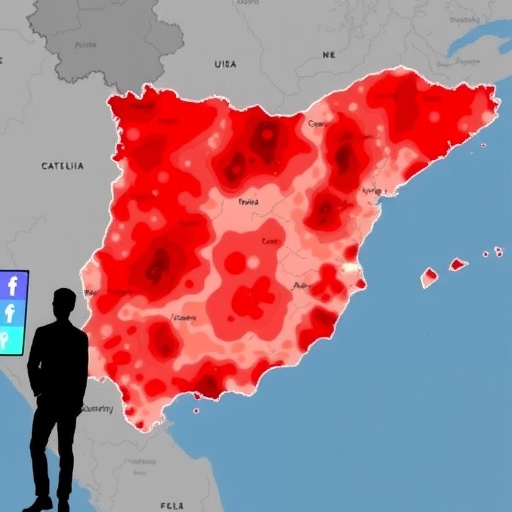
A groundbreaking collaborative study spearheaded by the Germans Trias i Pujol Research Institute (IGTP), in conjunction with AQUALAB, the Public Health Agency of Catalonia, the Meteorological Service of Catalonia, and Fundació Lluita contra les Infeccions, has unveiled a compelling link between climatic conditions, the proliferation of Legionella bacteria in water systems, and the incidence of Legionnaires’ disease in Catalonia. Published in the prestigious journal Water Research, this research underscores how shifting meteorological patterns, influenced by climate change, have profound effects on the colonization of artificial water infrastructures by Legionella, necessitating urgent revisions in public health surveillance and disease prevention strategies.
Legionella, a Gram-negative bacterium naturally residing in freshwater and soil environments, poses serious health risks when it colonizes man-made water systems. These systems—comprising pipework, cooling towers, and ornamental fountains—can harbor the pathogen, which upon aerosolization can be inhaled, causing respiratory infections that escalate to Legionnaires’ disease, a severe form of pneumonia. This pathogen thrives within a temperate water temperature range of 25 to 42 degrees Celsius, conditions becoming increasingly prevalent due to global warming, thus amplifying public health hazards in urban settings.
While prior investigations have often linked climatic variables to Legionnaires’ disease epidemiology, comprehensive data addressing how such meteorological factors directly influence Legionella colonization in artificial water systems have remained scarce. This innovative study distinguishes itself by adopting a holistic, multidisciplinary approach, leveraging routine environmental monitoring data rather than outbreak-driven sampling, thus capturing a more representative picture of the bacterium’s ecology within urban water infrastructures.
Utilizing an extensive dataset consisting of over 32,000 water samples collected across a five-year span from 2018 to 2023—excluding 2020 due to pandemic-related disruptions—and parallel meteorological records and disease notifications, the research team elucidated how variables such as ambient temperature, rainfall, and relative humidity intricately govern the presence and concentration of Legionella in monitored installations. The rigorous statistical analyses integrated environmental science, microbiology, and epidemiology to decode these complex relationships.
The study’s most salient finding is the affirmation that rising ambient temperatures, along with prolonged warm spells, foster conditions conducive to Legionella proliferation. Elevated external heat raises the temperature within cold water systems and cooling towers sufficiently to facilitate bacterial multiplication. As detailed by Elisenda Arqué, the lead author and a doctoral candidate at IGTP, enduring heat episodes not only elevate surrounding air temperatures but also alter the internal thermal microenvironment of water infrastructures, heightening their susceptibility to microbial colonization. Correspondingly, an upsurge in Legionnaires’ disease cases typically follows such thermal anomalies.
Intriguingly, the investigation highlights that cold water systems, conventionally regarded as low-risk reservoirs for Legionella, assume critical threat status during periods of intense heat. According to Sonia Ragull, head of laboratory at AQUALAB, these water systems undergo thermal shifts that transform them into high-risk loci for bacterial growth, a factor previously underappreciated in public health frameworks. This discovery shifts the paradigm on water system risk assessments, demanding a reevaluation of existing sanitary practices.
An alarming trend uncovered by the team is the progressive increase in Legionella-positive samples detected over the study duration, a temporal trajectory mirroring the rise in reported Legionnaires’ disease cases. While many positive detections encompassed low bacterial loads, those indicating high colonization levels correlated strongly with subsequent spikes in human infections, suggesting a dose-response relationship between environmental bacterial density and disease incidence.
From a microbiological standpoint, the researchers observed that within the dominant species Legionella pneumophila, serogroup 1 and serogroups 2-14 appear equally prevalent in environmental samples. This is statistically notable, considering that standard diagnostic assays predominantly identify serogroup 1, potentially resulting in underdiagnosis of disease cases linked to other serogroups. Noemí Párraga, corresponding author and co-leader of the Clinical and Environmental Infectious Diseases Study Group (CEID) at IGTP, emphasizes that modern prevention efforts must evolve beyond mere detection towards anticipating high-risk temporal windows and infrastructural vulnerabilities in an era of climate perturbation.
The implications of these findings extend beyond microbiology to public health infrastructure resilience. Global warming not only impacts natural ecosystems but also destabilizes anthropogenic systems, introducing new challenges for infectious disease prevention. The compelling evidence from Catalonia serves as a clarion call for enhanced surveillance rigor, adaptation of water treatment protocols, and refinement of clinical diagnostic tools to more effectively mitigate Legionnaires’ disease risk under a changing climate.
Looking forward, the authors advocate for extending this research framework to other geographies experiencing analogous climatic shifts and expanding temporal datasets to better capture long-term trends. Moreover, advancing microbial detection technologies and incorporating additional environmental parameters—such as water chemistry, system maintenance practices, and structural characteristics—into predictive models could revolutionize Legionella risk management.
This multifaceted approach, intertwining climatology, environmental microbiology, and epidemiology, holds promise for novel public health interventions. By anticipating climate-related fluctuations in Legionella colonization and disease burden, policymakers can devise dynamic, evidence-based strategies, reducing Legionnaires’ disease incidence. In doing so, such efforts will enhance community health protection amidst the escalating challenges posed by global climate change.
Ultimately, this research imparts a powerful message: the interface between climate change and public health extends to microscopic ecological dynamics within human-managed environments. Addressing these emerging threats demands integrated scientific inquiry and the timely translation of findings into actionable policies, safeguarding populations from insidious risks hidden within seemingly benign infrastructures.
News Publication Date: 9-Jan-2026
Web References:
10.1016/j.watres.2026.125365
Cite Scienmag News
Phoebe Ingram. (February 5, 2026). Extensive Study Examines Climate’s Influence on Legionnaires’ Disease in Catalonia. Scienmag. https://scienmag.com/extensive-study-examines-climates-influence-on-legionnaires-disease-in-catalonia/
Phoebe Ingram. "Extensive Study Examines Climate’s Influence on Legionnaires’ Disease in Catalonia." Scienmag, 5 February 2026, https://scienmag.com/extensive-study-examines-climates-influence-on-legionnaires-disease-in-catalonia/. Accessed 4 September 2026.
Phoebe Ingram. "Extensive Study Examines Climate’s Influence on Legionnaires’ Disease in Catalonia." Scienmag. February 5, 2026. https://scienmag.com/extensive-study-examines-climates-influence-on-legionnaires-disease-in-catalonia/


