


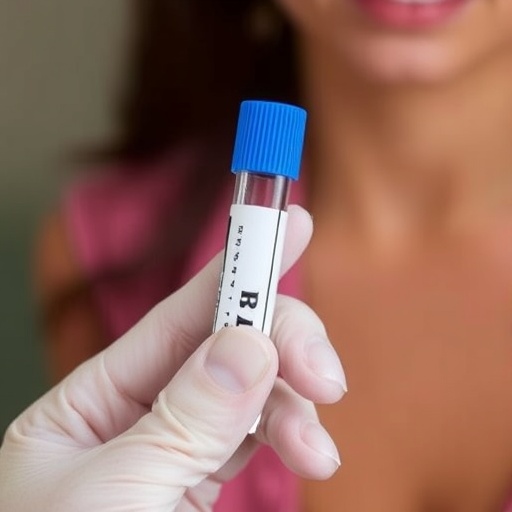
In a groundbreaking study published recently in The BMJ, researchers from China have unveiled compelling evidence supporting the use of menstrual blood as a viable medium for human papillomavirus (HPV) testing, potentially revolutionizing cervical cancer screening protocols. The new method offers a non-invasive, convenient, and potentially more accessible alternative to clinician-obtained cervical samples, fundamentally changing how healthcare professionals could approach early detection of cervical lesions. Given the persistent global challenges surrounding cervical cancer screening uptake, these findings could mark a pivotal shift, especially for populations facing barriers such as stigma, pain apprehensions, or logistical constraints that traditionally limit attendance to clinical appointments.
Cervical cancer, predominantly attributable to persistent infections with high-risk HPV strains, remains a significant cause of morbidity and mortality in women worldwide. Current screening methodologies primarily rely on clinician-collected cervical samples for HPV DNA testing or cytological examination. While effective, clinical screening is often impeded by socio-cultural, psychological, and logistical factors. These challenges have propelled researchers to investigate alternative specimen types that could enable self-sampling and thereby improve screening coverage. Among these, menstrual blood sampling has remained relatively unexplored despite its theoretical advantages, as menstrual blood naturally contains exfoliated cervical and vaginal cells, along with viral particles if present.
The comprehensive observational study conducted between September 2021 and January 2025 enrolled 3,068 women aged 20 to 54 years with regular menstrual cycles from both urban and rural communities in Hubei Province, China. Each participant was tasked with providing three distinct samples: a menstrual blood sample harvested via a specially designed sterile minipad, a clinician-collected cervical specimen that served as the comparator, and an additional cervical sample for laboratory confirmation. This stratified sampling approach allowed for a robust cross-validation of diagnostic accuracy between menstrual blood and traditional cervical specimen testing. Notably, the utilization of a minipad — a sterile cotton strip adhered to the absorbent section of a sanitary pad — provided a practical and hygienic means of collecting menstrual blood for HPV analysis.
Diagnostic accuracy was primarily assessed through metrics such as sensitivity, specificity, positive predictive value (PPV), and negative predictive value (NPV), with a focus on detecting high-grade cervical intraepithelial neoplasia (CIN2+ and CIN3+) — lesions typically requiring clinical intervention. Strikingly, the sensitivity of HPV testing using minipad-collected menstrual blood for CIN2+ detection was 94.7%, closely mirroring the 92.1% sensitivity of clinician-obtained cervical samples. This result underscores the minipad method’s capacity to identify nearly all women with significant cervical lesions, highlighting its reliability as a screening tool. Specificity, albeit slightly lower for menstrual blood samples (89.1%) compared to cervical samples (90.0%), remained sufficiently high, mitigating concerns about excessive false positives.
Equally critical was the examination of predictive values, which offer clinical context on the probability of actual disease presence or absence given test results. The NPV — indicating the likelihood that individuals with negative test results are genuinely disease-free — was almost identical for both methods at 99.9%. This exceptionally high NPV reassures that missed diagnoses are minimized regardless of sampling technique. Meanwhile, the PPV between the two modalities showed no significant disparity (9.9% for menstrual blood vs. 10.4% for cervical samples), suggesting equivalent efficacy in confirming positive HPV statuses that warrant further diagnostic evaluation.
Referral rates to colposcopy, the definitive diagnostic procedure following positive screening outcomes, were also comparable between the two groups. For every CIN2+ lesion detected, the number of referrals was closely aligned: 10.1 from menstrual blood test positives and 9.6 from clinician sample positives. This parity reduces concerns about unwarranted diagnostic procedures stemming from less specific screening methods, affirming the clinical practicability of menstrual blood HPV testing without burdening healthcare resources disproportionately.
This study also incorporated digital health innovations to enhance participant engagement and streamline communication. Leveraging a popular mobile platform, the WeChat-based Early Test app provided participants with seamless access to their test results alongside tailored healthcare guidance. The integration of such e-health tools is pivotal in facilitating widespread adoption and scaling of new screening paradigms, especially in resource-limited settings or regions with limited access to traditional healthcare infrastructure. Digital interfaces foster timely result dissemination and enable prompt patient education, arguably improving follow-up adherence and clinical outcomes.
While the findings are encouraging, the authors rightly caution that the observational design precludes definitive causal interpretations. Multiple confounding factors could influence results, and certain limitations warrant circumspection. For instance, the study population was restricted to women with regular menstrual cycles, potentially limiting generalizability to women with irregular cycling patterns or menopause. Additionally, although high diagnostic concordance was observed, varying HPV assay methodologies and the potential for contamination in menstrual blood samples may affect reproducibility. Further longitudinal studies and randomized trials are necessary to validate these findings across diverse populations and clinical contexts.
Nonetheless, the implications of adopting menstrual blood-based HPV testing are profound. Offering a standardized, non-invasive, and user-friendly sampling method directly addresses major barriers to cervical cancer screening uptake globally. Women could autonomously collect samples in the privacy of their homes, circumventing fear, stigma, and logistical hurdles inherent in clinic-based procedures. By potentially expanding screening accessibility, early detection rates could improve substantially, thereby reducing cervical cancer incidence and associated mortality. Moreover, such innovations may democratize healthcare, empowering women with greater control over their reproductive health.
In summary, this pioneering research provides a robust foundation for considering menstrual blood HPV testing as either an alternative or a replacement to traditional clinician-collected cervical samples in cervical cancer screening frameworks. The high sensitivity and NPV demonstrated by this approach, coupled with its user-friendly nature and digital health integration, position it as a promising strategy to enhance screening participation and efficacy. Healthcare policymakers and clinical guideline developers may soon need to deliberate the inclusion of menstrual blood HPV testing within national screening protocols, potentially heralding a new era of accessible and patient-centric cervical cancer prevention.
As the global healthcare community continues to combat cervical cancer, innovations like menstrual blood-based HPV testing underscore the critical need for adaptive, culturally sensitive, and technologically supported strategies. This study from China exemplifies how blending traditional medical diagnostics with modern self-sampling methodologies and digital platforms can foster impactful public health advances. Future investigations will clarify the long-term clinical outcomes and cost-effectiveness of this approach, but the current evidence strongly indicates a transformative potential for global cervical cancer screening efforts.
Cite Scienmag News
Nathaniel Bowman. (February 5, 2026). Menstrual Blood Testing for HPV Shows Promise as a Reliable Alternative to Cervical Screening. Scienmag. https://scienmag.com/menstrual-blood-testing-for-hpv-shows-promise-as-a-reliable-alternative-to-cervical-screening/
Nathaniel Bowman. "Menstrual Blood Testing for HPV Shows Promise as a Reliable Alternative to Cervical Screening." Scienmag, 5 February 2026, https://scienmag.com/menstrual-blood-testing-for-hpv-shows-promise-as-a-reliable-alternative-to-cervical-screening/. Accessed 5 September 2026.
Nathaniel Bowman. "Menstrual Blood Testing for HPV Shows Promise as a Reliable Alternative to Cervical Screening." Scienmag. February 5, 2026. https://scienmag.com/menstrual-blood-testing-for-hpv-shows-promise-as-a-reliable-alternative-to-cervical-screening/


