


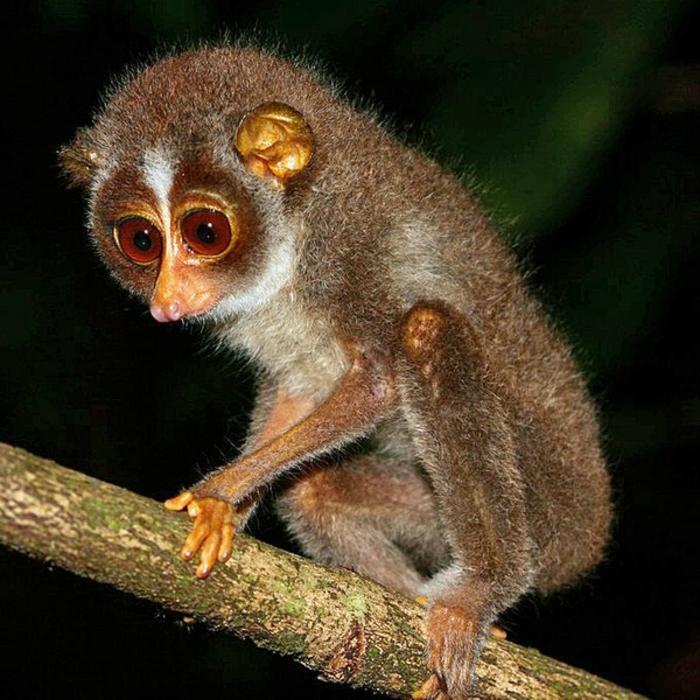
Researchers developed TetrapodTraits – a global database of animals with four feet – which can now be applied for better ecology, evolution and conservation research. Mario Moura of the Universidade Estadual de Campinas, Brazil, and Walter Jetz of Yale University, US, published this work on July 9th in the open-access journal PLOS Biology.

Credit: Alexander Pyron (CC-BY 4.0,
Researchers developed TetrapodTraits – a global database of animals with four feet – which can now be applied for better ecology, evolution and conservation research. Mario Moura of the Universidade Estadual de Campinas, Brazil, and Walter Jetz of Yale University, US, published this work on July 9th in the open-access journal PLOS Biology.
Tetrapods, which include amphibians, reptiles, birds and mammals, are generally well-documented species, which makes them useful as models in global biodiversity studies. However, gaps in our knowledge about many of these species, data inconsistencies and shifting scientific names can lead to biased conclusions about biodiversity. To help address this issue, researchers created TetrapodTraits, a comprehensive database containing more than 33,000 tetrapod species that includes traits such as body size, habitat, ecosystem, geography, when the animal is active and whether it is threatened by humans.
In compiling the database, researchers revealed multiple gaps in our global tetrapod knowledge. For example, animals are more likely to have incomplete data if they have smaller bodies, are active at night, or live in tropical regions. The team filled these gaps by predicting the missing data based on existing observations. They found that using the completed data set changed biodiversity patterns informing which kind of species are commonly found in a region.
This new work reveals the scale of our missing tetrapod data and provides a comprehensive assessment of gaps and biases across different tetrapod groups. This is important because missing and biased data can lead to incorrect conclusions about how an ecosystem is functioning, and a species’ risk of extinction. The researchers conclude that while more data collection is needed, TetrapodTraits can lead to less biased results for studies of tetrapod ecology and conservation.
The authors add, “Our research utilizes artificial intelligence to uncover biases in biodiversity data and offer guidance for enhancing the effectiveness of field research and sampling strategies.”
#####
In your coverage, please use this URL to provide access to the freely available paper in PLOS Biology:
Researchers developed TetrapodTraits – a global database of animals with four feet – which can now be applied for better ecology, evolution and conservation research. Mario Moura of the Universidade Estadual de Campinas, Brazil, and Walter Jetz of Yale University, US, published this work June 25th in the open-access journal PLOS Biology.
Tetrapods, which include amphibians, reptiles, birds and mammals, are generally well documented species, which makes them useful as models in global biodiversity studies. However, gaps in our knowledge about many of these species, data inconsistencies and shifting scientific names can lead to biased conclusions about biodiversity. To help address this issue, researchers created TetrapodTraits, a comprehensive database containing more than 33,000 tetrapod species that includes traits such as body size, habitat, ecosystem, geography, when the animal is active and whether it is threatened by humans.
In compiling the database, researchers revealed multiple gaps in our global tetrapod knowledge. For example, animals are more likely to have incomplete data if they have smaller bodies, are active at night, or live in tropical regions. The team filled these gaps by predicting the missing data based on existing observations. They found that using the completed data set changed biodiversity patterns informing which kind of species are commonly found in a region.
This new work reveals the scale of our missing tetrapod data and provides a comprehensive assessment of gaps and biases across different tetrapod groups. This is important because missing and biased data can lead to incorrect conclusions about how an ecosystem is functioning, and a species’ risk of extinction. The researchers conclude that while more data collection is needed, TetrapodTraits can lead to less biased results for studies of tetrapod ecology and conservation.
The authors add, “Our research utilizes artificial intelligence to uncover biases in biodiversity data and offer guidance for enhancing the effectiveness of field research and sampling strategies.”
#####
In your coverage, please use this URL to provide access to the freely available paper in PLOS Biology:
Citation: Moura MR, Ceron K, Guedes JJM, Chen-Zhao R, Sica YV, Hart J, et al. (2024) A phylogeny-informed characterisation of global tetrapod traits addresses data gaps and biases. PLoS Biol 22(7): e3002658.
Author Countries: United States, Brazil, Portugal, Puerto Rico
Funding: see manuscript
Journal
PLoS Biology
Method of Research
Computational simulation/modeling
Subject of Research
Not applicable
COI Statement
Competing interests: The authors have declared that no competing interests exist.
Cite Scienmag News
Drew Townsend. (July 9, 2024). Global database reveals large gaps in our knowledge of four-footed animals. Scienmag. https://scienmag.com/global-database-reveals-large-gaps-in-our-knowledge-of-four-footed-animals/
Drew Townsend. "Global database reveals large gaps in our knowledge of four-footed animals." Scienmag, 9 July 2024, https://scienmag.com/global-database-reveals-large-gaps-in-our-knowledge-of-four-footed-animals/. Accessed 9 September 2026.
Drew Townsend. "Global database reveals large gaps in our knowledge of four-footed animals." Scienmag. July 9, 2024. https://scienmag.com/global-database-reveals-large-gaps-in-our-knowledge-of-four-footed-animals/

