


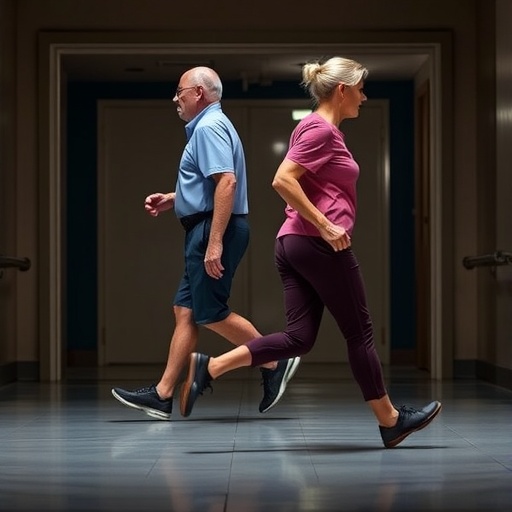
In a groundbreaking study conducted at Wayne State University, a multidisciplinary team of researchers unveiled promising results from an innovative backward walking program tailored for individuals affected by multiple sclerosis (MS). This neurological condition, characterized by progressive deterioration of motor function and balance, poses significant challenges to mobility and quality of life. The team, comprising experts from the Eugene Applebaum College of Pharmacy and Health Sciences, the School of Medicine, the College of Liberal Arts and Sciences, and the Institute of Gerontology, meticulously explored the structural and functional brain changes that accompany an eight-week regimen of backward walking therapy.
The study, published in the January 2026 issue of the Journal of Neurologic Physical Therapy, represents a pioneering approach in physical rehabilitation by emphasizing the unique biomechanical and neurological demands of backward ambulation. Unlike conventional forward walking, backward walking requires different muscle activation patterns and engages neural circuits that are less commonly utilized, potentially fostering neuroplastic adaptations. This paradigm shift offers a novel therapeutic avenue aimed at counteracting MS-related decline by stimulating central nervous system pathways critical for balance and gait stability.
At the helm of this investigation was Dr. Nora Fritz, a renowned professor and director of research within the Department of Health Care Sciences and the Department of Neurology. The research team undertook a rigorous experimental study design, enrolling individuals diagnosed with multiple sclerosis into an intervention featuring both treadmill and overground backward walking exercises conducted over an eight-week period. The primary objective was to assess whether this unconventional locomotor training could elicit measurable improvements in postural control, gait speed, and even induce morphological changes within brain white matter structures.
The results revealed compelling evidence of enhanced postural stability and increased gait velocity in a majority of participants following the training program. These findings underscore the capacity of targeted motor training to facilitate positive physical adaptations despite the neurodegenerative progression of MS. As Dr. Fritz articulated, the backward walking intervention appears to recruit and potentiate neural circuits responsible for balance, offering promising therapeutic benefits that extend beyond traditional rehabilitation paradigms.
A critical highlight of the study is the neuroimaging analysis focusing on white matter integrity within specific brain regions implicated in motor control and balance. Using advanced imaging techniques, the researchers identified structural changes in the body of the corpus callosum, the superior cerebellar peduncle, and the corticospinal tract. These regions play essential roles in interhemispheric communication, cerebellar output, and descending motor pathways respectively. The observed neuroplasticity within these tracts suggests that backward walking may enhance connectivity and functional resilience in circuits compromised by MS.
Despite the encouraging pilot results, the authors emphasized the necessity for larger clinical trials to validate the therapeutic potential and to generalize findings across the heterogeneous MS population. Such expanded studies would clarify the dose-response relationship and help optimize protocols for backward walking therapy, potentially integrating this method into standardized rehabilitation programs. By quantifying both functional and structural brain changes, these trials can also elucidate the mechanisms underpinning motor recovery and balance improvements.
The implications of this research extend beyond symptom management, proposing that targeted physical therapy interventions might actively contribute to neuroprotection and neuroregeneration in MS. The concept that backward walking facilitates neuroplasticity aligns with emerging neuroscientific perspectives that endorse repetitive, task-specific motor training for driving central nervous system changes. This paradigm shift challenges the traditionally static view of MS-related damage and opens new avenues for therapeutic innovation.
Dr. Fritz and her colleagues see backward walking therapy as a strategic countermeasure against the progressive degeneration typical of MS. By addressing the complex interplay between motor control networks and sensory feedback mechanisms, this intervention could mitigate fall risk—a major concern that significantly impairs independence and elevates morbidity among MS patients. The program’s emphasis on balance retraining through dynamic and novel motor patterns is particularly relevant given the multifaceted motor deficits encountered in MS.
Methodologically, the study demonstrated the feasibility of integrating backward walking into clinical practice, leveraging accessible equipment such as treadmills and overground walking pathways. This approach facilitates individualized therapy tailored to patient capacity and progression, enabling scalable application in diverse clinical settings. The collaboration across several disciplines at Wayne State University exemplified the synthesis of clinical expertise, neuroscience, and patient-centered research paradigms.
Notably, the study’s funding by a University Research Grant underscores institutional commitment to advancing MS research and rehabilitative innovation. This support enabled the incorporation of cutting-edge neuroimaging and motor assessment technologies, enhancing the study’s scientific rigor and translational value. The research team comprised a mixture of faculty and students, fostering a rich educational environment conducive to cultivating future experts in neurologic rehabilitation.
In conclusion, the investigation into backward walking training presents a compelling case for its adoption as a novel therapeutic modality for individuals with multiple sclerosis. By enhancing gait performance, postural stability, and promoting adaptive neuroplastic changes in key neural pathways, this intervention holds significant promise for improving outcomes in this challenging disease. Continued efforts to expand the clinical trial and refine treatment protocols will be paramount in transforming these preliminary findings into a widely accepted rehabilitative standard.
News Publication Date: 1-Jan-2026
Web References: http://dx.doi.org/10.1097/NPT.0000000000000529
Cite Scienmag News
Ophelia Keating. (February 3, 2026). Backward Walking Study Reveals Promising New Approach to Enhance Mobility and Reduce Falls in Multiple Sclerosis Patients. Scienmag. https://scienmag.com/backward-walking-study-reveals-promising-new-approach-to-enhance-mobility-and-reduce-falls-in-multiple-sclerosis-patients/
Ophelia Keating. "Backward Walking Study Reveals Promising New Approach to Enhance Mobility and Reduce Falls in Multiple Sclerosis Patients." Scienmag, 3 February 2026, https://scienmag.com/backward-walking-study-reveals-promising-new-approach-to-enhance-mobility-and-reduce-falls-in-multiple-sclerosis-patients/. Accessed 3 September 2026.
Ophelia Keating. "Backward Walking Study Reveals Promising New Approach to Enhance Mobility and Reduce Falls in Multiple Sclerosis Patients." Scienmag. February 3, 2026. https://scienmag.com/backward-walking-study-reveals-promising-new-approach-to-enhance-mobility-and-reduce-falls-in-multiple-sclerosis-patients/


