


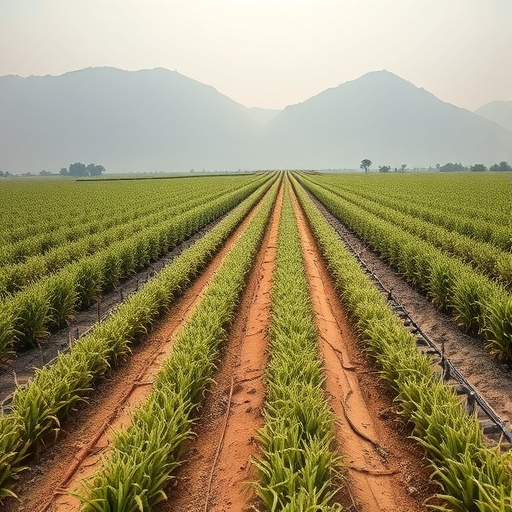
In recent years, the escalating threats posed by climate change have manifested in increasingly frequent and severe extreme weather events. Among these, the concurrence of heatwaves and droughts—termed compound extreme events—stands out for its profound and multifaceted impacts on agriculture. A groundbreaking study led by Guo, S., Zhao, C., Jin, Z., and colleagues delves into this alarming phenomenon with a specific focus on oil crop production across China, revealing how the interplay of temporal and spatial extremes critically undermines crop yields and threatens agricultural sustainability.
China, a global powerhouse in oil crop production, relies heavily on commodities like soybean, peanut, rapeseed, and sunflower. These crops are integral not only to the nation’s food security but also its economy and rural livelihoods. However, the increasing incidence of combined heat and drought stress is exerting compounded pressures on these vital crops. By merging novel datasets and advanced modeling frameworks, the research offers unprecedented insights into how these compound events unfold across different time frames and geographical regions in China, providing a nuanced understanding of their impacts.
This study uniquely considers both temporal and spatial dimensions of compound extreme events, moving beyond conventional analyses that often assess heatwaves and droughts in isolation or at single locations. Through sophisticated climate and crop yield modeling, the researchers unveiled significant heterogeneity in the timing and distribution of these extremes. Some regions experience prolonged periods of concurrent heat and drought, whereas in others, these stressors alternate or overlap intermittently, producing diverse patterns of crop vulnerability.
The temporal clustering of extreme heat and drought episodes appears to exacerbate physiological stress in oil crops far beyond what isolated events induce. Heat stress accelerates crop phenology, reducing the time for grain filling, while drought impairs water uptake and photosynthesis. The study’s findings suggest that the synergy formed by these stresses leads to amplified damages in both crop development stages and yield quantity. Such intricate interactions are often overlooked but are critical for accurate risk assessment and development of adaptive strategies.
Spatial analysis plays a crucial role in highlighting regional disparities in vulnerability. Northern and northeastern China, regions pivotal to soybean and rapeseed cultivation, experience more frequent compound heat-drought extremes in tandem, resulting in markedly greater yield reductions. Conversely, southeastern regions, though exposed to sporadic heat and drought patterns, show variable resilience owing to differences in local climate regimes and irrigation infrastructure. This spatially resolved perspective emphasizes the need for region-specific interventions.
A pivotal revelation from this research is the identification of “hot spots” where temporal-spatial compound extreme events coalesce with pre-existing agronomic and environmental stressors. These interaction zones represent critical vulnerabilities where current agricultural practices may prove insufficient. For example, rainfed agriculture in arid or semi-arid zones faces compounded risks without supplemental water resources, intensifying the yield variability and threatening farmer livelihoods.
The study further underscores the implications of climate variability trends on the frequency and intensity of compound extremes. With projections indicating increasing temperatures and altered precipitation patterns, the authors argue that China’s oil crop sectors will likely confront heightened risks. Future climate scenarios modeled in the research predict not only increases in the duration of drought episodes but also their temporal alignment with heatwaves, amplifying harmful effects.
A particularly innovative aspect of this research is the integration of remote sensing technology and high-resolution reanalysis climate data. This approach enables precise mapping of extreme event occurrences, correlating them with satellite-derived crop biomass and soil moisture indicators. Such cross-validation enhances the robustness of the findings and offers a dynamic tool for real-time monitoring and early warning systems tailored to agricultural stakeholders.
Equally important, social and economic dimensions factor into the research’s broader narrative. The compound stressors not only compromise yields but also impinge on market stability, food prices, and rural incomes. Smallholder farmers, who predominantly cultivate oil crops under rainfed conditions, face heightened risks of crop failure and income loss, exacerbating regional inequalities and posing challenges for poverty alleviation efforts.
In light of the rising threat posed by temporal-spatial compound extremes, the researchers advocate for multifaceted adaptation strategies. These include the development of heat and drought-resilient crop varieties through breeding programs, optimized irrigation scheduling informed by fine-scale climate predictions, and enhanced soil moisture conservation techniques. Policy frameworks must also prioritize investment in infrastructure and extension services that disseminate best practices to vulnerable farming communities.
Furthermore, this pivotal study calls for improved climate risk assessments that explicitly incorporate compound extremes rather than isolated phenomena. Existing agro-meteorological models would benefit from incorporating temporal-spatial dependencies to better predict agricultural outcomes under evolving climate regimes. This foresight is essential for formulating timely responses and mitigating crop yield losses on a national scale.
Crucially, the implications of this research transcend China’s borders, resonating globally as compound heat and drought events threaten oil crop production worldwide. The methodology and insights presented serve as a blueprint enabling other countries to evaluate their vulnerabilities and design regionally tailored mitigation and adaptation strategies, reinforcing global food security against a backdrop of climatic uncertainty.
The collaboration among climate scientists, agronomists, and data specialists exemplifies the multidisciplinary effort required to tackle such complex challenges. By blending cutting-edge climate analytics with agronomic expertise, the research breaks new ground in linking environmental extremes to tangible impacts on agricultural productivity, offering actionable intelligence for stakeholders across sectors.
As climate extremes become more frequent and interconnected, the urgency to understand their synergistic effects intensifies. This study’s robust evidence base enriches scientific understanding and propels urgent conversations among policymakers, farmers, and the wider scientific community. Tackling temporal-spatial compound extreme events is paramount for safeguarding oil crop sectors vital to China’s economy, the health of its population, and the well-being of future generations.
In conclusion, the findings by Guo et al. present a clarion call to prioritize research, policy, and investment aimed at mitigating the intertwined threats of heat and drought. By focusing on the complexity of temporal and spatial dynamics, this work highlights critical vulnerabilities hitherto underappreciated in agricultural risk management frameworks. It sets a new standard for future studies and adaptation approaches, paving the way toward more resilient and sustainable agricultural systems in China and beyond.
Cite Scienmag News
Alan Morgan. (February 3, 2026). Compound Heat-Drought Threatens China’s Oil Crops. Scienmag. https://scienmag.com/compound-heat-drought-threatens-chinas-oil-crops/
Alan Morgan. "Compound Heat-Drought Threatens China’s Oil Crops." Scienmag, 3 February 2026, https://scienmag.com/compound-heat-drought-threatens-chinas-oil-crops/. Accessed 4 September 2026.
Alan Morgan. "Compound Heat-Drought Threatens China’s Oil Crops." Scienmag. February 3, 2026. https://scienmag.com/compound-heat-drought-threatens-chinas-oil-crops/


