


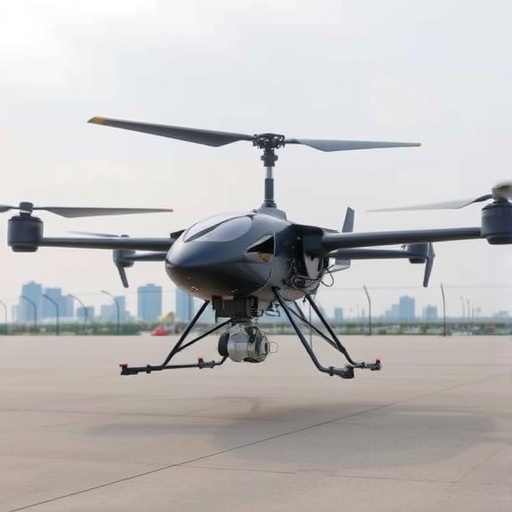
Nanyang Technological University (NTU) in Singapore has recently showcased an impressive technological advancement with the unveiling of the nation’s first locally conceived and constructed full-sized electric vertical take-off and landing (eVTOL) aircraft. This groundbreaking technology demonstrator is not just a significant marker in Singapore’s aerospace landscape; it encapsulates years of diligent research, innovative engineering, and a collaborative spirit among academia, industry, and governmental bodies. For the first time, a prototype of this magnitude, measuring an impressive eight meters in wingspan, stands as a testament to the city-state’s rising capabilities in aerospace research and development.
The eVTOL aircraft, which was a product of over three years of rigorous development, boasts eight lift rotors powered by electric motors designed specifically at NTU. This sophisticated configuration allows the aircraft to achieve vertical take-off and landing capabilities that can accommodate operations from small, confined spaces. This is particularly relevant in urban contexts where traditional aircraft might struggle with operational space limitations. Upon ascent, a proprotor situated at the rear of the aircraft begins to operate, transitioning the aircraft into forward flight similar to conventional airplanes. This dual-functionality encapsulates the ideal blend of helicopter-like maneuverability and the aerodynamic design efficiency often associated with fixed-wing aircraft.
The official unveiling of this innovative aircraft took place during the prestigious Singapore Airshow 2026, presented by NTU’s Vice President (Industry), Professor Lam Khin Yong, who articulated the significance of such a program. He underscored how the eVTOL initiative exemplifies the crucial partnerships formed between higher education institutions, the industry, and government entities, aimed at fostering a sustainable aerospace ecosystem. Through efforts like this, Singapore not only enhances its research and development capacity within the aviation sector but also positions itself as a future leader of aerospace innovation in Southeast Asia.
Prof. Lam pointed out that Singapore has already established itself as a regional leader in maintenance, repair, and overhaul (MRO) activities within the aerospace industry. This new eVTOL initiative represents a critical evolution towards advanced aircraft configurations and integral support technologies. He expressed his gratification at the active participation from industry stakeholders, emphasizing its role in this notable progression for Singapore’s aviation sector. The system integration and testing collaboration, fostered through close partnerships with both local and international entities, is key to the project. This approach is tailored to bring forth innovative solutions suited for intracity and intercity mobility, especially in densely populated urban regions.
Leading the research effort is Dr. James Wang, a highly respected professor within NTU’s School of Mechanical and Aerospace Engineering. Widely regarded as a trailblazer in electric flight technology, Prof. Wang earned the titling from WIRED Magazine as “the Steve Jobs of Rotorcraft”. He boasts an impressive pedigree in aerospace innovation, previously leading the development of the AgustaWestland Project Zero—an all-electric VTOL technology demonstrator unveiled at the renowned Paris Air Show in 2013. Under his guidance, this eVTOL project aims to lay the bedrock for future advancements in Singapore’s aerospace engineering capabilities by pushing the boundaries of what is achievable through technological innovation.
Prof. Wang articulated the ambitious trajectory of this project, highlighting that it integrates essential core technologies required for eVTOL aircraft, marking significant milestones in prototype production and testing. His statement that “if you can dream it, you can build it” encapsulates the spirit of innovation that drives this initiative, while presenting a substantive opportunity for Singapore to emerge as a pivotal player in eVTOL technology across Southeast Asia.
The eVTOL research program at NTU has been operational for about five years, establishing a dedicated research and innovation center helmed by Prof. Wang. This center consolidates expertise in craft design as well as advanced material and systems integration, reflecting a strategic investment aimed at spearheading future advancements in electric flight technologies. This vision is forthcoming, as NTU seeks to develop capabilities that ensure a comprehensive, end-to-end pipeline for eVTOL technology and associated applications.
Professor Louis Phee, NTU’s Vice President (Innovation and Entrepreneurship), stressed the importance of recruiting experts like Prof. Wang to capitalize on the university’s strong background in aerospace engineering. His ambition is to cultivate partnerships with leading aerospace industry entities to deepen Singapore’s knowledge base in advanced eVTOL technologies. By successfully developing a working prototype, the project strives not only to enhance local expertise but also to lay the groundwork for Singapore’s first commercially viable eVTOL operations within its airspace.
The eVTOL project is made possible through the Industry Alignment Fund – Pre-Positioning (IAF-PP) initiative which operates under the Research, Innovation and Enterprise 2025 (RIE2025) framework. The collaboration network is extensive, incorporating both local and international partnerships that fuse diverse expertise from across the aerospace spectrum, including advanced materials, manufacturing processes, and robust testing methodologies.
Collaborating organizations include Eaton Aerospace, Syensqo, Luminator, and Diab, all of which contribute to various aspects such as aircraft systems and material science. Additionally, German institutions like DLR and AVL provide pivotal support in research and flight testing, enriching the technical prowess involved in this venture. Other local partners such as Admiralty and Flare Dynamics lend their expertise in manufacturing, integration, and testing.
Furthermore, the Agency for Science, Technology and Research (ASTAR) and Republic Polytechnic contribute expertise in composite technology and talent development to the initiative. ASTAR’s support is unwavering as they emphasize the significance of developing critical capabilities for Singapore’s long-term vision of aerospace innovation and air mobility. This confluence of various strengths from different institutions elevates the eVTOL project from a mere prototype to a pivotal cornerstone for future aviation advancements in the region.
As the project progresses, stakeholders at NTU are poised to explore the commercialization potential of the developed eVTOL technologies. By continuing to refine the full-sized prototype’s capabilities to accommodate passengers and cargo, NTU embodies a vision that sees Singapore not merely as an aircraft manufacturer but as an innovative leader in the aerospace industry on a global scale. The eVTOL program stands as a beacon of what is attainable through collaborative innovation and sustained investment in technological research.
The endeavor, showcasing Singapore’s commitment to harnessing cutting-edge technology, is just the beginning. It reaffirms a future focused on enhanced mobility solutions that respond to an ever-evolving urban environment. Through significant investments in academic and industry collaboration, the eVTOL project represents a bold leap forward in the quest for advanced air mobility, not just within Singapore but as a part of a larger international movement towards sustainable and efficient transportation. The future of aviation may well lie in the reliability, efficiency, and environmental considerations exemplified by this ambitious project.
Keywords
Electric vertical take-off and landing, eVTOL, aerospace technology, Singapore aviation, NTU, research and development, advanced mobility.
Cite Scienmag News
Grant Pearson. (February 3, 2026). Singapore’s NTU Unveils Homegrown eVTOL Aircraft at Airshow 2026. Scienmag. https://scienmag.com/singapores-ntu-unveils-homegrown-evtol-aircraft-at-airshow-2026/
Grant Pearson. "Singapore’s NTU Unveils Homegrown eVTOL Aircraft at Airshow 2026." Scienmag, 3 February 2026, https://scienmag.com/singapores-ntu-unveils-homegrown-evtol-aircraft-at-airshow-2026/. Accessed 4 September 2026.
Grant Pearson. "Singapore’s NTU Unveils Homegrown eVTOL Aircraft at Airshow 2026." Scienmag. February 3, 2026. https://scienmag.com/singapores-ntu-unveils-homegrown-evtol-aircraft-at-airshow-2026/


