


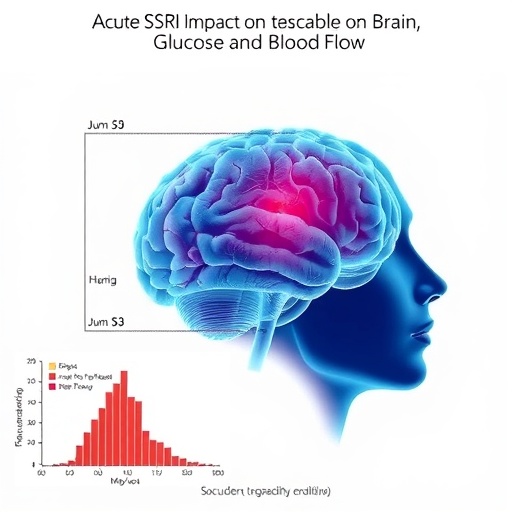
In a groundbreaking study poised to reshape our understanding of antidepressant mechanisms, researchers have unveiled compelling evidence on how selective serotonin reuptake inhibitors (SSRIs) acutely modulate cerebral glucose metabolism and cerebral blood flow. This revelation, published recently in Translational Psychiatry, offers unprecedented insights into the immediate neurophysiological impacts of SSRIs, a class of drugs primarily known for their delayed therapeutic effects. Given the widespread use of SSRIs in treating depression and anxiety disorders globally, these findings could influence future approaches to psychiatric treatment and accelerate the development of more effective interventions.
SSRIs have long been celebrated for their ability to elevate synaptic serotonin levels by inhibiting its reuptake into presynaptic neurons; however, much of their clinical action remains shrouded in mystery due to the delayed onset of symptomatic relief. The present study spearheaded by Silberbauer, L.R., Reed, M.B., and Gryglewski, G. et al. pioneers the exploration of SSRIs’ immediate cerebral effects, particularly focusing on metabolic and hemodynamic parameters that have been challenging to quantify until recent technological advances. The researchers employed a combination of metabolic and perfusion imaging to capture the nuances of brain activity moments after SSRI administration.
At the heart of this research lies the critical question: how do SSRIs, within hours rather than weeks, alter fundamental brain functions linked with glucose utilization and blood flow? Cerebral glucose metabolism is a direct indicator of neuronal activity, as active neurons consume glucose to fuel their complex signaling processes. Cerebral blood flow complements this by delivering oxygen and nutrients, ensuring neuronal sustenance. By interrogating these two intertwined systems, researchers aimed to unveil the acute effects that might underpin the gradual mood improvements experienced clinically.
The methodology adopted in this study represents a significant advance in neuropsychiatric imaging. Utilizing advanced positron emission tomography (PET) combined with dynamic susceptibility contrast magnetic resonance imaging (DSC-MRI), the team meticulously mapped changes in both glucose metabolism and perfusion patterns across various brain regions immediately following SSRI administration. This dual-imaging strategy allowed for a spatially and temporally precise measurement, shedding light on the initial neural adaptations induced by SSRIs at a level of detail not feasible before.
Remarkably, the study uncovered a heterogeneous pattern of metabolic and blood flow alterations across cortical and subcortical areas implicated in mood regulation. Regions such as the prefrontal cortex, anterior cingulate cortex, and hippocampus, which are critically involved in emotional processing and cognitive regulation, exhibited subtle yet significant elevations in glucose metabolism within hours of SSRI intake. Correspondingly, cerebral blood flow in these regions also demonstrated an acute upsurge, suggesting that SSRIs rapidly enhance the neural substrate’s energy demands and vascular response.
This rapid modulation of brain metabolism and perfusion challenges the conventional wisdom that SSRIs work solely by long-term neuroplastic changes and receptor-level adaptations. Instead, these findings imply an immediate enhancement of neuronal functionality and perfusion, which may serve as the foundation upon which longer-term therapeutic changes are built. The nuanced interaction between metabolic and vascular responses hints at a coordinated mechanism wherein SSRIs prime the brain’s energy systems to support sustained alterations in synaptic activity and network connectivity.
Such acute cerebrovascular effects also raise intriguing questions about the role of neurovascular coupling in SSRI action. Neurovascular coupling, the relationship between neuronal activity and subsequent blood flow changes, is essential for maintaining optimal brain function. By acutely increasing glucose metabolism and blood flow, SSRIs might transiently recalibrate this coupling, potentially restoring dysfunctional networks observed in depressive states. This recalibration could facilitate rapid improvements in mood and cognition, mechanisms that have been elusive to detect using traditional clinical endpoints.
Importantly, the study also delves into the regional specificity of these acute effects. Not all brain areas responded uniformly; for instance, the amygdala, a region central to processing emotional salience and anxiety, showed comparatively modest metabolic changes, while the striatum exhibited more pronounced blood flow increases. These differential patterns could help explain variability in patient responses to SSRIs and might inform more personalized strategies in psychiatric treatment, tailoring drug choice or dosage to individual neurovascular profiles.
From a technical standpoint, the study’s sophisticated imaging paradigm sets a new benchmark for future research in psychopharmacology. The integration of PET tracers targeting glucose metabolism with MRI-based perfusion imaging provides a comprehensive framework for studying drug-induced brain dynamics. Additionally, by focusing on acute rather than chronic effects, the research opens avenues to investigate early biomarkers predictive of therapeutic success or adverse effects, a holy grail in antidepressant development.
The implications of this research extend beyond depression alone. Given that SSRIs are also prescribed for anxiety, post-traumatic stress disorder, and obsessive-compulsive disorder, understanding their immediate cerebral impact could elucidate rapid symptom modulation in these conditions. Moreover, this knowledge could stimulate the search for adjunct treatments that synergize with SSRIs’ acute metabolic and vascular enhancements, potentially reducing the latency of clinical improvement.
Despite these exciting advances, the authors note important caveats and directions for future study. The interplay between metabolic increases and neurotransmitter dynamics remains complex, and further research is warranted to dissect how specific serotonin receptor subtypes and downstream signaling pathways contribute to these acute cerebral changes. Moreover, longitudinal studies assessing how these early effects correlate with long-term clinical outcomes will be essential to translate imaging findings into therapeutic innovations.
In summary, the work by Silberbauer and colleagues dramatically shifts the paradigm surrounding the neural underpinnings of SSRI action. By revealing that these widely prescribed drugs rapidly augment cerebral glucose metabolism and blood flow in key brain regions, the study not only enriches our mechanistic understanding of antidepressants but also heralds a new era in the use of functional neuroimaging to track and predict treatment response. This fusion of neurobiology, imaging technology, and clinical psychiatry may ultimately lead to more precise, dynamic, and effective interventions for mental health disorders that continue to challenge modern medicine.
As the field progresses, these acute metabolic and perfusion signatures might evolve into clinically actionable biomarkers, guiding drug development and individual patient management. This would represent a paradigm shift from symptom-based treatment to biologically grounded precision psychiatry. The scientific community and clinicians alike will keenly watch how this promising line of inquiry unfolds, potentially transforming millions of lives touched by mood disorders worldwide.
Cite Scienmag News
Glenn Wilkins. (February 3, 2026). Acute SSRI Impact on Brain Glucose and Blood Flow. Scienmag. https://scienmag.com/acute-ssri-impact-on-brain-glucose-and-blood-flow/
Glenn Wilkins. "Acute SSRI Impact on Brain Glucose and Blood Flow." Scienmag, 3 February 2026, https://scienmag.com/acute-ssri-impact-on-brain-glucose-and-blood-flow/. Accessed 4 September 2026.
Glenn Wilkins. "Acute SSRI Impact on Brain Glucose and Blood Flow." Scienmag. February 3, 2026. https://scienmag.com/acute-ssri-impact-on-brain-glucose-and-blood-flow/


