


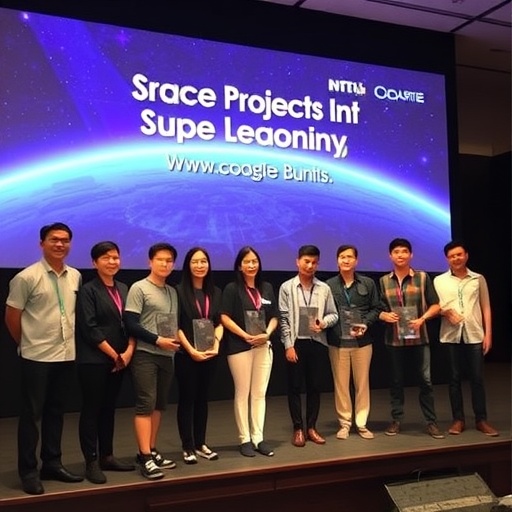
Nanyang Technological University (NTU) in Singapore is embarking on a groundbreaking journey to enhance the nation’s presence in the field of space technology. With the launch of three innovative space projects under the Space Technology Development Programme (STDP), NTU aims to catalyze the commercial potential of technologies designed and developed within Singapore. This venture not only marks an important milestone for NTU but also sets a promising trajectory for the future of the country’s endeavors in the aerospace sector.
At the core of this initiative is a satellite project equipped with sophisticated edge-computing artificial intelligence (AI). This satellite is designed to process data directly in space, thereby revolutionizing how data is managed when captured during missions. Under this innovative arrangement, images obtained by the satellite will be analyzed onboard using compact AI models and an edge processing engine. This not only minimizes the need for transmitting extensive quantities of raw data back to Earth but greatly expedites the decision-making process in orbit. Such advancements will lead to enhanced mission efficiencies and a more streamlined approach in satellite operations.
Leading this ambitious project is the expert team from NTU’s Satellite Research Centre (SaRC). In collaboration with local space technology firm Satoro Space, they are constructing a 3U nanosatellite that measures 30cm x 10cm x 10cm. This nanosatellite will also serve to test next-generation perovskite solar cells in the harsh realities of space. The lightweight solar panels being investigated are a product of joint research efforts from NTU’s School of Electrical and Electronic Engineering and the School of Materials Science and Engineering, together with the local technology start-up, Singfilm. The combination of cutting-edge AI and advanced solar cell technology highlights the interdisciplinary approach NTU is taking to advance the field of space technology.
The recent announcement indicates that these new projects are among the pioneers supported by the Space Access Programme (SAP), a segment of the STDP spearheaded by the Office for Space Technology & Industry, Singapore (OSTIn). The implication of rapid deployment and frequent launches to occur in 2026, 2027, and 2028 signifies Singapore’s commitment to establishing itself as a leading player in the global space industry. This dedication is underscored by the initiative’s design to provide local researchers and businesses with expedited access to space for testing and validation purposes.
Professor Warren Chan, Dean of the NTU College of Engineering, expressed optimism regarding the Space Access Programme, emphasizing the transformative impact it may have on the local space ecosystem. Citing NTU’s rich history as the birthplace of Singapore’s satellite and space education program, he articulated that the new initiative represents a significant evolution towards accelerated development and more intelligent operations within the realm of space technologies. The amalgamation of extensive expertise acquired over two decades places NTU in a pivotal position to harness the transformative power of this ecosystem.
In a testament to collaboration and innovation, Mr. Maverick Shih, Chairman of Satoro Space, conveyed enthusiasm about working alongside NTU’s Satellite Research Centre. According to him, this partnership signifies more than just building reliable CubeSat solutions; it establishes a local framework for rapidly developing cutting-edge space technology within Singapore. The excitement emanating from both institutions hints at the synergies being realized from this collaboration, not just for their respective organizations but for the nation as a whole.
The second project under the Space Access Programme is equally intriguing as it involves the development of another nanosatellite purposed for maneuverability enhancements in space. This advanced 16U nanosatellite, measuring 40cm x 30cm x 30cm and weighing up to 30 kilograms, will incorporate the innovative Multi-Stage Ignition Compact (MUSIC) engine. Developed by NTU’s spin-off company Aliena, this propulsion system is designed to enhance in-orbit mobility significantly. It employs a unique method of electrically ionizing gas propellant and leveraging finely controlled electric and magnetic fields, leading to a steady thrust which can effectively maneuver satellites for orbit adjustments.
Dr. Lim Jian Wei, Co-founder and CEO of Aliena, emphasized that the company’s involvement in the Space Access Programme aligns with their vision of providing versatile propulsion systems across various satellite platforms. As the count of satellites in low Earth orbit escalates, the importance of advanced in-orbit mobility cannot be overstated. Not only does it increase the operational capacity of satellites, but it also fosters sustainability among satellite constellations, which are essential for meeting emergent space challenges.
Accompanying this project, an Atomic Oxygen Detector developed by NTU Temasek Laboratories is to be integrated within this satellite. This detector will allow for evaluating the durability of materials against atomic oxygen, a corrosive gas that poses a threat to satellite components operating in very low Earth orbit. By addressing this critical concern, the project reflects a proactive approach to enhancing the robustness of satellite systems in the challenging environment of space.
The third project on NTU’s itinerary involves testing an electro-optical imaging payload designated as LEOCAM aboard the International Space Station (ISS). This unique payload represents Singapore’s commitment to developing high-resolution Earth observation technologies. Designed with an innovative triple-mirror system, LEOCAM is capable of capturing incredibly detailed images of the Earth, identifying objects as small as a meter in size. Dr. Phua Poh Boon, Chief Technology Officer of LightHaus Photonics, has expressed excitement about this milestone, as it marks the debut of a Singaporean company testing a space-based optical system.
These overlapping projects reveal a broader paradigm shift within the global space industry, underscoring a movement towards smaller, agile satellites that can be developed, launched, and tested with unprecedented speed compared to traditional large-scale missions. As the landscape continues to evolve, the trend of miniaturization and increased efficiency within satellite missions is expected to characterize the forthcoming era of space exploration and commercialization.
In closing, Professor Warren Chan reaffirmed that NTU is uniquely poised to lead in harnessing edge-computing AI technologies in space. He spoke passionately about the strategic advantages these developments could bring to Singapore’s burgeoning space ecosystem. The capability to process information onboard allows for a reduction in dependency on ground infrastructures, leading to quicker, informed decision-making—a crucial benefit for satellite missions. This initiative not only affirms NTU’s position within the global arena but also strengthens Singapore’s overall competitiveness on the world stage, paving the way for future innovations and advancements in the commercial space sector.
The inception of these three remarkable Space Access Programme projects not only signifies a pivotal moment in the advancement of NTU’s capabilities but also serves to bolster Singapore’s reputation as a burgeoning space-faring nation. The projects are set to roll out in 2023 and extend over the subsequent three years, inevitably solidifying NTU’s pivotal role in propelling Singapore’s aspirations within the challenging landscape of outer space exploration.
Keywords
Space Technology, Artificial Intelligence, Nanosatellite, Edge Computing, International Space Station, Propulsion Systems, Earth Observation, Space Research, Singapore, NTU, Space Access Programme.
Cite Scienmag News
Grant Pearson. (February 2, 2026). NTU Singapore Unveils Three Innovative Space Projects as Part of Singapore’s Space Access Programme. Scienmag. https://scienmag.com/ntu-singapore-unveils-three-innovative-space-projects-as-part-of-singapores-space-access-programme/
Grant Pearson. "NTU Singapore Unveils Three Innovative Space Projects as Part of Singapore’s Space Access Programme." Scienmag, 2 February 2026, https://scienmag.com/ntu-singapore-unveils-three-innovative-space-projects-as-part-of-singapores-space-access-programme/. Accessed 7 September 2026.
Grant Pearson. "NTU Singapore Unveils Three Innovative Space Projects as Part of Singapore’s Space Access Programme." Scienmag. February 2, 2026. https://scienmag.com/ntu-singapore-unveils-three-innovative-space-projects-as-part-of-singapores-space-access-programme/


