


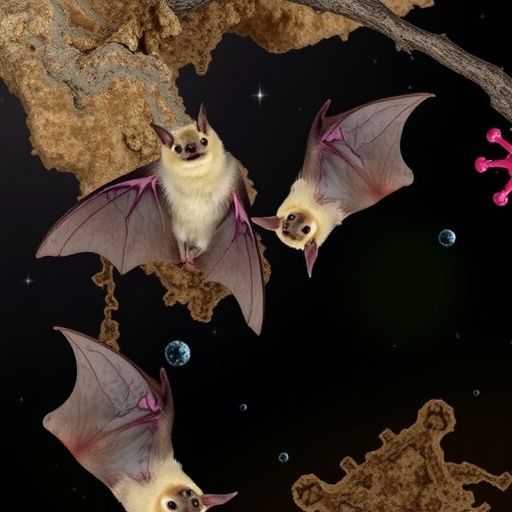
A pioneering study investigating bat viromes across the Indochina Peninsula has unveiled critical viral diversity and evolutionary insights that reshape our understanding of zoonotic spillovers, specifically highlighting the evolutionary lineage of porcine epidemic diarrhea virus (PEDV). Conducted by a collaborative team from Beijing University of Chemical Technology and the Academy of Military Medical Sciences, this extensive research emphasizes the Indochina Peninsula as a hotspot for coronavirus recombination and viral genetic exchange, underscoring the urgent need for enhanced biochemical surveillance and cross-border health initiatives.
Between 2020 and 2024, researchers collected and analyzed 659 biological samples from 197 bats representing 16 distinct species inhabiting regions of China’s Yunnan and Guangxi Zhuang Autonomous Regions, as well as Cambodia. Employing next-generation sequencing (NGS) technologies, the team identified 137 unique viral strains spanning 27 virus families. Among these, 40 were previously unknown species, a discovery that significantly expands the recognized viral biodiversity in bat populations of the Indochina region. Rhinolophidae bats demonstrated remarkable viral richness, particularly in harboring coronaviruses related to Middle East Respiratory Syndrome (MERS), signaling their fundamental role in viral ecology.
One of the most groundbreaking findings was the identification of a PEDV-related virus in Cambodian Chaerephon plicatus bats. This specific strain—termed CB_Mo.plicatus_PEDV-like_1—exhibited approximately 90.36% genomic homology with the well-documented PEDV CV777 strain, a pathogen responsible for substantial morbidity and mortality in swine herds globally. Genetic analyses revealed a recombinant viral genome architecture in this strain, whereby the ORF1ab region retained suid-adaptive features, whereas the Spike protein gene displayed bat-specific adaptations. This mosaic genetic signature confirms past recombination events and strongly supports the hypothesis that bats are the evolutionary origin reservoir for PEDV.
Recombination mapping further illuminated the dynamic nature of viral genomes circulating in bat populations, revealing mosaicism in 16 out of 18 analyzed sequences. Intriguingly, five genomic regions lacking detectable breakpoints, known as breakpoint-free regions (BFRs), were characterized, suggesting conserved functional domains potentially critical for viral fitness and cross-species transmission capacity. This rampant recombination possibly accelerates viral adaptability, increasing the likelihood of spillover events into new hosts, including humans and domestic animals.
In addition to genomic characterizations, the study harnessed deep learning algorithms to model host adaptation potential, thereby providing a predictive framework for zoonotic risk assessment. The neural network analyses identified a differential adaptation pattern in the PEDV-related virus: ORF1ab showed a higher predilection towards suid hosts, whereas the Spike protein exhibited a closer affinity to bat receptor tropism. This divergence may indicate the virus’s evolutionary capacity to bridge host barriers, a phenomenon that underscores the complex interplay between viral receptor binding domains and host entry mechanisms.
The geographical and ecological context of the Indochina Peninsula, characterized by diverse bat populations and complex interspecies interactions, appears to drive viral diversity and recombination hotspots. The high degree of intra- and interspecies viral genetic exchange suggests that this region functions as a crucible for emerging recombinant coronaviruses. This has profound implications for zoonotic disease emergence, especially considering the burgeoning interface between wildlife, livestock, and human activities in rapidly developing areas of Southeast Asia.
The researchers highlighted critical surveillance gaps that expose regional and global populations to future epidemic threats. Present monitoring efforts inadequately capture the viral diversity and recombination dynamics that underpin the evolution of zoonotic viruses. Targeted “One Health” strategies that synergize veterinary, human medical, and ecological disciplines are imperative for the timely detection and mitigation of pathogens at the wildlife-livestock-human interface.
This comprehensive research underscores the importance of integrating next-generation sequencing, bioinformatics, and artificial intelligence-driven predictive modeling to holistically understand viral dynamics in wildlife reservoirs. The identification of novel bat viruses and the molecular dissection of recombinant genomic architectures provide a rich dataset for future antiviral development and vaccine design efforts. Understanding recombination mechanisms also arms virologists with the knowledge to predict and potentially preempt spillover events.
Furthermore, this study adds to the growing evidence that coronaviruses exhibit remarkable genomic plasticity facilitated by high recombination rates, fostering the emergence of novel variants with altered host specificities and pathogenic potentials. Continuous viral surveillance in bat populations—especially in recombination hotspots such as the Indochina Peninsula—is essential to chart viral evolutionary trajectories and inform public health interventions.
The intricacies of the Spike protein gene, crucial for host receptor binding and viral entry, merit particular attention in ongoing surveillance programs. Mutations or recombination events affecting this region could dramatically alter the zoonotic potential of bat-derived coronaviruses. The interplay between suid-adapted ORF1ab and bat-adapted Spike gene in the identified PEDV-related virus exemplifies a molecular scaffold capable of cross-species leaps, warranting focused functional analyses in vitro and in vivo.
As urbanization, agricultural expansion, and wildlife trade continue to intensify in Southeast Asia, the risk of novel zoonotic pathogen emergence escalates substantially. This study serves as a clarion call for international cooperation, advocating for robust, cross-border “One Health” initiatives that encompass environmental, animal, and human health sectors. Addressing surveillance gaps will accelerate early warning capabilities and enable rapid response to preempt potential epidemics arising from bat-borne viruses.
In conclusion, the Indochina Peninsula, with its complex ecological network and diverse bat reservoirs, stands as a critical frontier in the study of viral evolution and zoonotic emergence. Through sophisticated genomic and computational methodologies, this research illuminates the evolutionary pathways of coronaviruses and related viruses, including PEDV. It highlights an urgent imperative: to expand interdisciplinary surveillance and enhance viral genomic monitoring to mitigate the global threat of zoonotic coronaviruses before they manifest as public health crises.
News Publication Date: 9-Jan-2026
Web References: http://dx.doi.org/10.1016/j.hlife.2025.10.008
Cite Scienmag News
Kristina Jarvis. (February 2, 2026). Evolution of Bat Viruses in the Indochina Peninsula Uncovers Cross-Species Origins of Porcine Epidemic Diarrhea Virus and Highlights Gaps in Regional Surveillance. Scienmag. https://scienmag.com/evolution-of-bat-viruses-in-the-indochina-peninsula-uncovers-cross-species-origins-of-porcine-epidemic-diarrhea-virus-and-highlights-gaps-in-regional-surveillance/
Kristina Jarvis. "Evolution of Bat Viruses in the Indochina Peninsula Uncovers Cross-Species Origins of Porcine Epidemic Diarrhea Virus and Highlights Gaps in Regional Surveillance." Scienmag, 2 February 2026, https://scienmag.com/evolution-of-bat-viruses-in-the-indochina-peninsula-uncovers-cross-species-origins-of-porcine-epidemic-diarrhea-virus-and-highlights-gaps-in-regional-surveillance/. Accessed 4 September 2026.
Kristina Jarvis. "Evolution of Bat Viruses in the Indochina Peninsula Uncovers Cross-Species Origins of Porcine Epidemic Diarrhea Virus and Highlights Gaps in Regional Surveillance." Scienmag. February 2, 2026. https://scienmag.com/evolution-of-bat-viruses-in-the-indochina-peninsula-uncovers-cross-species-origins-of-porcine-epidemic-diarrhea-virus-and-highlights-gaps-in-regional-surveillance/


