


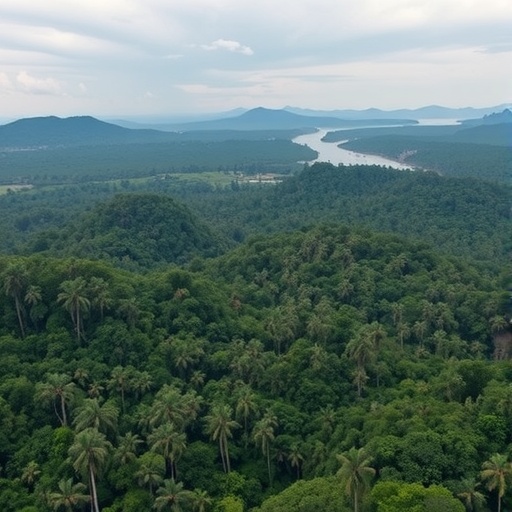
In the world of environmental science, the ability to monitor and assess land use and land cover changes is crucial, especially in regions like tropical dry forests. These ecosystems are under immense pressure from agricultural expansion, urbanization, and climate change. A recent study by González-Vélez and colleagues explores innovative methods to detect these changes through advanced semi-supervised deep learning algorithms combined with remote sensing technology. This approach not only enhances detection capabilities but also improves the efficiency of data analysis in complex ecological environments.
Tropical dry forests are unique ecosystems that play a vital role in biodiversity and carbon storage. However, these forests have seen alarming rates of deforestation and degradation, making the need for accurate monitoring systems more pressing than ever. Understanding land cover dynamics is essential for developing effective management strategies that conserve these irreplaceable biomes. The integration of machine learning techniques into remote sensing data offers a promising avenue for capturing the nuances of these environmental changes in real time.
Recent advancements in deep learning technologies have opened new frontiers for environmental monitoring. Traditional methods relied heavily on supervised learning, requiring large amounts of labeled training data, which can be both time-consuming and expensive to compile. However, González-Vélez et al. introduce a semi-supervised approach, significantly reducing the need for extensive datasets while maintaining accuracy in land cover classification. This innovation could democratize access to powerful analytical tools, empowering researchers in developing regions.
The researchers utilized high-resolution satellite imagery as their primary data source, processing it through structured frameworks designed to train their algorithms. This imagery provides detailed insights into landscape composition, allowing the detection of subtle changes over time. By employing semi-supervised learning, their model was able to enhance its performance by leveraging a smaller set of labeled data and a larger pool of unlabeled data. This aspect of the research is particularly groundbreaking, as it could lead to applications that require less pre-existing data.
The implementation of these techniques has yielded results illustrating how land use/land cover changes occur in tropical dry forests, including the effects of natural phenomena and human activities. The integration of environmental data, such as precipitation patterns and temperature variations, further refines the analysis, offering a comprehensive view of how these changes impact forest ecosystems. Such a detailed analysis is crucial for policymakers and conservationists who are striving to mitigate deforestation and its environmental consequences.
A particular strength of the research is its adaptability. The semi-supervised deep learning algorithms developed in this study can be fine-tuned to fit various tropical dry forest regions, each with its distinct characteristics and challenges. Such flexibility ensures that the framework can be employed in multiple contexts, offering the potential for global applications in forest management and conservation.
Another critical element addressed in the study is the democratization of technology in ecological research. The techniques and tools developed by the authors could potentially be translated into user-friendly applications for local stakeholders, meaning that non-experts could also engage with and benefit from high-level remote sensing capabilities. This accessibility could foster grassroots conservation efforts and enhance community involvement in environmental monitoring.
Additionally, the ongoing capacity for the model to learn and adapt over time signifies a shift towards more dynamic monitoring systems. As new data becomes available, the algorithms can refine their predictions, making them increasingly accurate. This adaptability means that forest managers can get timely updates on land cover changes, enabling proactive management that responds to challenges as they arise.
As the study showcases, the melding of machine learning with remote sensing opens a promising avenue for future research. There are numerous other variables that can be incorporated into the analysis, such as socioeconomic factors and land management practices, which could provide even deeper insights into the dynamics of tropical dry forest ecosystems. This aligns with broader environmental research narratives focusing on integrated approaches that consider both ecological and human elements.
Ultimately, the findings of González-Vélez et al. signify a significant step forward in the realm of ecological monitoring. By leveraging advanced technologies, researchers can better track and understand the complexities of land use and land cover changes in tropical dry forests. The implications of this research extend beyond mere academic interest; they hold the potential to influence conservation policies and practices worldwide.
The critical insights derived from this study have sparked interest and discussions within the scientific community, raising vital questions about how best to integrate technology with traditional ecological knowledge. As researchers continue to innovate, collaborative efforts will likely emerge, combining expertise from various disciplines to tackle pressing environmental issues.
In closing, the future of tropical dry forest conservation may increasingly hinge on the ability to harness data and technology efficiently. Studies like that of González-Vélez and colleagues highlight the transformative potential of machine learning and remote sensing in reshaping our understanding of ecological changes. Through continued investment in these areas, we stand to gain invaluable tools for safeguarding the future of our planet’s biodiversity.
By improving the mechanisms for monitoring and analyzing land use changes, we position ourselves to enact meaningful conservation efforts. As the tools of remote sensing and advanced analytics continue to evolve, they may help pave the way to a more sustainable coexistence between human development and ecological preservation.
Cite Scienmag News
Blake Davidson. (February 2, 2026). Mapping Tropical Dry Forest Changes with Deep Learning. Scienmag. https://scienmag.com/mapping-tropical-dry-forest-changes-with-deep-learning/
Blake Davidson. "Mapping Tropical Dry Forest Changes with Deep Learning." Scienmag, 2 February 2026, https://scienmag.com/mapping-tropical-dry-forest-changes-with-deep-learning/. Accessed 4 September 2026.
Blake Davidson. "Mapping Tropical Dry Forest Changes with Deep Learning." Scienmag. February 2, 2026. https://scienmag.com/mapping-tropical-dry-forest-changes-with-deep-learning/


