


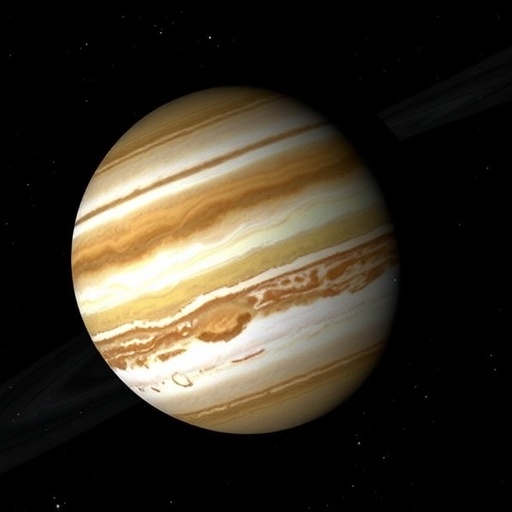
Jupiter, the colossal gas giant reigning as the largest planet in our Solar System, continues to unveil secrets about its intricate nature as new research offers unprecedented insights into its true shape and dimensions. Known for its rapid rotation, completing a spin in just under ten hours, Jupiter’s distinctive equatorial bulge has long fascinated scientists. This oblate figure—where the equator stretches further than the poles—is a direct consequence not only of its spin but also the planet’s complex internal makeup and dynamic atmospheric winds. However, up to now, our understanding of Jupiter’s precise dimensions had been limited by considerable uncertainties and data largely derived from decades-old space missions.
For nearly fifty years, the planetary science community relied primarily on measurements from the Voyager and Pioneer spacecraft, which used radio occultation techniques to deduce Jupiter’s size and shape. These historic observations provided valuable but somewhat coarse estimates, carrying uncertainties on the order of several kilometers. Furthermore, they failed to sufficiently account for the impacts of Jupiter’s intense zonal winds—the high-speed jet streams running parallel to its equator—that subtly deform the planet’s figure by redistributing mass in its gaseous envelope. Consequently, prior shape models could not fully reconcile the observed gravitational data with the planet’s atmospheric dynamics.
This long-standing gap has now been bridged by the wealth of high-precision data beamed back from NASA’s Juno spacecraft, which has orbited Jupiter since 2016. Juno’s radio occultation experiments have measured the planet’s limb—the apparent edge of the planet as seen from the spacecraft—with extraordinary accuracy. Taking advantage of these precise observations, a new study has applied refined techniques to jointly model Jupiter’s shape while integrating the effects of its vigorous atmospheric winds. This integrated approach drastically reduces uncertainties to under half a kilometer, representing an order-of-magnitude improvement over prior estimates.
Through this advance, researchers have revealed that Jupiter’s shape is slightly smaller than previously thought. At the reference pressure level of 1 bar—which roughly corresponds to the visible cloud tops—the planet’s polar radius measures approximately 66,842 kilometers, while the equatorial radius is about 71,488 kilometers. Both values are smaller than earlier figures by several kilometers, with the equator shrinking by around four kilometers and the poles by nearly twelve kilometers. This subtle but significant refinement also adjusts Jupiter’s mean radius downward to about 69,886 kilometers, providing a more exact geometric baseline for future studies of its atmosphere and interior.
One of the most intriguing findings from this new modeling effort is the confirmation that Jupiter’s atmospheric winds exhibit a predominantly barotropic structure. In fluid dynamics terms, this means that the zonal winds maintain nearly uniform velocity at varying altitudes above the cloud tops, showing minimal vertical shear or variation. This barotropic nature implies a simpler and more stable wind profile than previously assumed, which has important implications for understanding how Jupiter’s jet streams penetrate and interact with its deep atmosphere.
The improved radius measurements also serve as a crucial stepping stone toward refining internal structure models of Jupiter. Planetary scientists use shape data alongside gravitational field measurements to infer the distribution of elements, temperatures, and phases of matter inside a planet. The updated radius values direct modelers toward scenarios featuring a metal-enriched atmosphere that is somewhat cooler than prior estimates suggested. These cooler, metal-rich conditions help bridge longstanding discrepancies between theoretical models, direct in situ measurements from the Galileo probe—which plunged into Jupiter’s atmosphere in 1995—and temperature profiles derived from Voyager-era observations.
By reconciling these divergent data points, the refined shape now grounds a more coherent picture of Jupiter’s interior and atmospheric composition, aiding researchers in piecing together the processes that govern gas giant formation and evolution. This holistic perspective elevates our comprehension of not only Jupiter itself but also the broader class of giant exoplanets whose masses and radii place them in a similar structural regime.
Moreover, the updated profile offers enhanced spatial referencing for pressure-dependent atmospheric measurements. Precision in radius changes directly informs how scientists interpret remote sensing data related to temperature, composition, and dynamics at different altitudes. By applying a more accurate geometric framework, researchers can more reliably attribute observed atmospheric features, such as storms and waves, to underlying physical conditions, effectively sharpening the resolution of our planetary weather maps.
This breakthrough at Jupiter highlights the essential role of combining observational prowess with cutting-edge modeling in planetary science. As Juno continues its mission to probe the gas giant’s gravity and magnetic fields, these improved shape constraints will synergize with other datasets to unlock secrets about Jupiter’s deep internal flows, core composition, and the mechanisms driving its magnetosphere.
Furthermore, this finding reverberates throughout solar system science by underscoring the dynamic interplay between rotation, fluid motions, and planetary shape. Jupiter remains a laboratory for studying how large-scale atmospheric phenomena influence planetary figures, applicable to icy giants like Uranus and Neptune, and expanding our knowledge of diverse worlds beyond our solar system.
This milestone also raises pertinent questions about the temporal stability of Jupiter’s shape and atmospheric structure. How stable are these barotropic winds over time, and how do transient events like the Great Red Spot influence the planet’s external profile? Continuous monitoring and future missions will be crucial to explore the dynamic facets of this ever-changing giant.
Highlighting the extraordinary precision achieved, the uncertainties accompanying the new radius measurements stand at only ±0.4 kilometers for both equatorial and polar values. This degree of exactness marks a revolutionary step compared to older models whose error margins of several kilometers limited subtle insight. Such precision opens the door to re-examining long-held assumptions about gas giants and refining aspects of planetary science that once seemed out of reach.
In summary, revamped measurements of Jupiter’s size and form have ushered in a new era in understanding the planet’s atmospheric dynamics and internal constitution. By harnessing data from modern space missions and integrating complex physical processes like zonal winds, scientists now possess an unprecedentedly clear portrait of our Solar System’s largest planet. These insights pave the way for deeper explorations of giant planet physics, fine-tuning models not only for Jupiter but other planetary bodies within and beyond our solar system.
As these findings ripple through the planetary science community, they underscore a vital truth: precision in measurement, combined with sophisticated modeling, reveals the nuanced heart of even the most colossal worlds. Jupiter stands resplendent as not only a colossal gas sphere but a finely sculpted globe whose shape encodes tales of wind, rotation, and the profound depths beneath its swirling clouds.
Cite Scienmag News
Grant Pearson. (February 2, 2026). Jupiter’s Massive Size and Unique Shape Revealed. Scienmag. https://scienmag.com/jupiters-massive-size-and-unique-shape-revealed/
Grant Pearson. "Jupiter’s Massive Size and Unique Shape Revealed." Scienmag, 2 February 2026, https://scienmag.com/jupiters-massive-size-and-unique-shape-revealed/. Accessed 4 September 2026.
Grant Pearson. "Jupiter’s Massive Size and Unique Shape Revealed." Scienmag. February 2, 2026. https://scienmag.com/jupiters-massive-size-and-unique-shape-revealed/


