


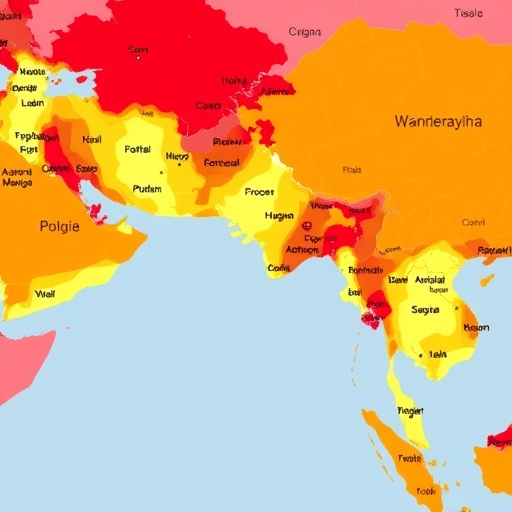
A recent University of Notre Dame study has revealed a troubling aspect of fine particulate matter pollution, specifically PM 2.5, showing that nearly 40 percent of premature deaths linked to this airborne pollutant in the United States stem from pollution drifting across state boundaries. This finding highlights an enduring challenge within air quality management: the transboundary nature of pollution and the difficulty of containing its health impacts within political jurisdictions. PM 2.5, consisting of microscopic particles less than 2.5 microns in diameter, penetrates deep into the respiratory tract, causing significant damage to human health by contributing to cardiovascular and pulmonary diseases.
Published in the journal Environmental Research Letters, this investigation advances a novel airshed-based framework to quantify state-level responsibility for PM 2.5 pollution, diverging from the reliance on complex and resource-intensive chemical transport modeling traditionally applied in atmospheric sciences. The airshed concept, analogous to watershed hydrology but applied to air movement, defines geographical areas where air masses and their pollutant loads travel cohesively. By leveraging this principle with robust data analytics, the research team developed a scalable tool that regulators—and policymakers—can use globally to assess cross-jurisdictional pollution impacts with refined precision.
The implications of this work are particularly relevant against the backdrop of recent policy shifts. Early in 2024, the Environmental Protection Agency announced it would cease calculating the economic valuation of health benefits derived from pollution regulations concerning ozone and PM 2.5. This decision emphasizes the urgency for alternative, health-focused metrics that prioritize the tangible human burden of pollution rather than solely monetary assessments. Researchers at Notre Dame propose that their data-driven approach can provide a transparent and actionable basis for regulatory decisions, especially when the economic rationale is contested or sidelined.
A key insight from this study is the persistent proportion—about 40 percent—of premature deaths attributable to cross-state PM 2.5 transport, a figure that has remarkably remained stable since 1998 despite a 35 percent decline in overall PM 2.5 pollution nationally. This plateau suggests that improvements in air quality have uneven benefits, disproportionately sparing or harming certain regions depending on their position relative to pollution sources and prevailing wind patterns. The system-wide redistribution of air pollutants thus emerges as a complex and enduring public health challenge.
In dissecting the spatial dynamics of PM 2.5 pollution transport, the research identifies that over half of the states function as net pollution exporters. Among them, Florida leads as the primary source of cross-border pollution impacting neighboring states such as Georgia and the Carolinas. The study also highlights significant exports from states across the Upper Midwest, Mid-Atlantic, and Southeast regions, including Wisconsin, Michigan, and Ohio, as well as key West Coast states like California, Oregon, and Washington. Conversely, less than twenty percent of states are net importers of air pollution, suffering a heavier burden of health risks without proportionate emissions.
Departing from the traditional dependence on high-fidelity atmospheric chemical transport models, which are computationally intensive and often inaccessible to low-resource regulatory bodies worldwide, this study applies the airshed framework in tandem with comprehensive air quality data. This method allows for more straightforward attribution of exposure risks exceeding safety thresholds. By mapping pollutant trajectories defined by prevailing meteorological conditions, the approach clarifies how PM 2.5 concentrations exceed healthy limits downwind, revealing the masked externalities inflicted upon communities distant from emission sources.
The researchers emphasize the ethical and policymaking implications of their findings. Prior studies indicate a tendency for states to position major polluting industries near downwind borders, effectively leveraging geographical and atmospheric dynamics to externalize health risks onto neighboring jurisdictions. This spatial strategy allows these states to reap economic gains from industrial activity without shouldering the full health consequences, presenting a striking inequity in environmental health responsibility.
From a governance perspective, the study arrives amid a complex regulatory landscape in the United States marked by decentralized air quality management and legal contention surrounding the Clean Air Act’s “Good Neighbor” provision, intended to address interstate pollution transport. Notably, a 2024 US Supreme Court decision temporarily halted an EPA effort to strengthen this provision, underscoring the legal challenges in implementing robust cross-state pollution controls. The presented airshed-based tool could offer a scientifically grounded foundation to support more definitive regulatory frameworks.
Beyond the US, air quality management faces distinct challenges in low-resource countries, where limited access to advanced atmospheric modeling constrains evidence-based policymaking. However, the universal nature of atmospheric transport means that pollution crossing political boundaries is a ubiquitous issue. By advancing a scalable, data-driven methodology, Notre Dame’s study provides a valuable template adaptable worldwide, enabling authorities to better identify pollution sources and protect vulnerable downwind populations in diverse contexts.
This research is not only an academic exercise but part of a broader effort to quantify environmental externalities in a manner that centers public health and social justice. Drawing on interdisciplinary expertise across engineering, environmental sciences, political science, and ethics, the team situates its work within the University’s Just Transformations to Sustainability Initiative—an endeavor to harmonize human wellbeing with ecological stewardship. The study contributes a practical tool for regulators to prioritize permitting, monitoring, and enforcement activities where cross-border pollution causes the most harm.
The scientific team is extending this work beyond national borders through a multi-year initiative exploring the global footprint of pollution originating in megacities and its implications for surrounding regions. By integrating atmospheric data with socio-political analyses, this project aims to elucidate pathways for more equitable and effective pollution governance on a planetary scale, recognizing that clean air is a global right constrained only by atmospheric circulation and political will.
PM 2.5’s health impacts are severe and widespread, responsible for an estimated 4 million premature deaths globally each year. Its minuscule size allows these particles to infiltrate the lungs and circulation, exacerbating chronic conditions such as cancer, chronic obstructive pulmonary disease (COPD), stroke, and cognitive decline. Vulnerable populations—pregnant women, children, elderly individuals, and those with pre-existing conditions like asthma or diabetes—are disproportionately affected, making the precise quantification of cross-jurisdictional PM 2.5 pollution critical for targeted public health interventions.
In summary, this University of Notre Dame study equips policymakers with an innovative, accessible framework to dissect—and ultimately address—the intricate problem of cross-state PM 2.5 pollution. By translating the airshed concept into operational tools grounded in empirical data, the research offers a blueprint for confronting one of the most intractable aspects of air pollution: its invisibility across borders and the resultant inequities in health burdens. As regulatory landscapes evolve, such evidence-driven solutions are indispensable to safeguarding public health and advancing environmental justice in the face of persistent air quality challenges.
News Publication Date: 12-Dec-2025
Web References:
- https://doi.org/10.1088/1748-9326/ae2638
- https://news.nd.edu/news/downwind-states-face-disproportionate-burden-of-air-pollution/
References:
Marcantonio, R. et al., “Quantifying responsibility for cross-state air pollution: an airshed approach,” Environmental Research Letters, 2025.
Cite Scienmag News
Russell Cooper. (February 1, 2026). New Tool Monitors Cross-Border Pollution, Uncovering Disparities in Risk and Accountability. Scienmag. https://scienmag.com/new-tool-monitors-cross-border-pollution-uncovering-disparities-in-risk-and-accountability/
Russell Cooper. "New Tool Monitors Cross-Border Pollution, Uncovering Disparities in Risk and Accountability." Scienmag, 1 February 2026, https://scienmag.com/new-tool-monitors-cross-border-pollution-uncovering-disparities-in-risk-and-accountability/. Accessed 4 September 2026.
Russell Cooper. "New Tool Monitors Cross-Border Pollution, Uncovering Disparities in Risk and Accountability." Scienmag. February 1, 2026. https://scienmag.com/new-tool-monitors-cross-border-pollution-uncovering-disparities-in-risk-and-accountability/


