


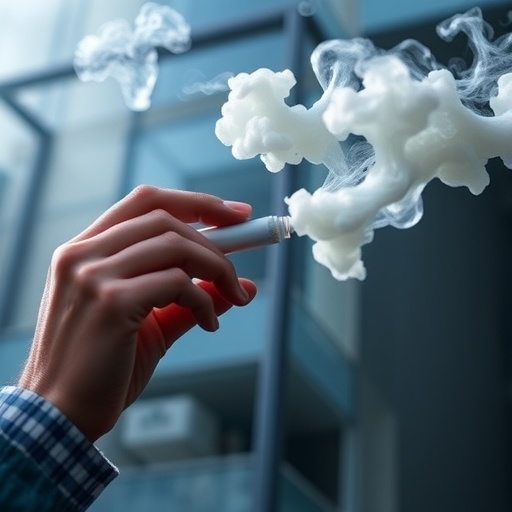
The use of electronic cigarettes, commonly known as vapes, has grown substantially in recent years, particularly among younger demographics seeking alternatives to traditional tobacco products. Unlike cigarettes that produce smoke through combustion, e-cigarettes work by heating liquid that contains various compounds, producing a vapor instead. This vapor is often perceived as a less harmful option; however, emerging research is raising significant concerns about its safety, particularly for bystanders exposed to secondhand vapor. Recent findings published in the esteemed journal Environmental Science & Technology have shed light on the potential dangers lurking within e-cigarette emissions, specifically focusing on the lingering impacts of vape plumes in confined spaces.
The study, conducted by a team led by Ying-Hsuan Lin from the University of California, Riverside, investigates the chemical makeup of aged vapor and its implications for respiratory health. Initial results indicate that the vapor released from e-cigarettes not only contains fine particles but is also laced with various metals and highly reactive compounds. These components, when inhaled, can lead to the production of free radicals known to potentially damage lung tissue. Such findings underscore the necessity for increased awareness regarding the health risks associated with secondhand vapor exposure, as Lauren emphasizes.
E-cigarettes have been marketed as a safer alternative, often promoting them as a means to transition away from traditional smoking. Yet, the absence of smoke does not mean the emission is devoid of health risks. Early research suggested that secondhand aerosols from vaping comprise volatile organic compounds (VOCs) that can interact with indoor ozone, resulting in the formation of harmful by-products such as reactive peroxides. Moreover, many vape liquids contain heavy metals and other reactive materials that can react with peroxides to yield potentially hazardous byproducts, including free radicals, creating a scenario reminiscent of traditional cigarette smoke but with distinct chemical profiles.
To gain deeper insights into how indoor ozone affects the composition of these vapors, Lin and colleagues meticulously designed their experiments to simulate realistic conditions in indoor environments. They formulated a simplified vape liquid consisting of a single flavoring agent—a floral-smelling terpene—and devoid of nicotine. This was then puffed into a chamber where ozone levels were environmentally controlled, allowing the researchers to analyze the resultant aging of the aerosols over a 90-minute period.
The findings were alarming. Upon analysis, particles from both vape pens revealed the presence of iron, aluminum, and zinc ions, alongside trace levels of hazardous heavy metals such as lead, arsenic, and tin. A careful examination of the aged aerosols unveiled that ultrafine particles bore significantly greater concentrations of metals and peroxide compounds in comparison to their larger counterparts. This is particularly concerning because ultrafine particles can penetrate deep into the lungs, reaching sensitive areas known as alveoli, which are lined with fluid and are crucial for gas exchange in the respiratory system.
As part of their research, the team wanted to understand the potential reactivity of these aged aerosols when coming into contact with lung fluids. They placed the collected aerosols into a water-based solution to simulate the conditions inside human lungs. Astonishingly, they discovered that the ultrafine particles created free radicals in quantities 100 times greater than larger particles relative to their weight. This elevated reactivity of ultrafine particles may present a considerable risk to lung health, particularly for individuals predisposed to respiratory diseases such as asthma or chronic obstructive pulmonary disease (COPD).
Despite being conducted under controlled lab conditions, Lin’s research lays a foundational understanding that necessitates further investigation. The findings underscore the urgent need for epidemiological studies in real-world environments to better assess the scope of risk posed by secondhand vape emissions. This concern takes on added significance as e-cigarette usage continues to proliferate among younger populations without fully understanding the long-term health implications.
Furthermore, the research highlights the complexity of the chemicals generated by e-cigarettes, challenging the narrative that they are purely benign or free from harmful consequences. With every puff, consumers and bystanders are exposed to a mixture of substances that could seriously impact lung health. As regulations surrounding e-cigarettes are still catching up to the rapid proliferation of these products, the urgency of this research cannot be understated.
In light of these findings, public health initiatives must prioritize education regarding the risks associated with secondhand vape exposure, particularly in environments densely populated by non-users, including homes, schools, and public transportation. The idea of a “safe zone” for non-smokers in locations where vaping occurs is a myth that needs to be debunked, as lingering vapors can create a hazardous environment for unsuspecting individuals.
As the research community aims to dissect and understand the full spectrum of e-cigarette emissions, efforts must also be coordinated with regulatory bodies to impose stricter guidelines on e-cigarette manufacturing. Ensuring transparency regarding the chemical contents of vape liquids could empower consumers to make safer choices. Meanwhile, healthcare professionals should remain vigilant in educating patients about the potential harms associated with secondhand vape exposure, particularly for vulnerable populations such as children and those with existing respiratory conditions.
The insights provided by this research serve as a clarion call for ongoing scientific inquiry into the health impacts of modern vaping. The complexities of chemical interactions within the aerosols need further exploration to unravel their implications fully. As society continues to navigate the changing landscape of nicotine consumption, the lessons learned from this study of e-cigarette aerosols may prove vital in shaping future public health policies and enhancing community safety.
In summary, while e-cigarettes were initially seen as a progressive shift in reducing smoking-related health risks, this study reveals that they are not without significant concerns, particularly for those exposed to secondhand vapors. The nuanced understanding of aerosol composition and reactivity points to a pressing need for more rigorous scientific examination to safeguard public health as vaping culture continues to evolve.
Keywords
E-cigarettes, secondhand vape exposure, respiratory health, ultrafine particles, chemical composition, public health, reactive oxygen species, indoor air quality, aerosol research, vaping risks.
Cite Scienmag News
Denise Maddox. (February 1, 2026). Secondhand Vape Clouds May Generate Lung-Damaging Free Radicals, Study Reveals. Scienmag. https://scienmag.com/secondhand-vape-clouds-may-generate-lung-damaging-free-radicals-study-reveals/
Denise Maddox. "Secondhand Vape Clouds May Generate Lung-Damaging Free Radicals, Study Reveals." Scienmag, 1 February 2026, https://scienmag.com/secondhand-vape-clouds-may-generate-lung-damaging-free-radicals-study-reveals/. Accessed 4 September 2026.
Denise Maddox. "Secondhand Vape Clouds May Generate Lung-Damaging Free Radicals, Study Reveals." Scienmag. February 1, 2026. https://scienmag.com/secondhand-vape-clouds-may-generate-lung-damaging-free-radicals-study-reveals/


