


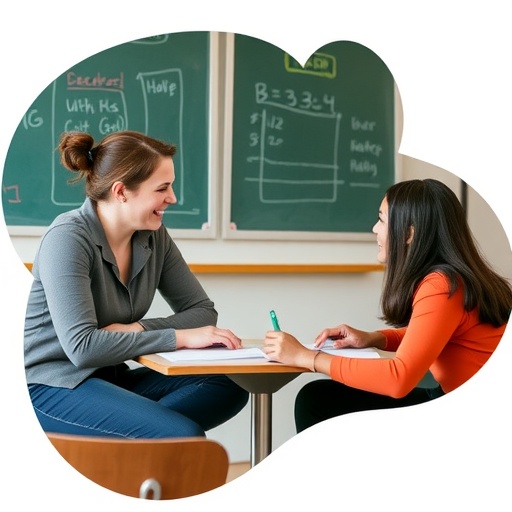
In the ever-evolving landscape of educational psychology, the intricate dynamics between teacher and peer support play a pivotal role in shaping student engagement, particularly in the often underestimated realm of middle school physical education. A groundbreaking longitudinal study by Zhang and Han, published in BMC Psychology in 2026, has unveiled compelling evidence of a bidirectional, dynamic relationship between these forms of support and how they collectively influence student involvement over time. This research offers profound insights into the social fabric of physical education classes, emphasizing the complex interplay that sustains and enhances student motivation and participation.
Physical education at the middle school level serves as a critical developmental phase where students not only cultivate physical skills but also form their attitudes towards exercise, teamwork, and personal health habits. Zhang and Han’s meticulous analysis brings to light how both teacher and peer support extend beyond immediate instructional assistance to foster sustained engagement that can spread ripple effects across students’ academic and social experiences. Unlike prior studies that isolated either teacher influence or peer relationships, this research adopts a dynamic approach to demonstrate how these sources of social support are interlinked and continuously interact over the course of the academic year.
The methodology employed involved tracking a sizable cohort of middle school students over multiple time points to examine how fluctuations in perceived teacher and peer support correlated with changes in levels of engagement in physical education classes. This nuanced approach allowed the researchers to identify patterns in which increased peer encouragement often amplified the impact of teacher support, while positive teacher interactions could, in turn, promote more cohesive peer relations. This reciprocity underlines the importance of considering the social ecosystem in physical education rather than isolating individual contributory factors.
One remarkable finding was the indication that teacher support, characterized not only by instructional clarity but also emotional encouragement, sets a foundational tone that empowers peers to become more supportive themselves. This suggests that when teachers foster an inclusive and motivating environment, peers are more likely to engage in positive behaviors such as encouragement and cooperative play. The ramifications for educational practice are profound, encouraging educators to intentionally design classroom climates that amplify these positive social feedback loops.
Furthermore, Zhang and Han explored the temporal dimension of these relationships, capturing how student engagement responds dynamically to shifts in social support. They observed that during periods when either peer or teacher support waned, engagement tended to decline, but when both sources of support were strong, students demonstrated sustained or even increased levels of active participation. This highlights the necessity of maintaining both forms of support continuously rather than viewing them as static or one-time interventions.
The study also delved into the differentiated impact of support depending on individual student characteristics such as prior engagement levels and social skills. Students who started with lower engagement showed the most pronounced benefits from enhanced teacher and peer support, implying that these social mechanisms can serve as powerful tools for educational equity. In such contexts, targeted efforts to boost relational support might mitigate disparities in physical education participation and outcomes.
From a theoretical standpoint, Zhang and Han’s work leverages and expands socio-ecological models of student engagement by incorporating bidirectional influences and feedback mechanisms into the framework. They adeptly argue that student engagement cannot be fully understood without recognizing the continuous interplay between individual agency and social context. This reframing challenges linear models and encourages more complex, systemic approaches to educational interventions.
Practical implications stretch beyond the immediate physical education setting. The findings advocate for professional development programs that train teachers not only in pedagogical techniques but also in social facilitation skills that nurture peer support networks. Additionally, the research underscores the potential value of peer-led initiatives and collaborative learning strategies that deliberately harness the motivational power of social connections among students.
Importantly, the longitudinal design of the study provides a robust empirical basis for policy recommendations. By documenting how supportive social environments evolve and exert influence over time, educators and administrators may strategically invest in sustained relationship-building efforts rather than short-term fixes. This insight is particularly relevant given the developmental challenges and shifting social dynamics characteristic of middle school years.
The researchers provide compelling evidence that the bidirectional nature of teacher and peer support creates a resilient framework for student engagement, one that adapts and thrives within the fluctuating social realities of adolescent learners. This innovative perspective not only enriches academic discourse but also offers actionable pathways for enhancing educational experiences through relational interventions.
Technologically, the study suggests avenues for integrating digital tools that facilitate real-time feedback and social interaction monitoring in physical education. Such innovations could help educators identify periods of declining support and intervene proactively, potentially extending the benefits of the research into tech-enhanced pedagogical environments.
Moreover, Zhang and Han’s investigation invites further exploration into the neuropsychological correlates of social support mechanisms in physical education. Understanding how interactions between teacher and peer support influence neurological pathways related to motivation and reward could open new frontiers for personalized educational strategies that optimize both mental and physical health outcomes.
Socially, the study resonates with broader conversations about fostering inclusivity and mental well-being in schools. By revealing how supportive relationships underpin engagement, it aligns with growing recognition that emotional and social dimensions of schooling are essential components of holistic student development.
As the field moves forward, Zhang and Han’s research stands as a compelling call to action for educators, researchers, and policymakers alike to rethink physical education not merely as a domain of physical development but as a critical social context where supportive relationships are central to thriving youth. Their robust empirical findings provide a blueprint for nurturing environments that sustain motivation and build lifelong healthy habits through the profound power of relational dynamics.
In conclusion, this landmark study enriches our understanding of the multifaceted influences on student engagement by illuminating the bidirectional, dynamic relationships between teacher and peer support. The implications extend well beyond physical education, potentially transforming educational practices across disciplines through a greater emphasis on social connectivity. As educational stakeholders embrace these insights, the prospect of more engaging, inclusive, and successful schooling experiences emerges as an exciting, attainable reality.
Cite Scienmag News
Glenn Wilkins. (January 31, 2026). Teacher and Peer Support Shape Middle School Engagement. Scienmag. https://scienmag.com/teacher-and-peer-support-shape-middle-school-engagement/
Glenn Wilkins. "Teacher and Peer Support Shape Middle School Engagement." Scienmag, 31 January 2026, https://scienmag.com/teacher-and-peer-support-shape-middle-school-engagement/. Accessed 4 September 2026.
Glenn Wilkins. "Teacher and Peer Support Shape Middle School Engagement." Scienmag. January 31, 2026. https://scienmag.com/teacher-and-peer-support-shape-middle-school-engagement/


