


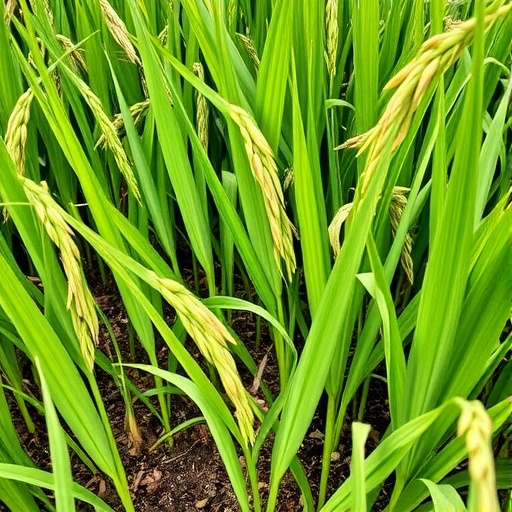
In the quest to enhance global food security and sustainable agriculture, scientists have long pursued innovative strategies to improve nutrient use efficiency in staple crops. A groundbreaking study recently published in Nature Plants unveils a fascinating genetic mechanism in rice that substantially boosts the plant’s organic nitrogen use efficiency by modulating the composition of its rhizosphere microbiota. This discovery not only sheds new light on plant-microbe interactions but also opens new avenues for developing crops that can thrive with reduced fertilizer inputs, mitigating environmental impacts while maintaining high yields.
Nitrogen is a vital macronutrient necessary for plant growth and development; however, its widely used synthetic forms often pose ecological threats due to leaching, greenhouse gas emissions, and eutrophication. In contrast, organic nitrogen, derived from decomposed plant and animal residues, constitutes a significant pool of soil nitrogen but is less efficiently utilized by most crops. The study spearheaded by an international team of plant geneticists and microbiologists uncovers an allele in rice that substantially improves the plant’s ability to harness organic nitrogen through an intricate influence on root-associated microbial communities.
Central to the study is the interrogation of a specific genetic variant—referred to as an allele—within the rice genome that induces notable shifts in the rhizosphere microbiota. The rhizosphere, the narrow region of soil influenced by root secretions and associated microbial activity, serves as a critical interface where plants recruit beneficial microbes that can facilitate nutrient acquisition. The team’s meticulous genomic analysis coupled with high-throughput sequencing techniques revealed that rice plants harboring this allele displayed a distinct microbial consortium enriched in taxa capable of organic nitrogen mineralization and transformation.
What makes this find particularly compelling is how the allele governs root exudate composition, directly shaping microbial community structure and function. By fine-tuning the chemical landscape in the immediate root environment, the allele creates favorable conditions for microbes that possess enzymatic machinery to breakdown complex organic nitrogen compounds into bioavailable forms. This symbiotic relationship significantly enhances nitrogen uptake efficiency, translating to improved plant growth metrics under organic nitrogen regimes, a paradigm shift from conventional nitrogen fertilization approaches.
The researchers conducted extensive field trials spanning multiple environments to validate the robustness of this genetic effect on nitrogen use efficiency. Across diverse soil types and climatic conditions, rice plants carrying the allele consistently outperformed their non-carrier counterparts when cultivated with organic nitrogen sources. Yield analysis showed an appreciable increase not only in biomass accumulation but also in grain protein content, underscoring both quantity and quality improvements attributable to the rhizosphere microbiome modulation.
Delving deeper, metagenomic and metatranscriptomic profiling exposed a fascinating enhancement in microbial genes involved in nitrogen cycling pathways, such as ammonification and nitrification, within the rhizosphere of allele-harboring plants. This enriched functional repertoire underscores a biological feedback loop wherein the plant’s genetic makeup orchestrates beneficial microbial functions, optimizing nutrient dynamics. Such mechanistic insights are invaluable for breeding programs aiming to harness natural plant-microbe partnerships for sustainable agriculture.
Moreover, the ecological implications of this discovery resonate broadly in the context of environmental stewardship. Reduction in synthetic nitrogen fertilizer reliance is an urgent global imperative to curtail pollution and greenhouse gas emissions. By leveraging inherent genetic traits that promote efficient organic nitrogen utilization, farmers can potentially reduce input costs and environmental footprints without sacrificing productivity. This study exemplifies a transformative approach where plant genetics and microbiome science converge to revolutionize crop nutrition paradigms.
The allele’s identification also spotlights the evolutionary interplay between plants and their associated microbial communities. The study’s evolutionary genomics analysis suggests that this allele may have been selected in certain rice populations endemic to low-nitrogen soils with high organic matter content, reflecting an adaptive advantage conferred by optimized microbial recruitment strategies. This insight not only adds depth to our understanding of plant adaptation but also hints at untapped reservoirs of beneficial genetic variation within crop germplasms worldwide.
To harness the full potential of this allele, the authors suggest biotechnological interventions, including marker-assisted selection and gene editing approaches, to incorporate this trait into elite rice cultivars. Such interventions hold promise to expedite the development of varieties that are inherently more efficient at utilizing organic nitrogen sources, making them fit for sustainable agricultural systems, especially in regions reliant on organic amendments or with limited access to synthetic fertilizers.
Beyond rice, this research invites exploration into whether analogous genetic mechanisms exist in other cereal crops or horticultural plants. Unraveling the genetic underpinnings of plant-microbe interactions across diverse species could unlock a new frontier in crop improvement, emphasizing holistic nutrient management rather than solely focusing on plant-centric traits. This cross-disciplinary synergy between plant genetics, microbiology, and soil science is poised to redefine how we conceive plant nutrition in the era of climate change and resource scarcity.
The study further emphasizes the importance of a systems biology perspective to fully comprehend the plant-soil-microbe nexus. Advanced omics technologies, computational modeling, and precision phenotyping collectively enabled the authors to decipher complex interactions underpinning nutrient cycling in the rhizosphere. This integrative approach sets a valuable standard for future research aimed at dissecting multifactorial traits that govern crop performance under variable environmental conditions.
Importantly, this research also touches upon the agricultural socioeconomics linked to nutrient management. Smallholder farmers in developing nations, often constrained by fertilizer costs and availability, stand to benefit immensely from crops with enhanced organic nitrogen use efficiency. Harnessing such natural genetic traits can contribute to food security, poverty alleviation, and sustainable land management, aligning with global development goals.
In addition to nutrient dynamics, the allele’s influence on microbiota composition hints at potential impacts on plant health and disease resistance. Beneficial microbes involved in nutrient cycling often confer protection against soil-borne pathogens and enhance plant stress resilience. While this remains an avenue for future investigations, the possibility of multifaceted benefits arising from rhizosphere engineering through genetic means is an exciting prospect for agriculture.
Another remarkable aspect of this discovery lies in its scalability and compatibility with existing agricultural practices. As organic nitrogen sources such as compost and manure become more widely adopted for sustainable farming, the presence of rice varieties tailored to efficiently exploit these resources can maximize their agronomic returns. This synergy between genetic improvement and agronomic practices represents an adaptive strategy for future-proofing crop production systems.
Beyond academic circles, this breakthrough has catalyzed interest among policymakers and industry stakeholders aiming to champion greener agriculture. The prospect of rice varieties that inherently reduce the need for synthetic nitrogen fertilizers aligns seamlessly with environmental regulations and climate action commitments. Scaling the deployment of such varieties can play a pivotal role in reducing agriculture’s carbon footprint on a global scale.
Finally, this study underscores the transformative potential of plant-microbiome research. By decoding the genomic blueprints governing beneficial symbioses, we are transitioning towards an era where crop improvement transcends classical breeding and enters the realm of microbiome-assisted agriculture. The discovery of this remarkable rice allele exemplifies the power of merging genetic and microbial sciences to unlock sustainable solutions for feeding a growing population while preserving planetary health.
As agriculture navigates the twin challenges of increasing productivity and environmental sustainability, innovations such as this are game-changers. The elucidation of a rice allele that orchestrates rhizosphere microbial communities to enhance organic nitrogen use efficiency heralds a new chapter in crop science—one where the hidden allies beneath our feet become pivotal partners in nurturing future harvests.
Cite Scienmag News
Alan Morgan. (January 30, 2026). Rice Gene Boosts Nitrogen Use via Microbiome. Scienmag. https://scienmag.com/rice-gene-boosts-nitrogen-use-via-microbiome/
Alan Morgan. "Rice Gene Boosts Nitrogen Use via Microbiome." Scienmag, 30 January 2026, https://scienmag.com/rice-gene-boosts-nitrogen-use-via-microbiome/. Accessed 4 September 2026.
Alan Morgan. "Rice Gene Boosts Nitrogen Use via Microbiome." Scienmag. January 30, 2026. https://scienmag.com/rice-gene-boosts-nitrogen-use-via-microbiome/


