


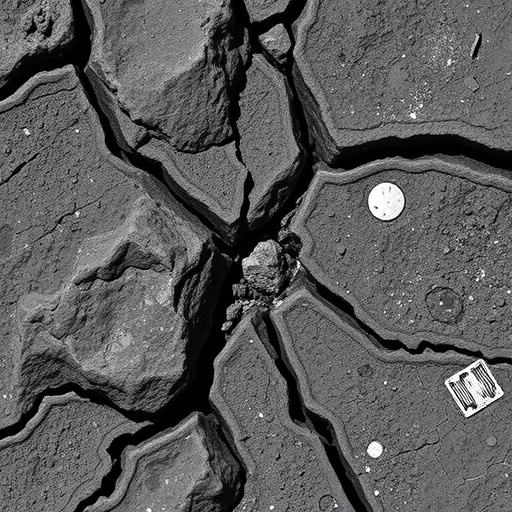
In the ongoing pursuit of understanding the geological and structural dynamics of coal, recent research has surfaced with groundbreaking insights into the propagation of cracks in gas-bearing coal. The study, led by notable researchers including Wang, D., Tang, Y., and Li, W., delves deep into the distinctive behaviors of fractures under varying gas conditions, specifically contrasting adsorptive versus non-adsorptive environments. Through advanced methodologies and meticulous experimentation, the researchers illuminate how variations in gas composition affect the integrity and stability of coal structures, which has significant implications for both extraction processes and geological safety.
Coal, primarily composed of carbon, is a vital energy resource globally. Its structure, however, is not uniform, and its ability to retain gases is influenced by its compositional characteristics. In the study, the authors present a comprehensive analysis of crack propagation, emphasizing the importance of gas-state influence on structural integrity. The concept of adsorption plays a crucial role in this setting, where specific gases interact with the coal matrix, leading to alterations in the mechanical properties of the material. This interaction is not just a surface-level phenomenon; it significantly affects internal crack growth and propagation mechanisms.
In non-adsorptive conditions, where gases don’t integrate with coal materials, the propagation of cracks tends to follow a predictable pattern. The researchers report that under these circumstances, crack growth is primarily driven by stress concentrations. The behavior of these cracks aligns with classical fracture mechanics principles, where the external stress applied to the coal matrix leads to predictable pathways of fracture. Interestingly, the study showcases that even when external conditions are stable, the internal structure of coal can result in unexpected behaviors if not properly accounted for.
Conversely, in adsorptive environments, the dynamic changes presented present a compelling contrast. The researchers found that the presence of adsorbed gases modifies the internal stress responses of coal. This phenomenon enhances the propagation rate of cracks substantially. The gaseous molecules penetrate the coal matrix, altering its physical characteristics and leading to the development of additional internal stresses. These stresses can amplify crack growth, highlighting the intricate connection between the chemical composition of the gas and the mechanical behavior of coal.
The implications of this research extend beyond academic interest; they directly impact industrial practices in coal mining and extraction. A better understanding of crack dynamics allows for enhanced safety protocols and improved recovery methodologies. For instance, in environments where adsorptive gases are likely to be present, mining operations can implement targeted strategies to mitigate risks associated with unexpected fractures. Identifying and understanding the environmental variables are crucial for safeguarding both infrastructure and personnel, making this research pivotal in developing better engineering practices.
One of the notable aspects of the research is its interdisciplinary nature, merging geosciences, materials science, and engineering principles. This complex interplay requires a comprehensive understanding of not only mechanical behaviors but also of chemical interactions at the molecular level. By addressing these multi-faceted challenges, the study sets a precedent for future research that could explore even more intricate dimensions of coal behavior in different environmental contexts.
Furthermore, the researchers employed advanced imaging techniques and computational simulations to elucidate the crack propagation phenomena in real-time. Utilizing tools such as X-ray computed tomography and finite element modeling, they were able to visualize and predict crack behaviors under various conditions with unprecedented accuracy. This methodological innovation significantly enhances the reliability of their findings, making them an important reference for future studies in the discipline.
Through their work, the authors contribute to a long-standing discussion within the geological and engineering communities regarding the best practices for managing and utilizing coal resources sustainably. Understanding fracture mechanics in gas-bearing coal is not just an academic exercise; it has real-world consequences for energy production and resource management. The challenges of balancing economic viability with safety considerations underscore the necessity of ongoing research in this area.
The impact of gas conditions on fracture propagation also raises important questions for environmental sustainability. As the world shifts towards cleaner energy sources, comprehending the behavior of coal in various states will be essential in transitioning to more responsible energy practices. The findings from this study can inform policies that guide coal extraction with an eye toward minimizing environmental damage, ensuring that the energy demands of the future are met in a sustainable way.
In conclusion, the comprehensive exploration of crack propagation behaviors in gas-bearing coal under adsorptive and non-adsorptive conditions, led by Wang et al., represents a significant advancement in the field of coal research. The insights revealed through their work have the potential to transform not only mining and extraction practices but also to influence policy and environmental approaches tied to coal usage. As the industry grapples with the challenges of safety and sustainability, this research serves as a critical reference point for future innovations.
In light of the critical importance of this research, it is clear that collaboration across disciplines will be crucial as scientists work together to further uncover the intricacies of coal behaviour under various conditions. With the mining and energy sectors under increasing scrutiny regarding their environmental impact, studies like this will be vital in ensuring that coal can be utilized more efficiently and safely, providing insights that resonate far beyond the realm of academia.
The path forward for coal research is illuminated by the findings of this investigation. Not only does it provide a clearer picture of the mechanical behaviours of coal under different gas conditions, but it also lays a foundation for future explorations into the rich interplay between geological materials and environmental variables. The call to action is clear: further studies that build on this research will only enhance our understanding of coal dynamics in an ever-changing global energy landscape.
With this knowledge, the energy industry can move confidently towards a future that respects both human and environmental needs, ensuring that coal remains a viable resource while minimizing its footprint. In this regard, the work of Wang et al. significantly contributes to the ongoing dialogue about the responsible management of our planet’s resources, emphasizing the need for continual innovation and research in the fields of geology and materials science.
As the world navigates through the complexities of energy production and its environmental ramifications, studies exploring the deep-seated interactions within coal matrices will undoubtedly play a pivotal role, shaping a sustainable trajectory for the future of energy production.
Wang, D., Tang, Y., Li, W. et al. Characteristics and Mechanisms of Crack Propagation in Gas-Bearing Coal Under Adsorptive Versus Non-Adsorptive Gas Conditions.
Nat Resour Res (2026). https://doi.org/10.1007/s11053-025-10610-x
Cite Scienmag News
Violet Maxwell. (January 30, 2026). Crack Propagation in Gas-Bearing Coal: Adsorption Effects. Scienmag. https://scienmag.com/crack-propagation-in-gas-bearing-coal-adsorption-effects/
Violet Maxwell. "Crack Propagation in Gas-Bearing Coal: Adsorption Effects." Scienmag, 30 January 2026, https://scienmag.com/crack-propagation-in-gas-bearing-coal-adsorption-effects/. Accessed 4 September 2026.
Violet Maxwell. "Crack Propagation in Gas-Bearing Coal: Adsorption Effects." Scienmag. January 30, 2026. https://scienmag.com/crack-propagation-in-gas-bearing-coal-adsorption-effects/


