


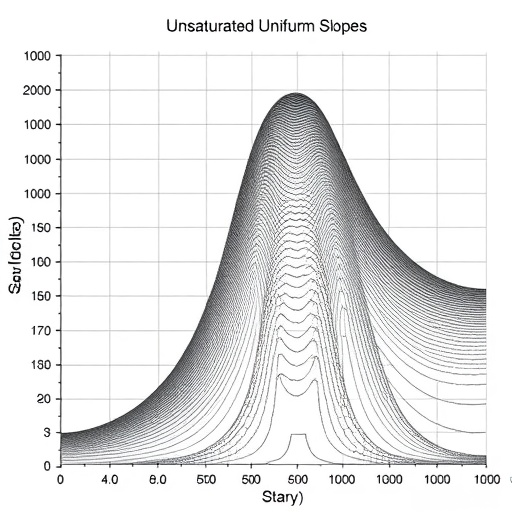
In a groundbreaking advancement bridging geotechnical engineering and environmental earth sciences, a new study has unveiled comprehensive stability charts tailored for unsaturated uniform slopes. These charts, meticulously developed by researcher B.J. Shwan, mark a significant leap forward in our understanding of slope stability under the complex conditions of unsaturated soils—a topic that has challenged engineers and scientists for decades.
Slope stability analysis is crucial for numerous engineering applications, from the design of embankments and cuttings to the assessment of landslide risks in natural terrains. Traditionally, slope stability research has largely focused on fully saturated or dry soils, leaving a critical gap in understanding the behavior of unsaturated slopes. The presence of matric suction and partial pore water pressure in unsaturated soils introduces nonlinearities in soil strength that cannot be adequately captured by conventional methods. Shwan’s study confronts this challenge head-on by deriving stability charts that incorporate the nuanced parameters governing unsaturated soil mechanics.
These stability charts are designed for uniform slopes, where the inclination and soil properties remain constant throughout the slope profile. This assumption simplifies the complex problem without compromising the utility of the results. The charts incorporate critical factors such as the soil’s matric suction, soil-water characteristic curve (SWCC), and shear strength parameters, enabling a direct and practical assessment of slope stability under varying degrees of saturation. Such an approach offers engineers a robust tool to quickly estimate factor of safety values and identify potential failure conditions in slopes exposed to environmental changes.
One of the study’s pivotal contributions is its reliance on advanced soil physics and unsaturated soil mechanics to inform the charts’ development. Unlike conventional saturated soil analyses that use total stress and effective stress concepts, this work applies the extended effective stress principle for unsaturated soils, integrating matric suction’s suction-dependent strength enhancement. This technical sophistication ensures the stability charts do not merely approximate but rather precisely reflect the soil behavior seen in natural and engineered environments.
The study’s methodology involved synthesizing laboratory and field soil data in combination with limit equilibrium analyses to construct the stability charts. By using typical soil parameters, ranges of suction values, and slope angles common in geotechnical practice, the charts cover a broad spectrum of realistic scenarios. This holistic approach enhances their applicability across diverse regions and soil types, offering a universal framework adaptable to local soil characteristics.
A crucial aspect of Shwan’s work is how it facilitates practical decision-making for slope design and hazard mitigation. Before these charts were available, engineers had to rely on complex numerical models and extended field investigations to evaluate slope stability under unsaturated conditions, both time-intensive and costly endeavors. By enabling a rapid visual assessment, the charts empower practitioners to screen slopes effectively and prioritize more detailed investigations where necessary, optimizing resource allocation and improving safety outcomes.
Moreover, the study addresses the dynamic nature of unsaturated slope systems influenced by seasonal moisture fluctuations, rainfall infiltration, and drought cycles. The charts provide insights not only for static stability evaluations but also for understanding how temporal changes in matric suction can precipitate slope failure. Such predictive capability is vital for early warning systems and proactive maintenance of slopes vulnerable to environmental stressors intensified by climate change.
From a theoretical perspective, Shwan’s stability charts reaffirm the importance of incorporating soil-water interactions when analyzing slopes. By explicitly reflecting the enhanced shear strength due to matric suction and detailing its interplay with geometric and material parameters, the charts advance geotechnical theory toward more realistic models. This progression addresses long-standing discrepancies between predicted and observed slope performances, bridging gaps between experimental data and practical design.
The implications of this research resonate beyond traditional engineering fields. Environmental scientists monitoring landslide-prone regions will find these charts invaluable for rapid landscape stability assessments. Urban planners and policymakers tasked with managing infrastructures in mountainous or hilly terrains can leverage this new knowledge to enforce safer land-use regulations, contributing to sustainable development goals.
Furthermore, the stability charts open avenues for future research into non-uniform and heterogeneous slopes, where spatial variability in soil properties and saturation complicate stability analyses. While the current study focuses on uniform slopes, its methodological framework lays the groundwork for extended models that could eventually address real-world soils’ complexities, including layered stratigraphy and anisotropy.
Critical to the practical uptake of the charts is their user-friendly format. Presented as clear graphical tools linking suction head, slope angle, and soil cohesion, these charts promote their integration into standard engineering practice. This user accessibility contrasts with often esoteric numerical modeling approaches, making slope stability assessment more inclusive for professionals with varying levels of computational expertise.
In summary, the work presented by B.J. Shwan furnishes the geotechnical community with a powerful new instrument to analyze and predict slope stability within the unsaturated soil regime. By merging theoretical rigor with practical applicability, it addresses a vital but once elusive segment of slope engineering knowledge. Its publication in Environmental Earth Sciences heralds a promising direction for interdisciplinary collaboration in managing earth surface processes sustainably and safely.
Continued adoption and enhancement of these stability charts have the potential to reshape slope risk management globally. Integrating these tools with real-time monitoring, remote sensing data, and climate projections could usher in a new era of smart geotechnical infrastructure capable of responding dynamically to environmental changes. As hillsides and embankments face increasing stressors, such innovations are more urgent than ever to prevent disasters and protect communities.
In essence, this pioneering study is not merely an academic exercise but a breakthrough that translates complex unsaturated soil behaviors into tangible, actionable insights. Its relevance extends from the design office to fieldwork and policy forums, promising to reduce slope failure incidences worldwide. The clarity, precision, and depth of these stability charts are poised to become canonical in geotechnical engineering literature and practice.
As we step into a future where anthropogenic influences and natural processes increasingly destabilize earth surfaces, tools like those developed by Shwan offer essential resilience. They empower engineers and scientists to anticipate failures with greater accuracy, optimize designs, and safeguard ecosystems. This marriage of scientific insight and practical utility exemplifies the best of modern earth sciences.
Ultimately, the significance of this research lies in its potential to save lives, protect infrastructure, and foster an informed relationship with the natural terrain. By illuminating the complex forces at play in unsaturated uniform slopes, it elevates our capacity to coexist sustainably with the dynamic earth beneath our feet. In a world of growing environmental uncertainty, such advancements resonate profoundly with global efforts for risk reduction and adaptive engineering.
Cite Scienmag News
Eleanor C. (January 29, 2026). Stability Charts for Unsaturated Uniform Slopes. Scienmag. https://scienmag.com/stability-charts-for-unsaturated-uniform-slopes/
Eleanor C. "Stability Charts for Unsaturated Uniform Slopes." Scienmag, 29 January 2026, https://scienmag.com/stability-charts-for-unsaturated-uniform-slopes/. Accessed 28 August 2026.
Eleanor C. "Stability Charts for Unsaturated Uniform Slopes." Scienmag. January 29, 2026. https://scienmag.com/stability-charts-for-unsaturated-uniform-slopes/


