


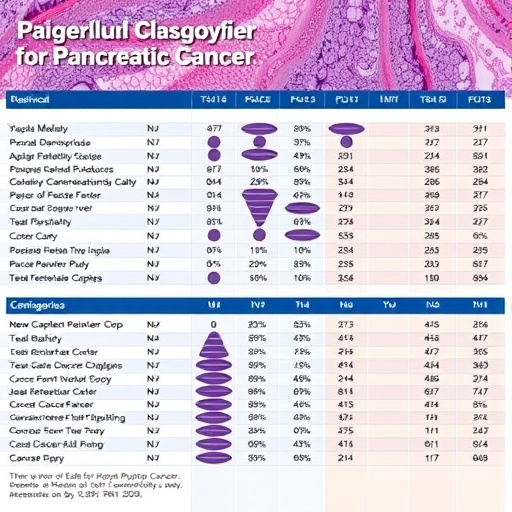
In a groundbreaking study, researchers have embarked on an ambitious journey towards creating a consensus molecular classifier for pancreatic ductal adenocarcinoma (PDAC), a rare but highly lethal form of cancer. Their work, published in the journal Genome Medicine, explores the depths of molecular pathology and genetics to better understand this complex disease. The aggressive nature of PDAC makes it one of the most challenging cancers to diagnose and treat, often leading to dismal patient outcomes. As cancer research continues to evolve, the need for improved diagnostic and prognostic tools has become paramount, which is precisely where this new consensus molecular classifier aims to make a significant impact.
One of the most critical aspects of this research is the utilization of multidisciplinary methodologies to ascertain a comprehensive molecular classification system. The researchers combined various data sources, including gene expression profiles, genomic mutations, and epigenetic alterations, to establish a more robust classification framework. By synthesizing these multiple dimensions of biological information, they were able to enhance the accuracy and predictive power of the molecular classifier. This integrated approach affords clinicians a more nuanced understanding of PDAC, presenting an opportunity to tailor therapeutic strategies that align with the unique characteristics of an individual patient’s tumor.
The process of developing this molecular classifier involved meticulous analysis of numerous existing datasets, which provided a wealth of information regarding the genetic landscape of PDAC. The researchers leveraged advanced bioinformatics tools to dissect these datasets, identifying key biomarkers associated with the disease’s progression and response to treatment. This rigorous computational analysis allowed for the validation of new molecular subtypes within PDAC, each with distinct biological behaviors and clinical implications. These findings underscore the heterogeneity of PDAC and the necessity for personalized medicine in treating this aggressive cancer.
Moreover, the study highlights the significance of interdisciplinary collaboration among molecular biologists, oncologists, and bioinformaticians. Such collaborative efforts have become increasingly vital in the cancer research landscape, where the convergence of diverse fields can lead to more innovative solutions for longstanding medical challenges. By fostering a collaborative environment, the research team was able to expedite the development of the molecular classifier, which is poised to change how PDAC is understood and treated in clinical settings.
The researchers also emphasized the importance of reproducibility and consensus when establishing molecular classifiers. The proposed classifier incorporates input from various existing classification systems, aiming to unify disparate findings in the literature under a single framework. This consensus approach not only enhances the reliability of the classifier but also facilitates its adoption in clinical practice, paving the way for more standardized treatment protocols for PDAC patients. The goal is to create a resource that oncologists can readily apply in their diagnostic workflows, thereby improving patient stratification and treatment outcomes.
In addition to its clinical implications, the development of this consensus molecular classifier could revolutionize research in pancreatic cancer. With a standardized classification system in place, future studies can utilize these molecular subtypes as a foundation for investigating novel therapeutic agents and treatment strategies. This could open up new avenues for clinical trials, fostering a more strategic approach to drug development targeting specific subpopulations of PDAC.
Importantly, the findings of this study are not only limited to therapeutic decision-making; they also hold promise for earlier detection of PDAC. The incorporation of molecular markers into screening protocols could potentially enhance the identification of the disease in its nascent stages, a critical factor since early detection is often linked to improved survival rates. The research team is optimistic that their consensus molecular classifier could eventually be integrated into routine diagnostic practices, allowing for timely intervention.
As the study progresses, the researchers have plans to expand their work by validating the classifier on independent cohorts of PDAC patients. This step is vital to ascertain the classifier’s clinical utility and robustness across diverse populations. By confirming the effectiveness of the consensus molecular classifier in a broader context, the research team hopes to solidify its role as a groundbreaking tool in the ongoing battle against pancreatic cancer.
The implications of this research extend beyond the immediate clinical applications. With an increasingly diverse genetic landscape of cancers, the need for similar molecular classifications for other forms of cancer is more apparent than ever. This study serves as a model for how molecular consensus approaches can be tailored to various malignancies, potentially paving the way for comprehensive classification systems across oncology.
Ultimately, the work undertaken by Villoslada-Blanco and colleagues represents a significant leap forward in the understanding and treatment of pancreatic ductal adenocarcinoma. By bridging the gap between molecular biology and clinical oncology, the researchers hope to contribute to a future where PDAC is no longer an insurmountable challenge for patients and healthcare providers alike. As the landscape of cancer research continues to evolve, this consensus molecular classifier may well lead to a new era of personalized medicine, where treatment decisions are based on the molecular underpinnings of individual tumors.
The potential of this classifier to reshape patient management strategies in PDAC is immense. With ongoing research and validation, it could soon be an integral component of clinical decision-making, influencing everything from initial diagnostics to therapeutic choices. The collaboration of diverse experts in this study exemplifies the future direction of cancer research—one marked by integration, innovation, and ultimately, improved patient care.
As the findings gain wider attention in the scientific community, there is growing anticipation regarding how this classifier could impact the future of cancer research. Researchers worldwide are closely monitoring the developments emanating from this study, with hopes that it might stimulate further inquiries and advancements in molecular classification for various cancers. The need for pioneering solutions in cancer treatment is urgent, and studies like this one serve as a beacon of hope for millions affected by this complex disease.
In conclusion, the development of a consensus molecular classifier for pancreatic ductal adenocarcinoma marks a significant milestone in cancer research. The comprehensive, data-driven approach employed by the research team promises to enhance our understanding of this aggressive disease and improve patient care. As the scientific community embraces this innovative framework, the potential for breakthroughs in pancreatic cancer treatment and diagnosis remains boundless.
Villoslada-Blanco, P., Alonso, L., Sabroso-Lasa, S. et al. Development of a consensus molecular classifier for pancreatic ductal adenocarcinoma.
Genome Med 17, 142 (2025). https://doi.org/10.1186/s13073-025-01568-9
Cite Scienmag News
Juliet Wilcox. (January 29, 2026). New Molecular Classifier for Pancreatic Cancer Unveiled. Scienmag. https://scienmag.com/new-molecular-classifier-for-pancreatic-cancer-unveiled/
Juliet Wilcox. "New Molecular Classifier for Pancreatic Cancer Unveiled." Scienmag, 29 January 2026, https://scienmag.com/new-molecular-classifier-for-pancreatic-cancer-unveiled/. Accessed 4 September 2026.
Juliet Wilcox. "New Molecular Classifier for Pancreatic Cancer Unveiled." Scienmag. January 29, 2026. https://scienmag.com/new-molecular-classifier-for-pancreatic-cancer-unveiled/


