


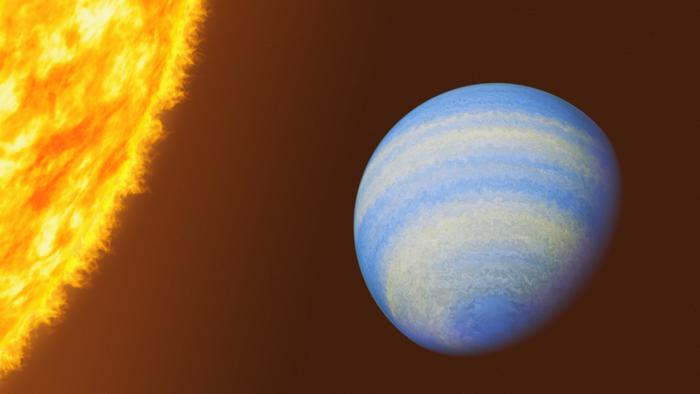
An exoplanet infamous for its deadly weather has been hiding another bizarre feature—it reeks of rotten eggs, according to a new Johns Hopkins University study of data from the James Webb Space Telescope.

Credit: Roberto Molar Candanosa/Johns Hopkins Univeristy
An exoplanet infamous for its deadly weather has been hiding another bizarre feature—it reeks of rotten eggs, according to a new Johns Hopkins University study of data from the James Webb Space Telescope.
The atmosphere of HD 189733 b, a Jupiter-sized gas giant, has trace amounts of hydrogen sulfide, a molecule that not only gives off a stench but also offers scientists new clues about how sulfur, a building block of planets, might influence the insides and atmospheres of gas worlds beyond the solar system.
The findings are published today in Nature.
“Hydrogen sulfide is a major molecule that we didn’t know was there. We predicted it would be, and we know it’s in Jupiter, but we hadn’t really detected it outside the solar system,” said Guangwei Fu, an astrophysicist at Johns Hopkins who led the research. “We’re not looking for life on this planet because it’s way too hot, but finding hydrogen sulfide is a stepping stone for finding this molecule on other planets and gaining more understanding of how different types of planets form.”
In addition to detecting hydrogen sulfide and measuring overall sulfur in HD 189733 b’s atmosphere, Fu’s team precisely measured the main sources of the planet’s oxygen and carbon—water, carbon dioxide, and carbon monoxide.
“Sulfur is a vital element for building more complex molecules, and—like carbon, nitrogen, oxygen, and phosphate—scientists need to study it more to fully understand how planets are made and what they’re made of,” Fu said.
At only 64 light-years from Earth, HD 189733 b is the nearest “hot Jupiter” astronomers can observe passing in front of its star, making it a benchmark planet for detailed studies of exoplanetary atmospheres since its discovery in 2005, Fu said.
The planet is about 13 times closer to its star than Mercury is to the sun and takes only about two Earth days to complete an orbit. It has scorching temperatures of 1,700 degrees Fahrenheit and is notorious for vicious weather, including raining glass that blows sideways on winds of 5,000 mph.
As it did by detecting water, carbon dioxide, methane, and other critical molecules in other exoplanets, Webb gives scientists yet another new tool to track hydrogen sulfide and measure sulfur in gas planets outside the solar system.
“Say we study another 100 hot Jupiters and they’re all sulfur enhanced. What does that mean about how they were born and how they form differently compared to our own Jupiter?” Fu said.
The new data also ruled out the presence of methane in HD 189733 b with unprecedented precision and infrared wavelength observations from the Webb telescope, countering previous claims about that molecule’s abundance in the atmosphere.
“We had been thinking this planet was too hot to have high concentrations of methane, and now we know that it doesn’t,” Fu said.
The team also measured levels of heavy metals like those on Jupiter, a finding that could help scientists answer questions about how a planet’s metallicity correlates to its mass, Fu said.
Less-massive giant icy planets like Neptune and Uranus contain more metals than those found in gas giants like Jupiter and Saturn, the largest planets in the solar system. The higher metallicities suggest Neptune and Uranus accumulated more ice, rock, and other heavy elements relative to gases like hydrogen and helium during early periods of formation. Scientists are testing whether that correlation also holds true for exoplanets, Fu said.
“This Jupiter-mass planet is very close to Earth and has been very well studied. Now we have this new measurement to show that indeed the metal concentrations it has provide a very important anchor point to this study of how a planet’s composition varies with its mass and radius,” Fu said. “The findings support our understanding of how planets form through creating more solid material after initial core formation and then are naturally enhanced with heavy metals.”
In coming months, Fu’s team plans to track sulfur in more exoplanets and figure out how high levels of that compound might influence how close they form near their parent stars.
“We want to know how these kinds of planets got there, and understanding their atmospheric composition will help us answer that question,” Fu said.
This research was supported by NASA through the JWST GO program.
Other authors are Luis Welbanks, Dana R. Louie, and Michael Line of Arizona State University; Drake Deming, Jegug Ih, Arjun B. Savel, Eliza M.-R. Kempton, and Matt Nixon of University of Maryland; Julie Inglis and Heather A. Knutson of California Institute of Technology; Michael Zhang of University of Chicago; Joshua Lothringer of Utah Valley University; Julianne I. Moses and Gregory Henry of Tennessee State University; Everett Schlawin of University of Arizona; David K. Sing of Johns Hopkins; and Thomas Greene of NASA Ames Research Center.
Journal
Nature
Method of Research
Observational study
Subject of Research
Not applicable
Article Title
Hydrogen sulfide and metal-enriched atmosphere for a Jupiter-mass exoplanet
Article Publication Date
8-Jul-2024
Cite Scienmag News
Grant Pearson. (July 8, 2024). Stench of a gas giant? Nearby exoplanet reeks of rotten eggs. And that’s a good thing. Scienmag. https://scienmag.com/stench-of-a-gas-giant-nearby-exoplanet-reeks-of-rotten-eggs-and-thats-a-good-thing/
Grant Pearson. "Stench of a gas giant? Nearby exoplanet reeks of rotten eggs. And that’s a good thing." Scienmag, 8 July 2024, https://scienmag.com/stench-of-a-gas-giant-nearby-exoplanet-reeks-of-rotten-eggs-and-thats-a-good-thing/. Accessed 8 September 2026.
Grant Pearson. "Stench of a gas giant? Nearby exoplanet reeks of rotten eggs. And that’s a good thing." Scienmag. July 8, 2024. https://scienmag.com/stench-of-a-gas-giant-nearby-exoplanet-reeks-of-rotten-eggs-and-thats-a-good-thing/

