


The cosmos, a canvas of unfathomable scale and bewildering phenomena, continues to challenge our understanding of reality. Among its most enigmatic inhabitants are black holes, celestial entities so dense that not even light can escape their gravitational clutches. For decades, these cosmic titans have been the subject of intense scientific scrutiny, pushing the boundaries of theoretical physics and offering glimpses into the very fabric of spacetime. Now, a groundbreaking new study published in the European Physical Journal C unveils a novel perspective on these enigmatic objects, proposing the existence of “Topological Mod(A)Max AdS black holes.” This research ventures into the realm of modified gravity theories and the complex interplay between topology and black hole thermodynamics, potentially reshaping our perception of gravity in extreme environments and hinting at a universe far more intricate than previously imagined.
At the heart of this revelation lies the concept of gravity itself, a force we experience daily but whose ultimate nature remains a profound mystery. Einstein’s General Relativity, while spectacularly successful in describing gravity on macroscopic scales, encounters profound challenges when applied to the singularities at the heart of black holes or the very beginning of the universe. This has spurred physicists to explore “modified gravity” theories, which propose alterations to Einstein’s equations to better account for these extreme conditions. The research on Topological Mod(A)Max AdS black holes operates within this fertile ground of theoretical exploration, suggesting that by modifying the gravitational framework, we can uncover new, potentially more stable and realistic, black hole solutions that align with observational cosmologies and offer a richer understanding of quantum gravity.
The term “AdS” in “AdS black holes” refers to Anti-de Sitter space, a theoretical concept in cosmology characterized by a negative cosmological constant. This type of spacetime is crucial in theoretical physics, particularly in the context of the AdS/CFT correspondence, a powerful duality that links gravitational theories in AdS space with quantum field theories on its boundary. Understanding black holes in AdS spacetimes is therefore vital not only for comprehending gravity but also for exploring the fundamental nature of quantum information and the emergence of spacetime itself. The current work extends this exploration by investigating black hole solutions within a modified gravitational framework, specifically within an AdS background, aiming to resolve some of the limitations of standard black hole models.
The “Mod(A)Max” aspect of these newly theorized black holes points to a specific modification being applied to the gravitational theory. While the precise details of this modification are complex and rooted in advanced theoretical physics, it suggests an approach to gravity that accounts for phenomena not fully captured by General Relativity, potentially involving higher-order curvature invariants or additional fields. Such modifications are often motivated by the quest to achieve a more consistent description of gravity at both very large and very small scales, and to provide a framework where black holes, especially those in cosmological settings, behave in ways that are more amenable to study and observation, bridging the gap between theoretical predictions and experimental verification.
Furthermore, the introduction of “topological” considerations is a significant departure from many standard black hole studies. Topology, in mathematics, deals with the properties of objects that are preserved under continuous deformations, essentially looking at the shape and connectivity of space. Applying this to black holes means that their fundamental structure and classification might depend not just on their mass and charge, but also on these topological features. This could lead to black holes with more intricate internal geometries or different thermodynamic properties, depending on how these topological invariants influence the spacetime metric and the curvature invariants that define them.
The study delves into the thermodynamic properties of these Topological Mod(A)Max AdS black holes, a field that has seen remarkable progress with the discovery of the Bekenstein-Hawking entropy. Black holes, despite their fearsome reputation, are understood to possess thermodynamic qualities like temperature and entropy. This apparent paradox, merging gravitational objects with thermodynamic laws, has been a driving force behind the search for a quantum theory of gravity. The new research aims to explore how the topological characteristics and the modified gravity framework influence these thermodynamic quantities, potentially leading to new insights into black hole evaporation, information paradox, and the very nature of entropy in the universe.
One of the critical aspects explored in this research is the behavior of black holes in the context of modified gravity theories under phase transitions. Similar to how water can transform from ice to liquid to gas, black holes can exhibit phase transitions where their thermodynamic properties change abruptly. Understanding these transitions in a modified gravitational framework, and how they are affected by topology, is crucial for building a comprehensive picture of black hole physics and their role in cosmic evolution. The possibility of new types of phase transitions or alterations to existing ones could have profound implications for our understanding of stellar evolution and the large-scale structure of the universe.
The mathematical framework underpinning this research involves complex calculations and theoretical constructs, pushing the boundaries of what is currently understood in theoretical physics. The derivation of these Topological Mod(A)Max AdS black hole solutions likely involves intricate tensor calculus, differential geometry, and advanced field theory techniques. The researchers have navigated these complexities to present a theoretical model that, while abstract, offers a tangible roadmap for future investigations and potentially for observational verification in the long run, even if direct observation of such exotic black holes remains a distant prospect.
The implications of discovering stable and physically meaningful Topological Mod(A)Max AdS black holes are far-reaching. They could provide valuable theoretical laboratories for testing quantum gravity scenarios, offering insights into the early universe, and perhaps even explaining some of the persistent cosmological puzzles, such as the nature of dark energy and dark matter. This research is not merely an academic exercise; it is a significant step towards a more unified and complete description of the physical universe, bridging the gap between the macroscopic realm of gravity and the quantum world of elementary particles.
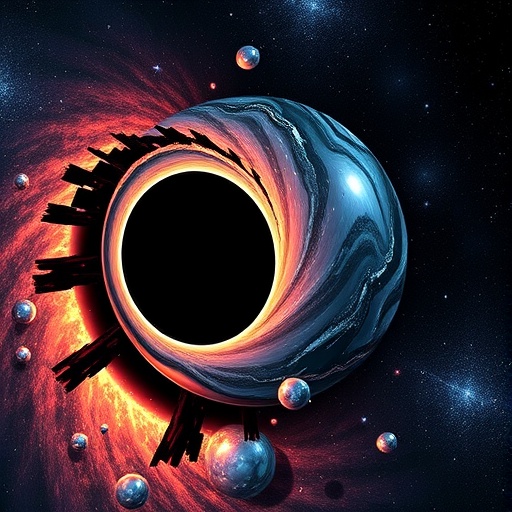
The visual representation accompanying this announcement, likely generated by artificial intelligence, hints at the complex geometric structures and exotic nature of these theorized black holes. While current visualizations of black holes are based on General Relativity, this AI depiction could be an artist’s impression inspired by the novel topological and modified gravity aspects of the new solutions, offering a glimpse into theoretical possibilities that transcend our current observational capabilities and visual metaphors for cosmic phenomena. The abstract nature of the image underscores the cutting-edge theoretical work involved.
The methodology likely involved a combination of analytical calculations and potentially numerical simulations to explore the properties of these black holes. Researchers would have started with modified gravitational field equations and imposed specific topological constraints. Solving these equations under the conditions of an Anti-de Sitter spacetime would then yield the metrics describing these new black hole solutions. Investigating their thermodynamic behavior and stability would follow, employing established principles of thermodynamics and advanced analytical techniques to uncover their unique characteristics.
This research contributes to a broader scientific effort to construct a “theory of everything,” a single, coherent theoretical framework that describes all fundamental forces and particles in the universe. Modified gravity theories, and the study of exotic black hole solutions within them, are crucial components of this endeavor. By exploring the landscape of possible gravitational theories, scientists hope to find one that is both mathematically consistent and accurately reflects the observed universe at all scales, from the smallest subatomic particles to the largest cosmic structures.
The European Physical Journal C is a reputable platform for disseminating cutting-edge research in particle physics, quantum field theory, and related areas of theoretical physics. The publication of this study in such a journal signifies its importance and the rigorous peer-review process it has undergone, lending significant credibility to the researchers’ findings and proposals. This ensures that the scientific community can engage with and build upon this potentially paradigm-shifting work.
The scientific community is abuzz with the potential implications of this research. While direct observational evidence for Topological Mod(A)Max AdS black holes is currently unavailable, the theoretical framework provides a fertile ground for future observational strategies and theoretical refinements. Physicists will undoubtedly be scrutinizing these findings, seeking to extend the analysis to other cosmological models and to explore the connections between these exotic black holes and observable cosmic phenomena. The journey to unraveling the universe’s deepest secrets is ongoing, and this study marks a significant stride forward.
This research opens up new avenues for exploring the fundamental nature of spacetime and gravity. The interplay between topology, modified gravity, and black hole thermodynamics offers a rich landscape for theoretical exploration. The development of new mathematical tools and computational techniques will be essential to further investigate the properties and potential observational signatures of these exotic objects. The quest for a deeper understanding of our universe is a continuous process, and each new theoretical insight brings us closer to unlocking its ultimate mysteries, pushing the boundaries of human knowledge into uncharted territories.
Panah, B.E., Hamil, B. & Rodrigues, M.E. Topological Mod(A)Max AdS black holes.
Eur. Phys. J. C 86, 81 (2026). https://doi.org/10.1140/epjc/s10052-025-15269-5
Cite Scienmag News
Katie Riggs. (January 27, 2026). Topology Unlocks Quantum Gravity’s Black Holes. Scienmag. https://scienmag.com/topology-unlocks-quantum-gravitys-black-holes/
Katie Riggs. "Topology Unlocks Quantum Gravity’s Black Holes." Scienmag, 27 January 2026, https://scienmag.com/topology-unlocks-quantum-gravitys-black-holes/. Accessed 4 September 2026.
Katie Riggs. "Topology Unlocks Quantum Gravity’s Black Holes." Scienmag. January 27, 2026. https://scienmag.com/topology-unlocks-quantum-gravitys-black-holes/


