


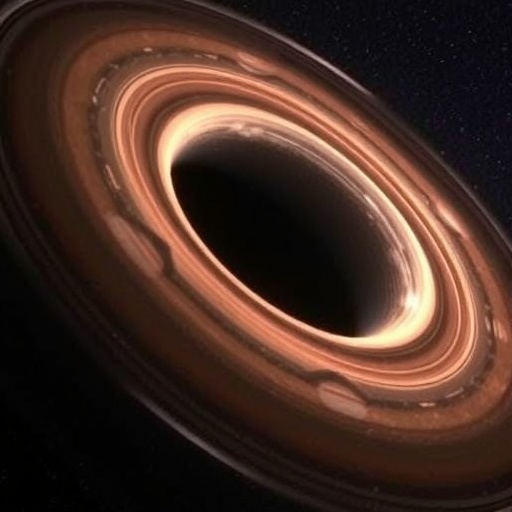
The universe, a cosmic tapestry woven with gravitational threads, has long held black holes as its most enigmatic inhabitants. These celestial behemoths, born from the death throes of massive stars, warp spacetime so profoundly that nothing, not even light, can escape their clutches. For decades, our understanding of black holes has been largely governed by Einstein’s theory of general relativity, which paints a picture of simple, uncharged, and non-rotating entities described by just two parameters: mass and spin. However, the cosmos is rarely so tidy, and the possibility of more complex black hole solutions, particularly those arising from more intricate gravitational theories beyond Einstein’s standard framework, has always lingered at the fringes of astrophysical inquiry. Recent groundbreaking research, delving into the subtle whispers emanating from the vicinity of these cosmic giants, is now challenging these long-held notions and hinting at a universe where gravity might be far more nuanced than we once believed, potentially unraveling secrets that could rewrite our fundamental understanding of reality.
The elegance of the Kerr black hole solution in general relativity, which accurately describes rotating black holes, has served as a cornerstone for much of our theoretical work. It postulates that a rotating black hole is fully characterized by its mass and angular momentum, and beyond these two fundamental properties, its presence exerts no further influence on the external universe, a concept famously dubbed “no-hair.” This simplicity, while mathematically appealing, has left astrophysicists searching for observational signatures that could probe deviations from this ideal scenario. The accretion disks surrounding black holes, swirling vortexes of superheated matter, are cosmic laboratories where these extreme gravitational environments can be scrutinized. The energetic emissions from these disks, particularly the characteristic quasiperiodic oscillations (QPOs), have proven to be incredibly sensitive probes of the spacetime structure in their immediate vicinity, offering tantalizing clues to gravity’s true nature.
Quasiperiodic oscillations are not random fluctuations; they represent coherent, nearly periodic variations in the luminosity of accreting systems, most prominently observed in X-ray binaries and active galactic nuclei, the luminous centers of galaxies powered by supermassive black holes. These oscillations are thought to arise from the orbital motion of matter in the innermost regions of the accretion disk, close to the event horizon. Different models attempt to explain the observed QPO frequencies, with some attributing them to the orbital and epicyclic frequencies of the accretion flow, while others propose resonance phenomena or instabilities within the plasma. The precise frequencies and their relationships are exquisitely sensitive to the gravitational field, thus acting as cosmic clocks that can measure the geometry of spacetime itself.
A particularly intriguing class of black hole solutions arises from extending Einstein’s general relativity into more complex gravitational theories. Among these, Horndeski gravity has garnered significant attention. This theory represents the most general scalar-tensor theory that can be formulated in a way that is free from ghost instabilities, meaning it doesn’t introduce problematic negative-energy states. Horndeski gravity allows for a scalar field to interact with gravity, potentially imprinting unique characteristics onto the spacetime geometry around massive objects, including black holes. The implications of such theories for the structure and behavior of black holes are profound, suggesting that these objects might possess additional “hair” beyond mass and spin, which could manifest in observable phenomena.
The research, published in the prestigious European Physical Journal C, focuses on the theoretical framework of Horndeski rotating black holes and utilizes the observational fingerprints of quasiperiodic oscillations to constrain their parameters. The study by Wu, Guo, and Kuang embarks on a sophisticated theoretical journey, modeling the spacetime around a rotating black hole within the context of Horndeski gravity. This theoretical construct predicts that the presence of the scalar field, an intrinsic feature of Horndeski theories, can subtly alter the gravitational field compared to the standard Kerr solution. These alterations, though potentially minute, are expected to leave an indelible mark on the dynamics of matter orbiting the black hole, particularly in the high-energy environment of an accretion disk.
The key innovation of this research lies in the direct link forged between the abstract theoretical construct of a Horndeski black hole and the observable data of QPOs. The authors meticulously developed a theoretical model that predicts how the characteristic frequencies of QPOs would be modified by the parameters of the Horndeski theory. This involved solving complex Einstein-scalar field equations and then analyzing the resulting spacetime metric to determine the orbital and epicyclic frequencies of test particles in the vicinity of the black hole. The theoretical framework is not merely an academic exercise; it is designed to be a predictive tool, capable of translating hypothetical gravitational theories into concrete, testable observational consequences.
By establishing a direct correlation between the scalar field coupling strength, the black hole’s spin, and the observed QPO frequencies, the research provides a powerful new avenue for testing fundamental physics. The idea is that if we can precisely measure the QPO frequencies from an astrophysical black hole and, through other astrophysical means, accurately determine its mass and spin (e.g., from the relativistic iron line in its spectrum), then any deviation from the predictions of general relativity could be attributed to the effects of a broader gravitational theory like Horndeski gravity. The paper outlines the precise mathematical relationships that govern these frequencies, offering a blueprint for future observational campaigns to seek out evidence for deviations from Einstein’s gravity.
The study quantifies how deviations from the standard Kerr metric, induced by the scalar field in Horndeski gravity, would translate into shifts in the QPO frequencies. Imagine the spacetime around a black hole as a fabric. In Einstein’s theory, this fabric is smooth and predictable. In Horndeski gravity, the presence of the scalar field can introduce subtle wrinkles and distortions. These ripples in the fabric directly influence how matter orbits the black hole, affecting its speed and the frequencies of its oscillations. The research provides the mathematical tools to precisely map these subtle distortions to observable effects, making the unseen gravitational environment tangible for astrophysical detection.
One of the most exciting aspects of this research is its potential to constrain the parameter space of Horndeski gravity. Gravitational theories beyond general relativity often introduce new parameters that dictate the strength of the scalar field’s interaction with gravity. The QPO data, when analyzed through the lens of this new theoretical framework, can effectively “weigh” these parameters, setting limits on their possible values. This is crucial for narrowing down the landscape of theoretical physics, allowing us to discard models that are inconsistent with astronomical observations and focus on those that remain, bringing us closer to a complete theory of gravity.
The paper meticulously details the analytical derivation of the expressions for the QPO frequencies in the context of a rotating Horndeski black hole. This involves advanced mathematical techniques to solve the perturbed geodesic equations in the curved spacetime of the black hole. The resulting formulas explicitly depend on the black hole’s spin parameter, the mass, and crucially, on the parameters characteristic of the Horndeski theory that govern the scalar field’s influence. The precision of these derivations is paramount, as even small theoretical inaccuracies can lead to incorrect interpretations of observational data when trying to constrain fundamental physics.
The researchers highlight that specific observational signatures are predicted for Horndeski black holes that would differ from those of standard Kerr black holes. These differences, though subtle, are expected to be imprinted onto the frequencies and their correlations. For instance, the ratio of different QPO frequencies might deviate from the predictions of general relativity in a way that is uniquely characteristic of Horndeski gravity. Identifying such deviations would be a smoking gun, providing compelling evidence for physics beyond the Einsteinian paradigm and guiding theorists in refining their models of gravity.
The quasiperiodic oscillations observed in the X-ray emissions from black hole systems are believed to originate from the innermost stable circular orbit (ISCO) or some region close to it. This region is where the spacetime curvature is most extreme, and therefore, it is the most sensitive probe of deviations from general relativity. The new research leverages the fact that the orbital dynamics in this highly relativistic regime are profoundly influenced by the specific metric describing the black hole. By analyzing the QPO frequencies, we are essentially probing the metric itself, and any deviation from the Kerr metric would indicate new gravitational physics at play.
Therefore, the study provides a concrete methodology for observational astrophysicists. It offers a set of predictions that can be tested against real-world data from X-ray telescopes. The future success of this approach hinges on the ability to observe black hole systems with sufficient detail and precision to resolve these subtle shifts in QPO frequencies. Advanced observatories with enhanced spectral and timing capabilities will be essential in differentiating between the predictions of general relativity and those of modified gravity theories like Horndeski gravity, ushering in an era of precision tests of gravity in the strong-field regime.
The implications of confirming deviations from general relativity and finding support for theories like Horndeski gravity are immense. It would signify that our current understanding of gravity, while incredibly successful in describing phenomena in weak gravitational fields, might be incomplete in the extreme environments around black holes. This could lead to a paradigm shift in theoretical physics, opening up new avenues of research into the unification of gravity with other fundamental forces and shedding light on the nature of dark energy and dark matter, phenomena that continue to puzzle cosmologists and require modifications to our standard cosmological model.
Furthermore, this research contributes to the broader quest of understanding the fundamental nature of spacetime and gravity. Black holes, by their very nature, are laboratories of extreme physics, pushing the boundaries of our theoretical understanding. By using QPOs as a tool to probe these environments, scientists are not just studying black holes; they are testing the very fabric of reality. The prospect that these cosmic entities might hold the key to resolving some of the most profound mysteries in physics, from the hierarchy problem to the nature of quantum gravity, makes this line of research incredibly exciting and potentially revolutionary for our cosmic worldview.
The study’s findings are not merely an academic exercise; they represent a crucial step towards a more complete picture of the universe. The ability to constrain parameters of alternative gravity theories using astrophysical observations marks a significant advancement in our empirical approach to fundamental physics. As observational capabilities improve and our theoretical models become more sophisticated, the synergy between theory and observation will undoubtedly continue to illuminate the secrets of the cosmos, with rotating black holes and their enigmatic QPOs playing a pivotal role in this ongoing scientific endeavor, potentially revealing that gravity behaves in ways we are only just beginning to imagine.
This research opens up a tantalizing possibility that the “no-hair” theorem, a cornerstone of black hole physics in general relativity, might not hold true for all black holes in more general gravitational theories. If Horndeski black holes do indeed possess scalar “hair,” it would mean that they are not solely characterized by mass and spin, but by additional, observable properties related to the scalar field. This would fundamentally alter our view of black holes, transforming them from the simplest possible solutions to gravity into potentially much richer and more complex objects, with profound implications for their formation, evolution, and interaction with their surroundings.
The paper is a testament to the power of theoretical physics to predict observable phenomena and guide experimental endeavors. By translating the abstract mathematics of modified gravity theories into concrete predictions about the behavior of accreting matter around black holes, Wu, Guo, and Kuang have provided astrophysicists with a crucial set of discriminators. The quest to find deviations from Einstein’s general relativity is one of the most significant challenges in modern physics, and this work offers a promising new tool to achieve that goal, potentially ushering in a new era of gravitational physics illuminated by the complex dance of matter around these ultimate cosmic enigmas.
The detailed mathematical framework presented in the paper allows for the calculation of specific QPO frequency shifts expected from rotating Horndeski black holes for various values of the theory’s parameters and for different spin values of the black hole. This is precisely the kind of predictive power that is needed to conduct actual observational tests. The authors are essentially providing a “fingerprint” for Horndeski gravity on QPO observations, a unique pattern that astronomers can look for in the data. The accuracy of these predictions will be a critical factor in their utility, and the rigorous derivation in this paper aims to provide that accuracy.
The investigation into Horndeski rotating black holes through the lens of quasiperiodic oscillations represents a significant leap forward in our ability to probe the fundamental nature of gravity in the strong-field regime. By connecting the intricate theoretical landscape of modified gravity theories with the observable signatures emanating from the most extreme environments in the universe, this research offers a tangible pathway to test our assumptions about fundamental physics. The subtle variations in the rhythmic pulses of light from accretion disks around black holes, when analyzed with the sophisticated tools developed in this study, could indeed reveal secrets that have long been hidden, potentially reshaping our understanding of the cosmos and our place within it.
Wu, MH., Guo, H. & Kuang, XM. Parameter constraints on Horndeski rotating black hole through quasiperiodic oscillations.
Eur. Phys. J. C 86, 79 (2026). https://doi.org/10.1140/epjc/s10052-025-15244-0
Cite Scienmag News
Grant Pearson. (January 27, 2026). Horndeski Black Holes: Oscillation Clues to Gravity. Scienmag. https://scienmag.com/horndeski-black-holes-oscillation-clues-to-gravity/
Grant Pearson. "Horndeski Black Holes: Oscillation Clues to Gravity." Scienmag, 27 January 2026, https://scienmag.com/horndeski-black-holes-oscillation-clues-to-gravity/. Accessed 4 September 2026.
Grant Pearson. "Horndeski Black Holes: Oscillation Clues to Gravity." Scienmag. January 27, 2026. https://scienmag.com/horndeski-black-holes-oscillation-clues-to-gravity/


