


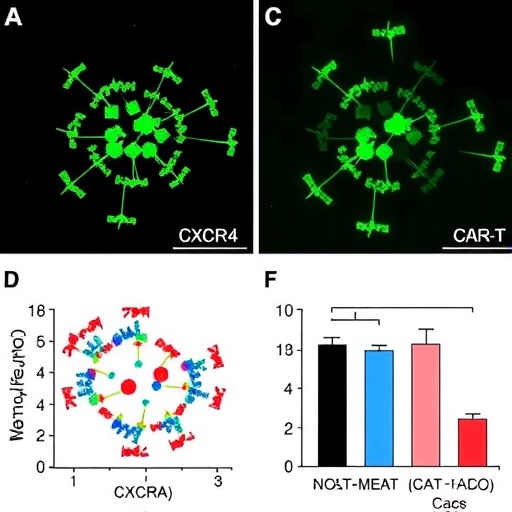
In the relentless quest to harness the immune system’s power to combat cancer, chimeric antigen receptor T cell (CAR-T) therapy has emerged as a transformative force in oncology. Yet, despite remarkable initial successes, durable remission remains a challenge in many patients due to T cell exhaustion. A recent breakthrough study led by Itoh-Nakadai and colleagues, published in Nature Communications, unveils a novel molecular mechanism that steers CAR-T cells toward a memory-like fate, circumventing exhaustion and significantly enhancing long-term leukemia control. This pioneering research spotlights the chemokine receptor CXCR4 as a pivotal regulator that skews CAR-T cells toward memory formation over terminal dysfunction, heralding a paradigm shift in cellular immunotherapy.
CAR-T therapy involves genetically engineering a patient’s T cells to express receptors that recognize specific antigens on cancer cells, enabling targeted eradication. While clinical trials have demonstrated potent anti-tumor effects, a significant impediment to long-lasting efficacy is T cell exhaustion, a state characterized by diminished proliferative capacity, cytokine production decline, and impaired cytotoxic function. Understanding and manipulating the molecular circuitry dictating this fate decision is paramount to optimizing CAR-T cell performance. The study by Itoh-Nakadai et al. provides compelling evidence that CXCR4 signaling critically governs the balance between memory cell differentiation and exhaustion in CAR-T populations.
Leveraging sophisticated murine leukemia models, the researchers meticulously tracked CAR-T cell fate post-transfer and investigated how CXCR4 expression impacts functional persistence. They discovered that CXCR4-expressing CAR-T cells preferentially adopt a central memory phenotype, marked by enhanced self-renewal and robust recall responses. This stands in stark contrast to CXCR4-deficient CAR-T cells, which were prone to rapid exhaustion, characterized by elevated expression of inhibitory receptors and impaired tumor clearance. Their experiments elegantly demonstrated that CXCR4 signaling fortifies CAR-T cells against terminal differentiation, a revelation that could be harnessed to boost therapeutic durability.
Delving deeper into the molecular landscape, the investigators identified that CXCR4 promotes a transcriptional program conducive to memory maintenance. Key transcription factors including TCF-1 and Bcl-6 were upregulated in CXCR4-positive CAR-T cells, orchestrating a gene expression profile that supports longevity and functional resilience. Conversely, the absence of CXCR4 disrupted this balance, leading to enhanced expression of exhaustion-related molecules such as TOX and PD-1. These findings underscore how chemokine receptor-mediated signaling pathways intricately regulate epigenetic and transcriptional networks, dictating the fate of therapeutic T cells within the tumor microenvironment.
Furthermore, the study illuminated how CXCR4 influences CAR-T cell metabolism—a critical determinant of fate and function. Memory T cells rely on oxidative phosphorylation for sustained energy demands, while exhausted cells exhibit metabolic deficits. CXCR4 engagement was found to preserve mitochondrial integrity and enhance metabolic fitness, thus enabling CAR-T cells to endure the hostile tumor milieu. This metabolic preservation not only sustains effector functions but also primes the cells for rapid expansion upon antigen re-encounter, essential for achieving durable remissions.
An exciting translational aspect of this research lies in its therapeutic modulation of CXCR4 pathways. By engineering CAR-T cells with enhanced CXCR4 expression or employing pharmacological agents that augment CXCR4 signaling, the investigators demonstrated superior leukemia targeting and prolonged survival in preclinical models. This approach promises to circumvent one of the major barriers in CAR-T therapy—premature exhaustion—offering a strategy to maintain a pool of memory-like T cells capable of continuous tumor surveillance and elimination.
The implications extend beyond leukemia treatment, as durable CAR-T cell responses are critical in a broad spectrum of malignancies including solid tumors, where the immunosuppressive microenvironment accelerates exhaustion. The delineation of CXCR4’s role as a molecular nexus governing CAR-T cell fate provides a strategic blueprint for next-generation therapies, emphasizing the need to nurture memory formation while suppressing exhaustion-inducing cues. Such refinements could revolutionize immunotherapy paradigms by enhancing efficacy and reducing relapse rates.
Importantly, the research also challenges conventional perceptions of CXCR4 merely as a chemotactic receptor directing T cell trafficking. Itoh-Nakadai and team reveal an underappreciated dimension of CXCR4’s involvement in intrinsic cellular programming, linking extrinsic environmental sensing to intrinsic epigenetic remodeling. This insight broadens our understanding of T cell biology and signals a call to re-evaluate chemokine receptors as multifaceted modulators of immune cell fate rather than mere navigational aids.
Moreover, the study reported that CXCR4’s protective effects on CAR-T cells were not associated with increased off-target toxicity or aberrant immune activation, a crucial consideration in clinical contexts. This indicates that enhancing CXCR4 signaling could safely augment CAR-T cell persistence without compromising safety, a frequent concern in the application of increasingly potent immunotherapies.
The approach taken by the researchers combined cutting-edge single-cell transcriptomics, functional assays, and in vivo leukemia models, offering a comprehensive picture of how CXCR4 influences CAR-T cell states over time. Such integrative methodologies afford unprecedented granularity in deciphering immune cell dynamics and pave the way for more sophisticated cellular engineering techniques tailored to harness specific molecular pathways favoring therapeutic success.
Another remarkable facet of this discovery is its potential to synergize with existing checkpoint blockade strategies. Since exhaustion is often defined by upregulation of inhibitory receptors like PD-1, combining CXCR4-mediated memory promotion with PD-1/PD-L1 inhibitors may yield additive or even synergistic benefits. This combinatorial approach holds promise to reinvigorate exhausted CAR-T cells and sustain their antitumor activity in hostile microenvironments.
The findings also prompt a re-examination of the tumor microenvironment’s influence on CAR-T outcomes. Tumor niches frequently exhibit altered chemokine landscapes that can subtly skew T cell fate. By modulating CXCR4, it may be possible to recalibrate how CAR-T cells sense and respond to the microenvironment, improving their fitness and infiltrative capacity while mitigating exhaustion-inducing signals.
Moving forward, the challenge lies in translating these preclinical insights to clinical practice. Human CAR-T cell therapies targeting hematological malignancies and solid tumors could incorporate CXCR4 enhancement strategies, but safety, dosing, and efficacy must be rigorously evaluated through clinical trials. Additionally, exploring the interplay between CXCR4 and other chemokine receptors or co-stimulatory pathways may uncover further avenues to fine-tune CAR-T functionality.
In summary, Itoh-Nakadai et al. have illuminated an elegant mechanism whereby CXCR4 signaling preferentially drives memory formation in CAR-T cells, acting as a crucial lever to bypass exhaustion and achieve sustained leukemia targeting. This work not only advances the scientific community’s understanding of T cell biology but also provides a tangible strategy to improve immunotherapeutic outcomes. As CAR-T cell therapy evolves, integrating insights into molecular fate regulation will be key to unleashing the full curative potential of these living drugs.
The convergence of immunology, molecular biology, and genetic engineering exemplified in this study marks a critical milestone on the path toward next-generation cellular immunotherapies. By rewriting the fate of CAR-T cells through CXCR4 modulation, researchers are forging a new frontier where durable, potent, and safe cancer treatments become an attainable reality. The ripple effects of this discovery will undoubtedly stimulate a wave of innovation seeking to capitalize on memory over exhaustion—a principle that could redefine success in cancer immunotherapy.
Cite Scienmag News
Nathaniel Bowman. (January 26, 2026). CXCR4 Boosts Memory, Limits Exhaustion in CAR-T Cells. Scienmag. https://scienmag.com/cxcr4-boosts-memory-limits-exhaustion-in-car-t-cells/
Nathaniel Bowman. "CXCR4 Boosts Memory, Limits Exhaustion in CAR-T Cells." Scienmag, 26 January 2026, https://scienmag.com/cxcr4-boosts-memory-limits-exhaustion-in-car-t-cells/. Accessed 4 September 2026.
Nathaniel Bowman. "CXCR4 Boosts Memory, Limits Exhaustion in CAR-T Cells." Scienmag. January 26, 2026. https://scienmag.com/cxcr4-boosts-memory-limits-exhaustion-in-car-t-cells/


