


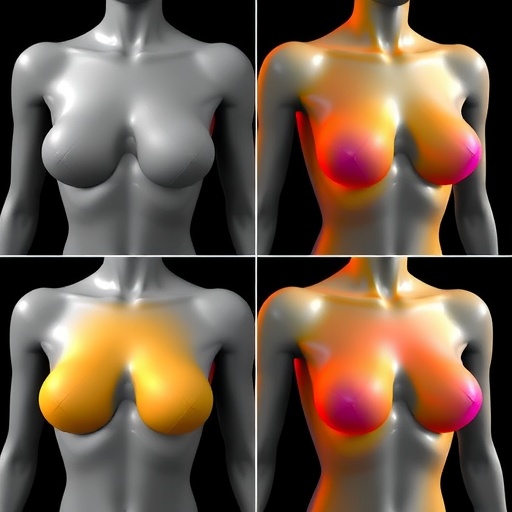
In a groundbreaking study recently published in the Annals of Biomedical Engineering, researchers have taken a significant leap in understanding the mechanical behavior of breasts, particularly focusing on natural breasts versus those augmented with silicone implants. The study led by prominent researchers Zhang, Y., Zhang, H., and Hu, J. explores the intricacies of breast biomechanics using innovative subject-specific finite element modeling. This advanced technique allows for a detailed analysis of the physical properties that play a crucial role in breast augmentation outcomes, ultimately influencing both aesthetic and clinical practices in cosmetic surgery.
The impetus behind this study stems from the growing popularity of breast augmentations worldwide. As more women opt for silicone implants to enhance their physical appearance, there has been an increasing demand for comprehensive understanding of the mechanical interactions between natural breast tissue and artificial implants. The objective of the research was to provide a thorough evaluation that could inform surgical practices and postoperative care, ensuring that women receive the best outcomes possible from their augmentation procedures.
Finite element modeling (FEM) stands at the forefront of this research, serving as a powerful computational tool that enables researchers to simulate and study complex physical phenomena. By creating detailed models of breast tissue—both natural and augmented—the researchers can analyze stress distributions, tissue deformations, and interactions between the implants and surrounding biological structures. This modeling approach not only contributes to a deeper understanding of breast mechanics but also paves the way for advancements in personalized medicine, allowing for tailored solutions based on individual anatomical variations.
The study specifically compared the biomechanical properties of natural breasts with those of breasts post-augmentation. Utilizing high-resolution imaging techniques, the researchers constructed intricate models that highlight the differences in elasticity, density, and overall biomechanical behavior. This evaluation revealed crucial insights not only into how silicone implants behave under various physiological conditions but also how they interact with the existing breast tissues, potentially affecting the longevity and aesthetic results of augmentations.
One of the notable findings of this research is the identification of key factors that influence the success of breast augmentations. For instance, the study emphasizes how silicone implant size, placement, and the characteristics of surrounding tissues can lead to varying results in terms of aesthetics and patient satisfaction. Understanding these variables is vital as it sheds light on why some women may experience complications or dissatisfaction after surgery while others enjoy successful outcomes.
Interestingly, the researchers also uncovered the role of gravity in the behavior of augmented breasts. Natural breasts have their own weight distribution and gravitational effects, whereas silicone implants alter this dynamic significantly. The differential movement patterns and stresses created by gravity were simulated in FEM studies, revealing how these factors contribute to the overall appearance and feel of augmented breasts over time.
Another critical aspect of this research is the attention it pays to the limitations and potential risks associated with silicone implants. By simulating conditions that may lead to implant rupture or capsule formation, the study provides invaluable risk assessments that could inform clinical guidelines. This proactive approach seeks to reduce complications and enhance patient safety, which remains a central concern within the field of cosmetic surgery.
Moreover, the findings of this study contribute to the ongoing discourse surrounding body image and aesthetics. Aesthetic preferences can greatly influence patient decisions regarding breast augmentation. Having a transparent understanding of the physical implications of augmentation allows practitioners to guide individuals towards realistic expectations, promoting mental well-being alongside physical transformations.
As part of their efforts, the research team highlights the importance of personalized surgical planning. By adopting a subject-specific approach, surgeons can leverage insights from FEM to make informed decisions that align with the unique anatomy of each patient. This tailored strategy aims to optimize surgical outcomes while ensuring the individual feels confident and satisfied with their body following the procedure.
In addition to its clinical applications, the study also has broader implications for the fields of materials science and tissue engineering. The insights gleaned from the mechanical properties of breast tissues and silicone implants could inform the development of new biomaterials designed to mimic natural tissue behavior. Such innovations may soon lead to improved implant designs that enhance compatibility with the human body, reduce adverse effects, and elevate aesthetic results.
The collaborative research underscores the potential of interdisciplinary techniques, merging fields such as engineering, medicine, and aesthetics. The findings reinforce the need for ongoing research into breast biomechanics, as the knowledge generated can have wide-ranging applications influencing multiple facets of women’s health.
As surgeons and practitioners digest these groundbreaking findings, a new era of informed breast augmentation practices may soon emerge. The use of advanced modeling techniques could revolutionize patient consultations, allowing for a more scientifically grounded approach to cosmetic procedures. Such advancements not only promise improved short-term success rates but also contribute to long-term satisfaction and well-being for patients.
In conclusion, the study conducted by Zhang and colleagues is a pivotal contribution to the field of biomedical engineering, particularly in understanding the complex interplay of natural and augmented breast tissues. By employing subject-specific finite element modeling, this research has laid the groundwork for more effective, safer, and satisfying outcomes in breast augmentation surgeries. It is clear that as technology advances, so too will our understanding of human anatomy and the innovations that can emerge from this knowledge.
Cite Scienmag News
Ophelia Keating. (January 24, 2026). Comparing Natural and Augmented Breasts via Finite Element Modeling. Scienmag. https://scienmag.com/comparing-natural-and-augmented-breasts-via-finite-element-modeling/
Ophelia Keating. "Comparing Natural and Augmented Breasts via Finite Element Modeling." Scienmag, 24 January 2026, https://scienmag.com/comparing-natural-and-augmented-breasts-via-finite-element-modeling/. Accessed 31 August 2026.
Ophelia Keating. "Comparing Natural and Augmented Breasts via Finite Element Modeling." Scienmag. January 24, 2026. https://scienmag.com/comparing-natural-and-augmented-breasts-via-finite-element-modeling/


