


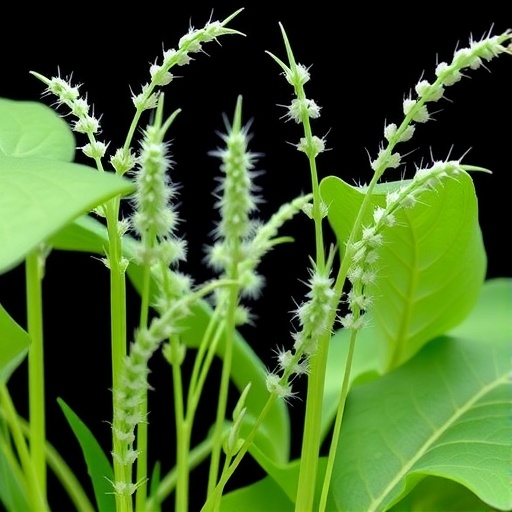
In the world of plant genetics, the study of gene families can often illuminate critical pathways that govern plant resilience to diseases. A recent exploration by Ferreira, dos Santos Oliveira, and Pereira focuses on the WAK/WAKL gene family in Phaseolus vulgaris, commonly known as the common bean. This research provides a comprehensive genomic characterization of this gene family and sheds light on its expression profile when faced with the challenges of Colletotrichum lindemuthianum infection. Understanding the interactions between host plants and pathogens is vital for developing disease-resistant crops, which is of utmost importance in agricultural sustainability.
The significance of the WAK/WAKL gene family cannot be understated as these receptor-like kinases play a pivotal role in plant immunity. They are integral to the perception of pathogen-associated molecular patterns (PAMPs) and the induction of defense responses. By exploring the context of Phaseolus vulgaris, the researchers aim to decipher how plants defend themselves against a virulent fungal pathogen. The conclusions drawn from their genomic analyses not only enhance our understanding of plant-pathogen interactions but also have practical implications for breeding programs aiming to enhance disease resistance.
The study utilizes cutting-edge genomic technologies to characterize the WAK/WAKL gene family within the bean’s genome. With advanced sequencing techniques, the researchers identified the full complement of WAK/WAKL genes, elucidating their structural characteristics and evolutionary relationships. This foundational work provides an essential reference for future studies that seek to exploit these genes for enhancing plant immunity. The identification of these genes is the first step towards understanding how they can be manipulated for better agricultural outcomes.
Moreover, the expression analysis of the WAK/WAKL genes during Colletotrichum lindemuthianum infection reveals vital insights into the dynamic nature of plant defense mechanisms. The researchers measured gene expression levels at various time points post-infection, painting a comprehensive picture of the bean’s defensive response. The temporal patterns observed suggest that certain WAK/WAKL genes are upregulated in response to pathogen attack, highlighting their significance in the early stages of plant defense. These findings pave the way for targeted breeding strategies aimed at enhancing expression levels of specific WAK/WAKL genes, thus increasing the resilience of beans to fungal infections.
In an era where food security is increasingly threatened by climate change and emerging plant pathogens, research such as this becomes even more crucial. The knowledge gained from the characterization of the WAK/WAKL gene family empowers researchers and breeders alike to engineer crops that can withstand biotic stresses. The long-term vision is to develop bean varieties that not only survive but thrive in the face of disease, ensuring a stable food supply for populations reliant on this staple crop.
Additionally, the study points to future research trajectories. Exploring gene editing technologies like CRISPR-Cas9 could enable precise modifications to enhance the functionality of the WAK/WAKL genes. This innovative approach holds tremendous potential as it allows for the introduction of beneficial mutations that could improve resistance to pathogens without the drawbacks associated with traditional breeding methods.
Ferreira and colleagues also discuss the potential role of environmental factors in regulating the expression of WAK/WAKL genes. Understanding how abiotic stressors such as drought and salinity affect gene expression alongside biotic stress response will help form a holistic view of how plants cope with multiple stressors simultaneously. This multifaceted approach to plant stress physiology is essential for breeding programs in changing climates.
Interestingly, the research also highlights the importance of collaborative efforts in the scientific community. Sharing resources, genetic data, and findings allows researchers worldwide to build upon each other’s work. This collaborative spirit accelerates advancements in plant science and aids in the quest to combat the myriad of challenges that modern agriculture faces, especially in developing nations where food security is paramount.
The implications of the study extend beyond the realm of Phaseolus vulgaris and fungal pathogens. Insights gained from the WAK/WAKL gene family may provide frameworks for understanding similar gene families across diverse plant species. The evolutionary conservation of these receptor-like kinases suggests that findings could be extrapolated to other crops, potentially benefiting a wide range of agricultural systems and practices.
To further enhance the research community’s understanding, the study’s underlying data sets and findings are made publicly available. This openness will foster further investigations and collaborations, allowing new and rising scientists to explore and build upon this foundational work. It is a true testament to the modern scientific ethos where the collective goal is to improve global agricultural practices through shared knowledge.
In conclusion, the exploration of the WAK/WAKL gene family in Phaseolus vulgaris during pathogen interaction serves as an excellent model for understanding plant immunity. The research not only contributes valuable data to the scientific community but also opens new avenues for future studies aimed at enhancing crop resilience against diseases. With ongoing collaboration and innovation, the future of sustainable agriculture looks promising, driven by the intricate understanding of plant genetics and genomics.
Cite Scienmag News
Juliet Wilcox. (January 24, 2026). Characterizing WAK/WAKL Genes in Phaseolus vulgaris. Scienmag. https://scienmag.com/characterizing-wak-wakl-genes-in-phaseolus-vulgaris/
Juliet Wilcox. "Characterizing WAK/WAKL Genes in Phaseolus vulgaris." Scienmag, 24 January 2026, https://scienmag.com/characterizing-wak-wakl-genes-in-phaseolus-vulgaris/. Accessed 4 September 2026.
Juliet Wilcox. "Characterizing WAK/WAKL Genes in Phaseolus vulgaris." Scienmag. January 24, 2026. https://scienmag.com/characterizing-wak-wakl-genes-in-phaseolus-vulgaris/


