


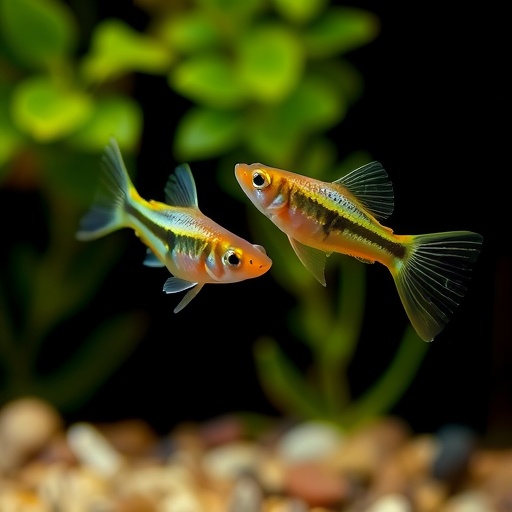
In the intricate dance of natural selection, social information plays a vital role, particularly in environments where social dynamics substantially influence individual decision-making. A pioneering study led by researchers Brusseau, Dumaresq-Synnott, and Morris sheds light on the fascinating behavior of Trinidadian guppies in exploiting male-male social information to navigate their social landscapes. This investigation, published in the journal “Animal Cognition,” delves deep into how these fish interpret and utilize signals from their male counterparts to enhance their own social strategies.
Trinidadian guppies, renowned for their vibrant colors and engaging social interactions, offer a unique window into understanding animal behavior and social cognition. Unlike many species that rely predominantly on individual experiences or direct observations, guppies seem to employ a more nuanced method of social learning. By analyzing the social behavior and interactions of their male peers, these fish can ascertain a wealth of information that informs their own choices and actions in a dynamic aquatic environment.
The research explores how male guppies use social cues to adjust their behavior, which is not only crucial for their short-term survival but may also have long-term implications for mating and territory establishment. The study meticulously documents instances where male guppies display heightened aggression or reduced risk-taking behavior based on the observed actions of other males. This suggests a level of cognitive sophistication that indicates the ability to assess social contexts and make informed decisions, tailoring their strategies to better fit the prevailing circumstances.
One of the key findings of the study is the impact of the social environment on individual behavior. Male guppies that are exposed to aggressive displays from peers are more likely to adopt similar strategies, demonstrating an associative learning mechanism driven by the social context. This blurs the lines between personal experience and social influence, suggesting that these fish are making adaptive choices based on the behaviors exhibited by those around them rather than solely their encounters within their environment.
Furthermore, the research highlights the concept of “social eavesdropping,” where individuals glean vital information from the interactions of others without direct engagement. The implications of such behavior extend to understanding how information spreads within groups and influences collective dynamics. Surrounding males, by simply exhibiting their own traits, inadvertently provide a menu of social cues that their peers can interpret and utilize for their own benefit.
In discussing the broader implications of these findings, the study opens doors to further questioning regarding the cognitive abilities of fish and the diversity of learning mechanisms across different species. As traditional notions of intelligence have often favored mammals and birds, this elucidation of social learning in guppies challenges preconceived limitations on animal intelligence, suggesting a much broader evolutionary tapestry of cognitive capabilities.
The potential applications of this research stretch beyond the aquarium. Insights gained from the study of Trinidadian guppies could extend into conservation strategies, particularly in understanding how social interactions can impact population dynamics within various ecosystems. With growing concerns over biodiversity loss and environmental changes, recognizing the subtleties of social interactions can aid in crafting more effective conservation policies.
Another intriguing aspect of the research revolves around the concept of social hierarchies and their influence on individual behavior. Male guppies often find themselves navigating complex social structures where rank and relationships can dictate access to resources and mates. This nuanced understanding could provoke further studies into how dominance and submission play out in guppy populations, adding yet another layer of complexity to their behavior.
The exploration of male-male social information in guppies augments our understanding of not only their behavior but also animal cognition as a whole. Through rigorous experimentation, the researchers have laid the groundwork for future inquiries into social learning across various species. As scientific methods advance, there lies a challenge for researchers to keep exploring diverse environments and populations to unravel more of nature’s secrets.
In summary, this study validates the importance of social learning in Trinidadian guppies, illustrating how these remarkable fish navigate their aquatic world. As they leverage the social information provided by their male counterparts, guppies exemplify a keen awareness of their environment driven by contextual awareness. This revelation serves as a reminder of nature’s complexity, and continues to fuel the ongoing discourse regarding the cognitive landscape across different animal species.
As researchers delve deeper into the social dynamics among animals, findings from studies like these underscore the interconnection of behavior, cognition, and environmental interaction. The lesson here contributes to a larger narrative—one that illustrates the fine balance of survival, social interconnectedness, and the evolving intelligence of the natural world.
Ultimately, Brusseau and his colleagues have succeeded not only in uncovering the nuances of guppy behavior but also in broadening our understanding of social information use in animal societies. The implications of such contributions resonate in various fields and echo the call for continued exploration into the behavioral sciences.
With ongoing research and persistent curiosity, the boundaries of what we know about animal cognition continue to expand, promising new discoveries and insights in the realms of ecology, behavior, and beyond.
Subject of Research:
The contextual use of male-male social information by Trinidadian guppies.
Article Title:
Contextual use of male-male social information by Trinidadian guppies.
Article References:
Brusseau, A.J.P., Dumaresq-Synnott, F., Morris, J. et al. Contextual use of male-male social information by Trinidadian guppies. Anim Cogn 29, 4 (2026). https://doi.org/10.1007/s10071-025-02027-z
Image Credits:
AI Generated
DOI:
29 December 2025
Keywords:
Guppies, Social Learning, Male-Male Interactions, Animal Cognition, Social Context.
Cite Scienmag News
Drew Townsend. (January 19, 2026). Trinidadian Guppies Use Male-Male Social Cues. Scienmag. https://scienmag.com/trinidadian-guppies-use-male-male-social-cues/
Drew Townsend. "Trinidadian Guppies Use Male-Male Social Cues." Scienmag, 19 January 2026, https://scienmag.com/trinidadian-guppies-use-male-male-social-cues/. Accessed 4 September 2026.
Drew Townsend. "Trinidadian Guppies Use Male-Male Social Cues." Scienmag. January 19, 2026. https://scienmag.com/trinidadian-guppies-use-male-male-social-cues/


