


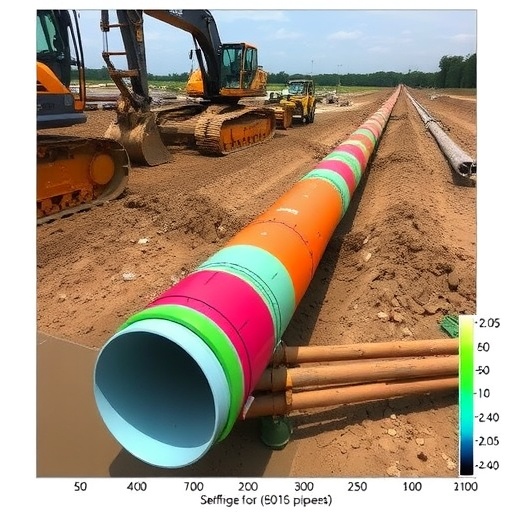
In a groundbreaking study slated for publication in April 2025, researchers led by Chen, H., Cui, J., and Li, Y., delve into the complexities surrounding the seismic response of buried pipelines, investigating how varying stiffness impacts their performance during seismic events. Such pipelines play a critical role in infrastructure, as they are instrumental in the transport of essential resources like water, gas, and oil. However, their vulnerability to seismic activity poses significant risks not only to the integrity of the pipelines themselves but also to the communities that depend on them.
Recent advances in engineering and seismic research have highlighted the necessity of understanding how different factors, such as soil characteristics, pipeline materials, and external loading conditions, influence the behavior of buried pipelines during an earthquake. This study aims to unravel these intricate dynamics through a series of controlled shaking table tests, revealing how variable stiffness can mitigate or exacerbate seismic responses.
In the context of the study, stiffness refers to the resistance of pipeline materials to deformation when subjected to external forces—like those generated during seismic activity. The research team designed experiments to closely examine how pipelines with different stiffness configurations reacted under controlled earthquake-like conditions. This experimental setup paves the way for a more nuanced understanding of the physical phenomena at play, enabling engineers to design more resilient pipeline systems in earthquake-prone regions.
The shaking table tests conducted in the study allowed for real-time observations of the performance of buried pipelines under simulated seismic loading. By varying the stiffness of the pipelines and the surrounding soil conditions, the researchers were able to generate valuable data that demonstrates the correlation between stiffness and seismic response. For instance, the results indicated that pipelines with higher stiffness generally exhibited reduced lateral displacements and less susceptibility to bending failures in comparison to their less-stiff counterparts.
Moreover, the study emphasizes the importance of soil-pipeline interaction, a critical factor that can significantly influence seismic performance. The response of the buried pipelines is intricately tied to the behavior of the surrounding soil, which can either support or hinder the pipeline’s stability. Through careful analysis, researchers were able to identify the optimal relationships between soil properties and pipeline stiffness, contributing vital insights to the field of geotechnical engineering.
The implications of these findings stretch beyond academic interest; they hold practical significance for infrastructure design and disaster preparedness. With urban areas increasingly situated in seismically active zones, ensuring the safety and reliability of buried pipelines is paramount. The insights derived from this research may guide the engineering practices employed in pipeline installation and maintenance, leading to the development of improved standards and building codes.
In addition to its practical applications, this research contributes to the broader body of knowledge concerning seismic resilience. As communities contend with the ever-present threat of earthquakes, understanding existing vulnerabilities in critical infrastructure systems becomes crucial. The correlation between pipeline stiffness and seismic response outlined in this study could serve as a foundation for future research aimed at enhancing the resilience of other structural systems.
As societies become more aware of the potential impacts of natural disasters, the need for innovative solutions in engineering becomes increasingly urgent. The findings presented in this study not only shed light on buried pipeline resilience but also underscore the importance of multidisciplinary approaches to address such complex challenges. Collaboration across fields like materials science, geotechnics, and civil engineering can accelerate advancements in the design of more robust infrastructure.
The implications of the study extend into the future, stressing the importance of continuous improvement in engineering practices aimed at reducing vulnerabilities in critical infrastructure. As advancements in technology provide new means of testing and simulation, researchers are better equipped to explore innovative design solutions that enhance safety and performance in the face of seismic threats.
In conclusion, Chen, H., Cui, J., and Li, Y. have paved the way for crucial developments in understanding the seismic performance of buried pipelines with variable stiffness. Their research advocates for a paradigm that integrates advanced materials, empirical testing, and innovative engineering practices aimed at bolstering infrastructure resilience. As communities evolve and adapt to the realities of living in earthquake-prone areas, the insights derived from this research will be invaluable in shaping the future landscape of civil engineering.
Ultimately, this study underscores the critical need for ongoing research and development in the field of seismic engineering. By cultivating a proactive approach to infrastructure resilience, societies can better prepare for and mitigate the potentially devastating impacts of earthquakes, ensuring that vital lifelines remain intact in the face of nature’s unpredictability.
Chen, H., Cui, J., Li, Y. et al. Seismic response analysis of buried pipelines with varying stiffness by shaking table tests. Earthq. Eng. Eng. Vib. 24, 583–594 (2025). https://doi.org/10.1007/s11803-025-2322-8
Cite Scienmag News
Violet Maxwell. (January 19, 2026). Seismic Testing of Buried Pipelines with Stiffness Variations. Scienmag. https://scienmag.com/seismic-testing-of-buried-pipelines-with-stiffness-variations/
Violet Maxwell. "Seismic Testing of Buried Pipelines with Stiffness Variations." Scienmag, 19 January 2026, https://scienmag.com/seismic-testing-of-buried-pipelines-with-stiffness-variations/. Accessed 3 September 2026.
Violet Maxwell. "Seismic Testing of Buried Pipelines with Stiffness Variations." Scienmag. January 19, 2026. https://scienmag.com/seismic-testing-of-buried-pipelines-with-stiffness-variations/


