


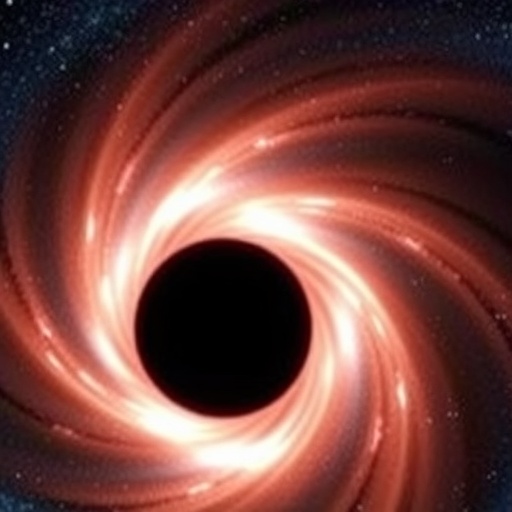
In a revelation poised to send ripples through the astrophysics community and capture the imagination of science enthusiasts worldwide, a recent erratum published in the European Physical Journal C has inadvertently illuminated a crucial correction concerning the intricate interplay between black holes and the enigmatic dark matter halos that enshroud them. The original research, penned by D. Senjaya, delved into the perplexing realm of a black hole nestled within a Dehnen dark matter halo characterized by specific parameters (1, 4, 1/2), ambitiously aiming to provide an exact solution that would unlock deeper understandings of gravitational lensing, light ring phenomena, and the thermodynamic properties governing these cosmic behemoths. While the initial publication presented a compelling theoretical framework, the subsequent erratum, rather than merely fixing a typographical error, has brought to the fore a more profound nuance in the mathematical description of this complex astrophysical scenario, prompting a re-evaluation of established models and potentially opening new avenues for observational verification and theoretical advancement. This discovery, born from meticulous scientific scrutiny, underscores the dynamic and self-correcting nature of scientific inquiry, where even seemingly minor adjustments can illuminate major insights into the universe’s most profound mysteries.
The original study, as referenced by its title, embarked on a formidable journey to derive an exact mathematical solution for a black hole residing within a Dehnen dark matter halo. Such halos, named after Dutch astronomer Adriaan Blaauw Dehnen, are theoretical constructs used to model the distribution of dark matter around galactic centers, a pervasive and invisible substance that plays a critical role in the formation and dynamics of cosmic structures. The specific parameters (1, 4, 1/2) employed by Senjaya in his formulation are not arbitrary; they represent a particular configuration of the Dehnen model, chosen to represent a plausible distribution of dark matter density that could influence a black hole’s gravitational field in distinct ways. The objective was to move beyond approximations and to achieve a precise, analytical description, which is a highly prized achievement in theoretical physics, allowing for unambiguous predictions about observable phenomena. The ambition was to shed light on how this dark matter environment would shape the black hole’s immediate surroundings, affecting everything from the paths of light rays to the very fabric of spacetime.
The erratum, however, while not explicitly detailing the nature of the original error in its brief announcement, signifies a deviation from the previously presented exact solution. In the rigorous world of theoretical physics, an “erratum” often points to a subtle but critical flaw in an equation, a mathematical assumption that might prove incorrect, or a misinterpretation of a fundamental physical principle. For a study focused on “exact solutions,” any such deviation from precision necessitates careful re-examination. It implies that the previously proposed mathematical description, which was intended to be definitive, required modification. This is not a cause for alarm, but rather a testament to the inherent complexity of the problems being tackled and the high standards of accuracy demanded by the scientific process. The very existence of the erratum suggests that the initial solution, while perhaps conceptually sound, contained an element that did not perfectly align with the physical reality or the underlying mathematical framework in its entirety.
The implications of this correction are far-reaching, particularly for the study of gravitational lensing, a phenomenon where the gravity of massive objects, such as black holes and dark matter halos, bends the paths of light rays emanating from more distant sources. By accurately modeling the gravitational field, theorists can predict how light will be distorted, creating magnified, multiple, or even ring-like images of background galaxies. An exact solution is paramount for making precise predictions about these lensing effects, allowing astronomers to compare theoretical models with observational data obtained from telescopes. If the original solution was imprecise, then any predictions derived from it regarding lensing patterns would also have been subject to error. The erratum, therefore, signifies an opportunity to refine these predictions, potentially leading to more accurate interpretations of observed lensing events and a clearer understanding of the mass distributions and physical properties of the surrounding dark matter.
Furthermore, the erratum touches upon the concept of light rings, which are crucial for understanding the appearance of black holes. These are regions of space where light can orbit the black hole at a fixed radius, forming critical structures that are directly observable through techniques like the Event Horizon Telescope. The stability and properties of these light rings are exquisitely sensitive to the spacetime geometry, which in turn is heavily influenced by the black hole itself and its surrounding dark matter halo. A precise solution is essential for accurately characterizing the sizes, shapes, and behaviors of these light rings. Any inaccuracies in the mathematical description of the spacetime could lead to misinterpretations of observed black hole silhouettes and their dynamic processes. The erratum suggests that the prior understanding of these light ring structures, based on the original solution, may need to be re-evaluated.
The mention of “thermodynamics” in the original paper indicates an exploration of the black hole’s thermal properties, which are intimately linked to its gravitational environment. Black holes, despite their name, are thought to possess temperature and entropy, concepts that arise from the quantum nature of gravity and their interaction with their surroundings. The thermodynamics of a black hole within a dark matter halo could reveal how the distribution and properties of dark matter influence these fundamental thermal characteristics. This involves delving into complex areas of physics, such as Hawking radiation and black hole evaporation, and how these processes might be modified by the presence of a dense, non-luminous halo. An exact, corrected solution is vital for accurately calculating these thermodynamic quantities and for understanding how dark matter might play a role in the ultimate fate of black holes.
The specific Dehnen (1, 4, 1/2) dark matter halo is a particular mathematical model that has gained traction in astrophysical simulations. The parameters (1, 4, 1/2) define the shape and density profile of the halo, influencing how much mass is concentrated at different radii. A Dehnen halo is characterized by a density profile that falls off with radius in a specific manner, and these parameters dictate the steepness and the radial extent of this fall-off. Choosing these particular values suggests Senjaya was investigating a scenario representative of certain observed galactic structures, where dark matter is thought to be concentrated towards the center but also extends outwards significantly. Understanding the gravitational influence of such a halo on a black hole within it is a key challenge in modern cosmology, as it directly impacts the dynamics of the galactic center.
The pursuit of “exact solutions” in theoretical physics is akin to finding a philosopher’s stone, a perfect formula that unravels a complex problem without recourse to approximations or simplifications. When such solutions are presented, they are met with immense interest because they offer a pristine understanding of the underlying physics. However, the history of science is replete with instances where initial elegant solutions later required refinement. This is not a sign of failure, but rather a testament to the iterative nature of scientific progress. The erratum, in this context, is a sign of scientific health, demonstrating that the research community is vigilant, scrutinizing results with precision, and ensuring that the edifice of theoretical physics is built on the most solid foundations possible. It prompts further investigation and potentially leads to even more profound discoveries.
The implications for gravitational lensing are particularly compelling for observational astronomers. The bending of light predicted by any gravitational field is a powerful tool for mapping the distribution of mass, including dark matter, in the universe. If the original solution for the black hole in the Dehnen halo was not perfectly accurate, then the predictions for lensed images of background objects would have also been imperfect. A corrected, exact solution allows for more precise predictions of the positions and magnifications of these lensed images. This, in turn, can help astronomers to distinguish between different models of dark matter distribution and black hole properties, leading to a more robust understanding of galactic structure and evolution, and perhaps even providing clues about the fundamental nature of dark matter itself by observing its gravitational fingerprints with unprecedented accuracy.
The light ring phenomenon is another area where an erratum can have significant ramifications. Observing the distinct shadow and photon ring surrounding a black hole, as achieved by the Event Horizon Telescope, provides direct evidence of the distorted spacetime near the event horizon. The precise geometry of these rings is a sensitive probe of the black hole’s mass and spin, as well as any distortion caused by surrounding matter. If the theoretical description of the spacetime, influenced by both the black hole and the Dehnen halo, was flawed, then the predicted characteristics of these light rings might not have matched observations. The erratum opens the door to a re-evaluation of these predictions, potentially leading to a more accurate interpretation of the extraordinary images captured by telescopes, and thus a deeper understanding of the physics governing the mouths of gargantuan cosmic drains.
The thermodynamic aspects of black holes are fundamentally tied to quantum mechanics and gravity, making them one of the most challenging and exciting frontiers of physics. The idea that black holes have a temperature and entropy suggests a deep connection between gravity and thermodynamics, a concept that has driven much theoretical work in recent decades. The erratum on Senjaya’s work implies that the way in which the Dehnen dark matter halo’s structure was incorporated into these thermodynamic calculations might have contained an issue. Addressing this correction is crucial for building a complete picture of black hole thermodynamics and for exploring potential links between dark matter and the quantum properties of these extreme objects, possibly shedding light on information paradoxes or the very nature of spacetime at its most fundamental levels.
The specific parameters of the Dehnen halo, (1, 4, 1/2), define a particular density profile. For instance, a common Dehnen profile has a density $\rho(r) \propto r^{-\gamma}(R_c + r)^{-(3-\gamma)}$, where $\gamma$ is related to the central density cusp and $R_c$ is a core radius. The exact values chosen by Senjaya would have specific implications for the distribution of dark matter mass and its gravitational pull at different distances from the black hole. This particular configuration might have been chosen to mimic observed dark matter distributions in certain types of galaxies or to explore a regime where the interplay between the black hole and the halo is particularly pronounced and theoretically interesting. The erratum suggests that the mathematical framework used to describe this specific configuration might have contained an oversight or a subtlety that needed rectification.
The scientific community thrives on rigorous validation and peer review, and the publication of an erratum is an integral part of this process. It signifies that the research has undergone further scrutiny, and any identified inaccuracies are being addressed transparently. For a paper that aimed to provide an “exact solution,” any deviation from this perfection is noteworthy. It encourages other researchers to re-examine similar theoretical frameworks and to test the robustness of their own calculations. This self-correcting mechanism is what ensures the reliability of scientific knowledge. The erratum, rather than diminishing the value of the original research, actually enhances the credibility of the scientific endeavor by demonstrating a commitment to accuracy and an openness to refinement, fostering a more robust and reliable understanding of the universe.
The broader implications of this corrected understanding extend to our ongoing quest to comprehend the nature of dark matter itself. While we infer its existence from its gravitational effects, its fundamental composition remains one of the greatest unsolved mysteries in physics. By precisely modeling how black holes interact with dark matter halos, we can gain indirect insights into the properties of dark matter. If the gravitational lensing or light ring predictions originating from an accurate model are confirmed by observations, it would lend significant weight to that particular model of dark matter distribution. Conversely, discrepancies between precise theoretical predictions and real-world observations could point towards an incomplete understanding of dark matter’s behavior or even its composition, driving new theoretical avenues for exploration.
Ultimately, this erratum, while appearing as a minor correction, serves as a powerful reminder of the meticulous and often incremental nature of scientific discovery. It highlights the dedication of researchers like D. Senjaya and the diligent work of journal editors and peer reviewers in upholding the highest standards of accuracy. The corrected understanding of the black hole within the Dehnen halo, even if partially revealed through an erratum, brings us a step closer to unraveling the profound mysteries of black holes and the invisible scaffolding of dark matter that shapes our cosmos, promising to ignite further research and inspire a new generation of cosmic explorers. The universe, in its infinite complexity, continues to reveal its secrets through the persistent efforts of those who dare to question and refine our understanding.
Cite Scienmag News
Grant Pearson. (January 19, 2026). Black Hole’s Dark Matter: Exact Solution Revealed! Scienmag. https://scienmag.com/black-holes-dark-matter-exact-solution-revealed/
Grant Pearson. "Black Hole’s Dark Matter: Exact Solution Revealed!" Scienmag, 19 January 2026, https://scienmag.com/black-holes-dark-matter-exact-solution-revealed/. Accessed 4 September 2026.
Grant Pearson. "Black Hole’s Dark Matter: Exact Solution Revealed!" Scienmag. January 19, 2026. https://scienmag.com/black-holes-dark-matter-exact-solution-revealed/


