


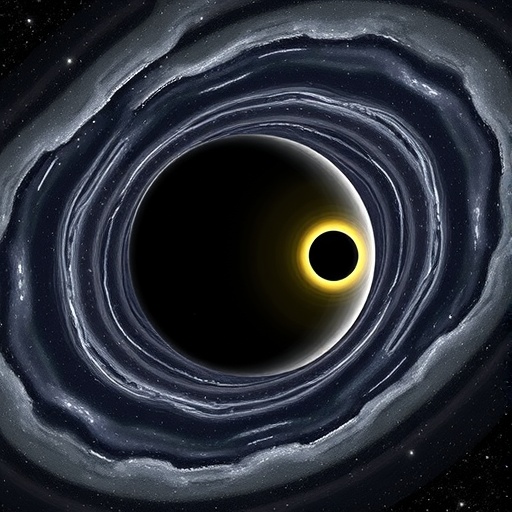
The universe, in its infinite grandeur, continues to surprise us with phenomena that push the boundaries of our understanding, and none are more mysterious than black holes. These cosmic titans, whose gravitational pull is so intense that not even light can escape, have long been subjects of intense scientific scrutiny. Now, a groundbreaking study published in the European Physical Journal C is sending ripples through the astrophysics community, offering tantalizing new insights into the very nature of these enigmatic objects. Researchers are exploring what happens at the precipice of a black hole, not just in the realm of classical gravity, but where the bizarre rules of quantum mechanics begin to play a significant role, potentially shedding light on the elusive quantum Oppenheimer–Snyder black holes. This new research delves into the subtle dance of objects spiraling into black holes, a process known as extreme mass-ratio inspirals, and how these cosmic ballets can act as sensitive probes of exotic black hole physics.
The study, led by a team of international physicists, focuses on a specific type of black hole called the Oppenheimer–Snyder black hole. Unlike standard black holes described by Einstein’s theory of general relativity, the Oppenheimer–Snyder model attempts to describe a black hole formed from the complete gravitational collapse of a spherically symmetric, homogeneous star. The crucial distinction, however, lies in the quantum interpretation of these objects. At the incredibly high densities and energies found near a black hole’s singularity, the smooth fabric of spacetime predicted by general relativity is expected to break down, necessitating a quantum description. The “quantum Oppenheimer–Snyder black hole” thus represents a theoretical construct that incorporates quantum effects at the black hole’s core, hinting at a possible departure from the infinite density singularity predicted by classical theory, and instead suggesting a finite, albeit extremely dense, quantum object.
What makes this research particularly exciting is its innovative use of eccentric extreme mass-ratio inspirals (EMRIs) as a cosmic laboratory. EMRIs occur when a compact object, like a stellar-mass black hole or a neutron star, spirals inwards towards a much larger, supermassive black hole. These events are akin to a tiny celestial partner performing an increasingly tight orbit around a colossal one, emitting powerful gravitational waves as they lose energy. The gravitational waves are not just a signature of the inspiral; they carry incredibly detailed information about the spacetime geometry and the properties of the central black hole. By analyzing the precise waveform of these gravitational waves, scientists can infer details about the extreme conditions near the black hole, including whether it behaves strictly according to general relativity or harbors exotic quantum features.
The “eccentric” nature of these EMRIs is key to the study’s success. Many theoretical models assume these inspirals are nearly circular. However, real astrophysical scenarios are often far from perfect. Objects perturbed by other stars, tidal forces, or initial conditions can find themselves on highly elliptical orbits. These eccentric trajectories lead to distinct gravitational wave patterns, offering a more nuanced and sensitive way to probe the black hole’s environment. The deviations from a purely general relativistic prediction become more pronounced in eccentric inspirals, making them prime candidates for detecting subtle modifications to our understanding of black hole interiors, potentially revealing the quantum nature of the Oppenheimer–Snyder singularity.
The theoretical framework developed in this paper allows researchers to compare the gravitational wave signals produced by an object spiraling into a standard black hole with those generated by an object falling into a quantum Oppenheimer–Snyder black hole. The differences, subtle as they might be, would manifest as detectable discrepancies in the frequency and amplitude modulations of the emitted gravitational waves. These deviations are expected to be most significant in the final stages of the inspiral, as the smaller object ventures closer to the uncharitable heart of the black hole, where quantum effects are hypothesized to become dominant and the classical singularity might be “fuzzed out” into a quantum fuzzball or a similar exotic structure.
The implications of finding evidence for quantum Oppenheimer–Snyder black holes are profound. It would signify the first direct observational evidence of quantum gravity in action, a holy grail for theoretical physicists who have been striving to unify the two pillars of modern physics: quantum mechanics and general relativity. Such a discovery would not only validate specific theoretical models but also open up entirely new avenues of research, potentially revolutionizing our understanding of gravity, spacetime, and the very origins of the universe. It would mean that the seemingly smooth, continuous spacetime described by Einstein breaks down at its most extreme, revealing a granular, quantum reality.
The researchers utilized sophisticated numerical simulations to model these complex inspiral events across a range of orbital parameters, paying particular attention to the influence of quantum corrections at the black hole’s innermost regions. These simulations are incredibly computationally intensive, requiring vast processing power to accurately capture the intricate dynamics of the infalling object and the resulting gravitational wave emission. The precision of these models is paramount, as even minor inaccuracies could lead to misinterpretations of the faint cosmic signals that are expected to be detected by future generations of gravitational wave observatories, such as the Laser Interferometer Space Antenna (LISA) currently under development.
By carefully analyzing the deviations in the gravitational waveform, the team can place stringent constraints on the parameters that define the quantum nature of the black hole. This includes placing limits on the size of the presumed quantum core and the strength of quantum gravitational effects that might modify spacetime in the vicinity of the singularity. Essentially, these inspirals act as incredibly precise cosmic rulers, allowing us to measure the “quantumness” of black holes. The more eccentric the orbit, the closer the object gets to the black hole’s event horizon and potentially its quantum core, thus amplifying the observable quantum effects in the gravitational wave signal.
This research is particularly pertinent given the ongoing efforts to build and deploy next-generation gravitational wave detectors. These advanced instruments are designed to be orders of magnitude more sensitive than current observatories, enabling us to detect fainter gravitational wave signals from more distant and extreme astrophysical events. The European Physical Journal C paper provides a theoretical framework that will be crucial for interpreting the data collected by these future observatories, guiding astronomers and physicists in their search for definitive evidence of quantum black holes. The development of such interpretative tools is as important as the instruments themselves in advancing scientific discovery.
The concept of a quantum Oppenheimer–Snyder black hole suggests that the singularity predicted by classical general relativity, a point of infinite density and curvature, might not represent the true endpoint of gravitational collapse. Instead, quantum mechanics could intervene, smoothing out this singularity into a different, albeit still incredibly dense, quantum state. This could involve phenomena like “fuzzballs” or other Planck-scale structures, effectively replacing the mathematical point of infinite density with a more complex, quantum object. The gravitational wave signatures from EMRIs are anticipated to be the most sensitive probes for distinguishing between these different theoretical possibilities.
The study highlights that deviations from the purely general relativistic description of black holes are expected to be most pronounced during the late stages of inspiral, as the compact object approaches the black hole’s event horizon and plunges towards the core. The eccentric orbits amplify these effects, creating a richer and more distinct gravitational wave signal that can be scrutinized for signs of quantum gravity. This is where the classical picture of spacetime folding into an inescapable abyss might begin to reveal its quantum underpinnings, offering a glimpse into physics beyond our current comprehension.
One of the significant challenges in this field is the extreme faintness of gravitational wave signals from distant events, especially those produced by EMRIs which are rare and require exceptionally precise detection. However, the theoretical predictions outlined in this paper provide clear observational targets and expected signatures for future gravitational wave observatories. By knowing what to look for, scientists can optimize their search strategies and data analysis techniques to maximize the chances of detecting these subtle yet revolutionary signals. The collaboration between theorists and experimentalists is crucial for this endeavor.
The work presented here is not merely an academic exercise; it has the potential to reshape our cosmic worldview. If confirmed, the existence of quantum Oppenheimer–Snyder black holes would imply that the universe is even stranger and more wonderful than we previously imagined. It would provide a tangible link between the enigmatic quantum realm and the vastness of cosmic structures, bridging the gap between the infinitesimally small and the overwhelmingly large in a way that has eluded scientists for decades, finally bringing the quantum and cosmic realms into a unified understanding.
Ultimately, this research represents a significant step forward in our quest to understand the most extreme objects in the cosmos. By harnessing the power of gravitational wave astronomy and sophisticated theoretical modeling, scientists are beginning to unlock the secrets hidden within black holes, pushing the boundaries of our knowledge and bringing us closer to a complete picture of the universe and the fundamental laws that govern it. The universe, it seems, is constantly whispering its secrets, and with tools like these, we are finally learning to listen.
Yang, S., Zhang, YP., Zhao, L. et al. Constraints on quantum Oppenheimer–Snyder black holes with eccentric extreme mass-ratio inspirals.
Eur. Phys. J. C 86, 35 (2026). https://doi.org/10.1140/epjc/s10052-026-15284-0
Cite Scienmag News
Grant Pearson. (January 19, 2026). Eccentric Black Holes Rebel: Oppenheimer-Snyder Bounds Tested. Scienmag. https://scienmag.com/eccentric-black-holes-rebel-oppenheimer-snyder-bounds-tested/
Grant Pearson. "Eccentric Black Holes Rebel: Oppenheimer-Snyder Bounds Tested." Scienmag, 19 January 2026, https://scienmag.com/eccentric-black-holes-rebel-oppenheimer-snyder-bounds-tested/. Accessed 5 September 2026.
Grant Pearson. "Eccentric Black Holes Rebel: Oppenheimer-Snyder Bounds Tested." Scienmag. January 19, 2026. https://scienmag.com/eccentric-black-holes-rebel-oppenheimer-snyder-bounds-tested/


