


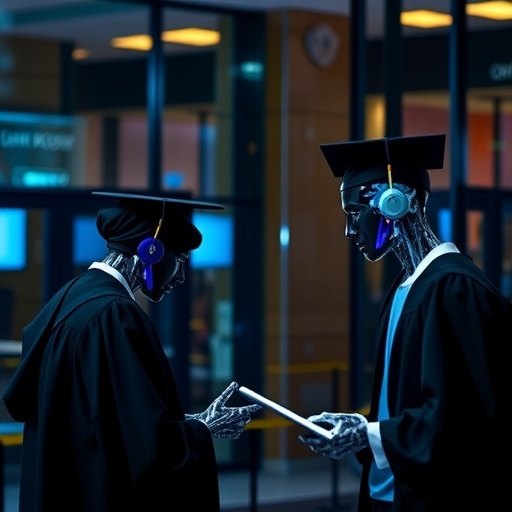
In a groundbreaking study published in the journal BMC Medical Education, researchers led by Z.S. Natto have demonstrated the potential of a blended peer-led research curriculum enhanced by artificial intelligence (AI) to significantly improve both the academic performance and overall satisfaction of postgraduate students. This compelling quasi-experimental mixed-methods study provides a comprehensive examination of how integrating modern technology within collaborative learning frameworks can lead to more effective educational outcomes.
The study comes at a pivotal time in higher education, where traditional teaching methodologies are being challenged by the rapid advancement of technology. With AI becoming an increasingly integral part of our academic landscape, the exploration of its application in education is both timely and necessary. Natto and colleagues meticulously designed their research to assess the impact of an innovative curriculum that leverages both peer-led learning and AI tools on postgraduate education. By focusing specifically on postgraduate students, the researchers aimed to delve deeper into how individuals who are already familiar with academic rigor can benefit from this blend of instructional strategies.
To assess the effectiveness of this blended curriculum, the research incorporated a quasi-experimental design that allowed for the comparison between students engaged in the AI-integrated curriculum and those who followed a more conventional learning approach. This methodological rigor ensured that the results could be attributed directly to the innovative teaching strategies employed, revealing not just anecdotal benefits but measurable improvements in academic performance. The methodology utilized a combination of quantitative assessments—such as grades and standardized tests—and qualitative feedback through surveys and interviews, providing a well-rounded view of the learning experiences of the students.
The integration of AI into the curriculum provided a dual advantage. First, students experienced a greater degree of personalized learning, as AI tools were tailored to respond to individual learning styles and paces. This customization allowed students to engage with complex research topics at a level that matched their understanding, thus increasing both their confidence and competence in the subject matter. Moreover, AI’s ability to analyze student interactions and performance data allowed educators to refine the curriculum in real time, addressing any challenges or gaps in understanding as they arose.
Another pivotal element of the study’s design was the incorporation of peer-led learning. By fostering an environment where students could collaborate and assist each other in their learning journeys, the researchers tapped into the social dimensions of education. This peer-led approach not only enhanced student engagement but also reinforced mastery of complex concepts, as students who taught their peers were found to solidify their own understanding through the process of teaching. The fusion of peer support and AI resources created a robust educational atmosphere that the study found to be highly conducive to learning.
Moreover, satisfaction rates among students who participated in the AI-integrated peer-led curriculum revealed a striking difference compared to those in traditional learning environments. Many students reported feeling more empowered and confident in their abilities, attributing this to the combination of support from their peers and the responsive nature of AI tools. The sense of community established through collaborative learning and the intelligence of responsive educational technologies contributed to a more satisfying learning experience overall.
A significant insight from the research was the importance of addressing various learning styles and preferences. The study underscored that students are not a monolithic group, and their academic journeys are highly individualistic. By leveraging AI technologies that adapt to different pedagogical needs, educators can cater to a wide range of learning preferences—ultimately leading to enhanced educational outcomes.
Not only did students in the AI-integrated curriculum report better grades, but they also expressed a deeper enjoyment of their studies. This correlation between improved outcomes and increased satisfaction has profound implications not only for educational institutions but also for policy makers who must consider how best to prepare future generations of scholars. The enthusiasm exhibited by the participants suggests that AI is not merely an optional enhancement, but a vital component of contemporary educational strategies.
As educational institutions pivot towards integrating more technology into their curricula, the findings of Natto’s study can serve as a model for implementing blended learning environments. By prioritizing collaboration and leveraging AI, schools can create dynamic educational experiences that not only improve academic performance but also fulfill the students’ desire for engagement and satisfaction.
Looking ahead, it is clear that the implications of this research extend beyond postgraduate education. While the focus of the study was on this particular demographic, the principles behind blended learning and the efficacy of AI can be scaled to other levels of education. Primary and secondary educational institutions stand to gain from adopting similar frameworks, ultimately widening the potential impact of this innovative approach.
This research invites educators and researchers to reconsider how they structure curricula and engage students. As we embrace the era of digital learning, the evidence suggests that the careful melding of peer-led initiatives and AI technology can transform the educational landscape, ushering in a new age of academic excellence.
In conclusion, the study led by Z.S. Natto opens up exciting avenues for future research. As technology continues to evolve, the possibilities for its application in education are limitless. The implications of such a rich blend of peer-led learning and artificial intelligence suggest not just improved academic performance and satisfaction but a complete reimagining of how we understand and facilitate learning. The question now stands: how will educational institutions harness these insights to sculpt the future of learning? It will be fascinating to observe how this burgeoning intersection of technology and pedagogy further develops in the years to come.
Cite Scienmag News
Courtney Benton. (January 19, 2026). AI-Enhanced Peer-Learning Boosts Postgraduate Success. Scienmag. https://scienmag.com/ai-enhanced-peer-learning-boosts-postgraduate-success/
Courtney Benton. "AI-Enhanced Peer-Learning Boosts Postgraduate Success." Scienmag, 19 January 2026, https://scienmag.com/ai-enhanced-peer-learning-boosts-postgraduate-success/. Accessed 3 September 2026.
Courtney Benton. "AI-Enhanced Peer-Learning Boosts Postgraduate Success." Scienmag. January 19, 2026. https://scienmag.com/ai-enhanced-peer-learning-boosts-postgraduate-success/


