


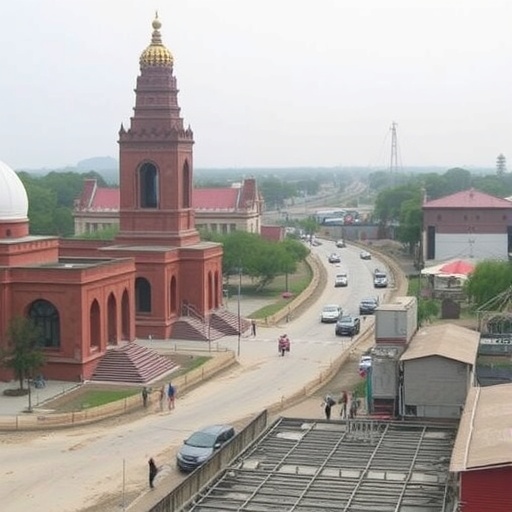
In a groundbreaking study, researchers led by Dr. Tian Wang, alongside co-authors Dr. Yi Zhou and Dr. Jin Chen, have conducted an in-depth field survey of the extensive building damage observed during the Mw 7.7 earthquake that struck Mandalay, Myanmar, in July 2025. This study, published in the journal Earthquake Engineering and Engineering Vibration, highlights not only the immediate catastrophic impacts of seismic activity on urban structures but also emphasizes the critical need for enhanced earthquake resilience in vulnerable regions. The findings underscore the importance of adopting advanced engineering practices and policies tailored to mitigate the risks posed by future seismic events in similar geologically active areas.
The study assembled a robust field team that traversed through Mandalay’s hardest-hit districts, meticulously documenting the extent of structural failures and assessing the overall integrity of buildings post-earthquake. With over a thousand structures examined, the data collected revealed alarming trends regarding failure mechanisms and their correlations to design flaws, material weaknesses, and safety regulations that were either inadequately implemented or entirely ignored. By analyzing both residential and commercial buildings, the authors were able to draw insightful conclusions about the collective vulnerabilities faced by the local population.
One particularly concerning observation made by the researchers was the disproportionate impact of the earthquake on older buildings, many of which had been constructed before modern seismic codes were introduced. The team noted that these structures exhibited multiple failure types, including shear wall failure, foundation settlement, and complete structural collapse. This highlights a crucial aspect of urban planning and disaster preparedness: the urgent need to prioritize retrofitting older buildings to meet contemporary standards that enhance resilience against seismic forces.
In addition to physical assessments, the study also integrated community feedback through interviews with affected residents. This qualitative data provided invaluable insights into the psychological toll of living through such traumatic events, as well as the public’s understanding of earthquake preparedness measures. The narratives shared by locals painted a vivid picture of anxiety and uncertainty, underscoring the human dimensions of natural disasters that often get overshadowed by structural concerns in academic studies.
Another striking finding from the study was the impact of socio-economic factors on building resilience. Researchers discovered that wealthier neighborhoods tended to have sturdier constructions with better materials, compared to poorer districts where ad-hoc building practices were prevalent. This disparity raises critical questions about equity in urban planning and disaster response, urging policymakers to consider socio-economic dimensions when developing and enforcing safety regulations for construction.
Through meticulous mapping of damage intensity across different regions of Mandalay, the researchers were able to identify a clear pattern: areas located closer to the earthquake’s epicenter sustained far greater destruction compared to those further away. This geographic analysis not only aids in understanding the immediate effects of the earthquake but also assists in future disaster risk management and urban planning initiatives aimed at minimizing similar vulnerabilities in upcoming seismic occurrences.
Moreover, the study also employed advanced analytical methodologies, including finite element analysis, to simulate the stress and strain experienced by various building typologies during the earthquake. These simulations revealed critical insights into how specific design features contributed to the failure of structures, providing a wealth of information that could be pivotal for civil engineers aiming to design more resilient buildings. By furnishing the engineering community with detailed mathematical models, the research paves the way for more informed construction practices that take local seismicity into account.
Among the study’s recommendations is a call for a comprehensive review of Myanmar’s building codes and construction practices. The authors advocate for the implementation of more rigorous engineering standards, continuous monitoring of seismic activity, and enhanced public awareness campaigns about earthquake safety. These recommendations, if adopted, could significantly bolster the country’s resilience to natural disasters, benefiting not only Mandalay but potentially other earthquake-prone regions in Southeast Asia.
Importantly, the research team’s findings are not isolated to the context of Myanmar but can resonate globally in earthquake preparedness discussions. The documented failures and subsequent recommendations serve as a crucial reference point for many developing countries that are similarly exposed to seismic hazards and may lack the resources or infrastructure to adequately prepare for, respond to, or recover from such disasters.
The study also emphasizes the necessity of international collaboration in the field of earthquake engineering. By sharing knowledge and experiences, countries can create a collective framework for building resilience against seismic threats. Engaging with global experts in structural engineering, disaster risk reduction, and urban planning can foster the development of innovative solutions tailored to local contexts while benefiting from global best practices.
In the wake of the 2025 Mandalay earthquake, it is clear that interdisciplinary approaches combining engineering science, urban planning, and community engagement are essential for mitigating future disaster risks. The recommendations made in this study, particularly the need for merging technical engineering practices with socio-economic considerations, could lead to pioneering revisions in how building resilience is conceptualized and implemented on a broader scale.
To further spread awareness, the researchers plan to engage with local communities, governmental agencies, and international organizations to disseminate their findings and recommendations. By actively involving stakeholders, the project aims to ensure that the voices of those affected are heard, and that their experiences lead to tangible changes in policies and practices.
In conclusion, this extensive field survey of Mandalay’s building damage during the Mw 7.7 earthquake sheds light on critical lessons that must be learned in the realm of disaster preparedness and response. The research not only documents the current state of vulnerability but also acts as a clarion call for immediate action aimed at enhancing resilience against future seismic events. As we move forward, the complexity of the relationship between human settlements and natural disasters must always remain a priority for researchers, policymakers, and civil society alike.
Wang, T., Zhou, Y., Chen, J. et al. Field survey of building damage at Mandalay during 2025 Myanmar Mw 7.7 earthquake.
Earthq. Eng. Eng. Vib. 24, 613–627 (2025). https://doi.org/10.1007/s11803-025-2325-5
Cite Scienmag News
Violet Maxwell. (January 19, 2026). Assessing Mandalay’s Damage: 2025 Mw 7.7 Quake. Scienmag. https://scienmag.com/assessing-mandalays-damage-2025-mw-7-7-quake/
Violet Maxwell. "Assessing Mandalay’s Damage: 2025 Mw 7.7 Quake." Scienmag, 19 January 2026, https://scienmag.com/assessing-mandalays-damage-2025-mw-7-7-quake/. Accessed 3 September 2026.
Violet Maxwell. "Assessing Mandalay’s Damage: 2025 Mw 7.7 Quake." Scienmag. January 19, 2026. https://scienmag.com/assessing-mandalays-damage-2025-mw-7-7-quake/


