


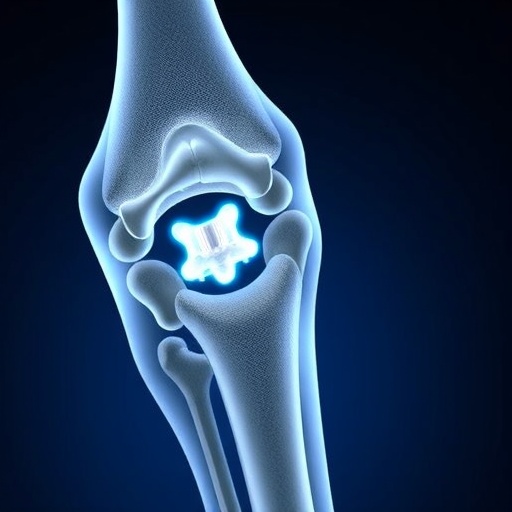
In recent years, the field of orthopedic surgery has seen transformative advances, particularly with the integration of 3D printing technology. A groundbreaking study conducted by Chaudhry et al. offers a remarkable illustration of this evolution. In this innovative research, the team takes on the formidable task of reconstructing a large distal femoral giant cell tumor (GCT) using a tailored 3D-printed condylar support lattice metal implant, alongside fibular grafts. This study not only showcases the application of cutting-edge technological solutions to complex orthopedic challenges but also highlights a novel approach combining biomechanical principles and surgical techniques.
The subject of giant cell tumors of the bone presents a unique set of challenges for orthopedic surgeons. These tumors, typically considered benign, can exert significant local aggression, leading to substantial bone destruction and necessitating complex reconstructive procedures. The distal femur is a common site for these tumors, complicating surgical interventions due to the intricate anatomy and biomechanical demands of the knee joint. Traditional treatment strategies often involve extensive surgical resection, followed by reconstruction methods that may not provide optimal functional outcomes.
Central to the study by Chaudhry and colleagues is the development of a custom 3D-printed condylar support lattice metal implant designed to mimic the anatomical and functional characteristics of the distal femur. This implant incorporates a lattice structure that offers a favorable balance between mechanical strength and lightweight design, allowing for adequate load-bearing capabilities while facilitating bone ingrowth. The innovative design is meticulously engineered to match the individual anatomy of each patient, thereby enhancing the integration of the implant within the existing biological framework.
Moreover, the use of fibular grafts is a crucial aspect of the reconstruction process. The fibula, which is a smaller bone located alongside the tibia, serves as an excellent source of structural support and biological augmentation during the healing process. The research demonstrates how fibular grafts, when combined with the 3D-printed implant, can significantly improve the mechanical stability and biological viability of the surgical site. This dual approach not only addresses the immediate structural needs post-resection but also enhances longer-term healing and functional restoration.
A pivotal point in the study is the biomechanical evaluation of the 3D-printed implant, which confirms its efficacy in load distribution and stress absorption. Using advanced modeling techniques, the authors assessed how the implant would perform under physiological conditions, focusing on factors such as weight-bearing and dynamic movements. The results indicate that the lattice structure is adept at reducing stress concentrations, which are often the precursors to implant failure. The findings bolster confidence in the use of 3D-printed materials in high-stress applications like orthopedic surgery.
The surgical technique employed in this research represents a convergence of traditional orthopedic methods and contemporary technologies. Prior to the intervention, meticulous preoperative planning and modeling allow for precise customization of the implant. Surgeons can visualize the planned procedure in 3D, guaranteeing that all aspects of the reconstruction align with the patient’s unique anatomy. This preparatory phase is critical, as it aids in anticipating potential surgical challenges and enhancing overall surgical efficiency.
As part of the study, the surgical team meticulously documents their experiences and outcomes, providing invaluable insights into the practicalities and complexities associated with using 3D-printed implants in clinical practice. The authors emphasize the importance of a multidisciplinary approach involving orthopedic surgeons, materials scientists, and biomedical engineers to achieve a successful outcome. Collaborative efforts in design and engineering ensure that the developed solutions are not only clinically relevant but also technologically robust.
Another important dimension of this research focuses on the postoperative recovery process. By utilizing a combination of advanced material technology and biological grafting techniques, the authors report favorable early outcomes in terms of functional recovery and overall health of the patients. This approach permits a more aggressive rehabilitation protocol, empowering patients to regain mobility and return to daily activities sooner than they would under traditional surgical paradigms.
Challenges remain in the field of bone reconstruction, particularly in terms of long-term implant performance and the potential for complications. The authors acknowledge that while short-term outcomes appear promising, ongoing research is necessary to address questions surrounding biocompatibility, integration, and the risk of implant failure over an extended period. Continuous monitoring of patient outcomes and implant longevity will be essential in refining such techniques and ensuring the safety and efficacy of 3D-printed solutions.
The promising results showcased in this study herald a new era in orthopedic surgery, where custom implant design and advanced manufacturing processes converge to meet the individualized needs of patients. As the techniques develop, the opportunity to treat challenging cases with minimally invasive approaches becomes more achievable. Surgeons of the future may find themselves equipped with a variety of tools that allow for tailored solutions, potentially transforming the landscape of orthopedic intervention.
The broader implications of this research extend beyond individual patient care; they resonate within the medical community, urging a reevaluation of existing paradigms in orthopedic surgery. As technologies such as 3D printing continue to evolve and become more accessible, the gap between innovative research and clinical application continues to close. The endorsement of such methodologies could facilitate a remarkable shift toward personalized medicine, where treatment plans are not only informed by standard protocols but also adapted to the distinct anatomical and physiological characteristics of each patient.
In conclusion, the work presented by Chaudhry et al. serves as a compelling example of the integration of 3D printing technology into advanced orthopedic practice. Their research not only expands the horizons of surgical capabilities but also instills hope for patients facing the daunting challenges of complex bone tumors. As the field continues to embrace innovation, multidisciplinary collaboration, and patient-centric approaches, the future of orthopedic surgery looks exceptionally promising.
Cite Scienmag News
Nathaniel Bowman. (January 16, 2026). 3D-Printed Implant Innovates Distal Femur Tumor Reconstruction. Scienmag. https://scienmag.com/3d-printed-implant-innovates-distal-femur-tumor-reconstruction/
Nathaniel Bowman. "3D-Printed Implant Innovates Distal Femur Tumor Reconstruction." Scienmag, 16 January 2026, https://scienmag.com/3d-printed-implant-innovates-distal-femur-tumor-reconstruction/. Accessed 6 September 2026.
Nathaniel Bowman. "3D-Printed Implant Innovates Distal Femur Tumor Reconstruction." Scienmag. January 16, 2026. https://scienmag.com/3d-printed-implant-innovates-distal-femur-tumor-reconstruction/


